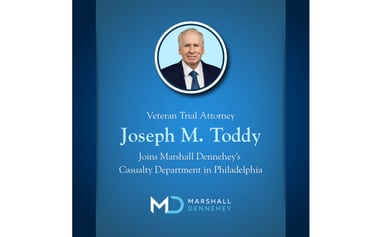
As an attorney in the Catastrophic Claims group, Joseph M. Toddy focuses his practice on litigation matters, including defense of trucking companies, dentists, auto and premises liability and taverns. He assists insurance carriers in bad faith litigation as well as issues involving employment litigation and white-collar criminal defense
For more than 40 years, Joe has represented clients in state and federal courts, developing extensive jury trial and appellate experience. Prior to joining the firm, he practiced at a full-service law firm, where he managed the casualty and employment practice groups, focusing on trucking and transportation matters, automobile liability, and dram shop litigation. Earlier in his career, Joe served as an assistant district attorney in the Northumberland County District Attorney's Office, where he prosecuted a wide range of felony cases, including murder and arson matters.
Joe has tried more than 50 cases to verdict in numerous states and serves as national trial counsel for a leading asbestos manufacturer and trucking company. He is also actively involved in handling catastrophic injury matters from the outset as a member of Marshall Dennehey’s Catastrophic Claims group.
Joe has been selected numerous times for inclusion in Pennsylvania “Super Lawyers” as published by Philadelphia Magazine and voted into “New Jersey Super Lawyers” as published by New Jersey Monthly. He is an AV® rated attorney by Martindale-Hubbell®.
- Widener University Commonwealth Law School (J.D.)
- University of Notre Dame (B.A.)
- Pennsylvania
- New Jersey
- New York
- Supreme Court of the United States
- Supreme Court of Pennsylvania
- U.S. Court of Appeals 3rd Circuit
- Supreme Court of New Jersey
- Supreme Court of the State of New York
- U.S. District Court Eastern District of Pennsylvania
- U.S. District Court Middle District of Pennsylvania
- U.S. District Court District of New Jersey
Super Lawyer in Pennsylvania, 2005 - 2021
Super Lawyer in New Jersey, 2006 - 2023
Defense Research Institute
Philadelphia Association of Defense Counsel
New Jersey Association of Defense Counsel
Tall Trees of Thornbury Home Ownership Association, President
Notre Dame Monogram Club
Obtained a complete dismissal of all claims for our client in a case where the settlement demand was twelve (12) million dollars, plus punitive damages. In the lawsuit, a large east-coast regional bakery was sued as a result of an underride collision on a tractor-trailer. The lawsuit was brought against multiple parties under a variety of theories, with allegations that implicated various portions of the Federal Motor Carrier Safety Act, including theories targeting the design and maintenance of a device referred to as a Rear Impact Guard (“RIG”). Drawing on our deep understanding of the Federal Motor Carrier Safety Regulations and the design, engineering, manufacture, and maintenance of rear impact guard (RIG) assemblies, we developed key favorable facts and, working alongside a multidisciplinary team of experts, achieved a complete dismissal of the claims against our client, eliminating any obligation to pay toward the resolution of the case.
Successfully defended a client in a criminal assault matter in Delaware County, demonstrating to the jury that the client did not intentionally strike the alleged victim and securing a defense verdict.
Obtained a favorable jury verdict in a personal injury matter arising from an incident in which the plaintiff alleged injuries sustained during a fitness class after reacting to a falling object nearby, which caused her to fall. The plaintiff claimed a hip fracture and later asserted additional medical complications, including a stroke, as being related to the incident. The matter involved extensive litigation and significant damages demands well in excess of the eventual verdict. Prior to trial, we successfully limited the presentation of certain damages evidence, including medical billing. Following trial, the jury returned a $40,000 verdict in favor of the plaintiff, which was substantially below the plaintiff’s demands and the court’s pretrial valuation of the case.
Obtained a favorable settlement in a premises liability action on behalf of a supermarket operator after the plaintiff agreed to resolve the case shortly after opening statements at trial. The plaintiff alleged a slip-and-fall in a store aisle resulting in a knee injury requiring multiple surgeries and claimed permanent disability with significant future lost earnings, supported by expert testimony estimating damages between $1.2 million and $3.3 million. Through discovery, we obtained records of preexisting knee injuries and evidence contradicting the alleged extent of disability, and challenged the opinions of the plaintiff’s medical and damages experts. After pre-trial demands up to $4.5 million (later reduced to $2 million), the matter settled in line with the court’s recommended value.
Secured summary judgment on behalf of our client in a negligence action arising from catastrophic injuries sustained by a law enforcement officer who was struck by a vehicle that had been stolen from our client’s premises. The plaintiff alleged that inadequate security measures at the property allowed the vehicle theft to occur and ultimately led to the accident. We successfully argued that the plaintiff’s injuries were not a foreseeable consequence of the alleged security deficiencies, particularly where the accident occurred more than 30 miles from our client’s premises. The court agreed and granted summary judgment in favor of our client.
Successfully defended our client in a negligence action arising from catastrophic injuries sustained by the plaintiff after being struck by a vehicle that had been stolen from our client’s property shortly before the accident. The plaintiff alleged that our client failed to provide adequate security for the premises and that a vehicle was left in an unsecured area with keys readily accessible, enabling the theft. We challenged the plaintiff’s claims regarding duty, causation, and foreseeability, ultimately securing a favorable outcome for our client.
Defeated claims in a motor vehicle accident case arising from a collision with a bicyclist who was traveling in the wrong direction on a one-way roadway. The bicyclist alleged significant injuries, including a fractured leg, after being struck by our client’s vehicle. We successfully challenged the plaintiff’s liability claims and secured a favorable outcome on behalf of our client.
Reached a favorable settlement during trial on behalf of our client in a wrongful death action arising from a collision between a commercial tractor-trailer operated by our client’s employee and the plaintiff’s vehicle. The plaintiff alleged that the tractor-trailer entered an intersection against a red light, had numerous violations of applicable federal motor carrier safety regulations, and caused a collision resulting in fatal injuries. Following extensive litigation and trial proceedings, the matter was resolved through a settlement that was satisfactory to our client.
Obtained a favorable jury verdict in a dram shop and negligent security action arising from an incident in which the plaintiff sustained serious facial injuries and scarring after being struck by a beer mug thrown by another patron during a crowded happy hour event. The plaintiff alleged that our client overserved an intoxicated patron and failed to provide adequate security. At trial, we argued that there was no evidence of visible intoxication that would have placed our client on notice and challenged the plaintiff’s claims regarding the adequacy of security measures at the premises. The matter was tried before a jury, resulting in a favorable outcome for our client.
Secured a jury verdict on behalf of our clients in an estate dispute involving allegations that a deed had been forged to transfer real property from a decedent’s estate to one beneficiary, to the exclusion of the remaining heirs. Our clients challenged the validity of the transfer and sought to restore the property to the estate. Following trial, the jury found that the deed was forged and ordered that the real property be returned to the decedent’s estate for proper administration and distribution.
Obtained a jury verdict on behalf of our client in an age discrimination action arising from allegations that she was demoted and subsequently terminated from her employment because of her age. Following trial, the jury returned a verdict in favor of our client in excess of $200,000, and the court awarded substantial attorneys’ fees.
Secured a favorable trial verdict on behalf of our client in an ERISA action involving the alleged wrongful denial of severance benefits. Following trial, judgment was entered in favor of our client, and the court awarded a substantial attorneys’ fee award. The matter is currently pending on appeal.
Successfully resolved a bankruptcy trustee and accountant in an adversary proceeding arising from a Chapter 11 bankruptcy matter in the Eastern District of Pennsylvania. The trustee had asserted claims against former officers and directors of the debtor seeking $30 million in damages, while the defendants brought counterclaims alleging professional malpractice. Through dispositive motion practice, we successfully obtained dismissal of all but one claim against our client. As a result, the matter resolved with no payment by our client on the counterclaims.
Defended a law firm in a series of legal malpractice matters arising from allegations that the firm misrepresented the status of client claims and continued representation after applicable statutes of limitations had expired. The claims alleged that lawsuits had been filed when, in fact, no actions had been initiated. Through strategic defense and negotiation, we successfully resolved the matters within applicable insurance policy limits, with no personal financial exposure to the law firm.
Secured a defense verdict following a two-day trial involving a regional trucking company arising from a road collision. The plaintiff alleged that the defendant driver pulled out of a gas station and caused a multi-lane obstruction, resulting in a collision and serious injuries, including multiple fractures and a concussion, and sought over $250,000 in damages. We maintained that our client was not negligent and that the plaintiff’s intoxication and excessive speed were the sole causes of the crash. Through accident reconstruction testimony and collision analysis, we demonstrated that the plaintiff’s delayed perception and speeding caused the incident. The jury returned a defense verdict after approximately 43 minutes of deliberation, finding no negligence by our client.
Obtained a favorable verdict on behalf of our client in a personal injury action arising from an incident in which the plaintiff alleged serious low back injuries after a stool collapsed while she was attempting to enter our client's vehicle. Despite the plaintiff's claims of significant injuries and damages, the jury returned a minimal verdict that was highly favorable to our client.
Achieved a favorable defense result in a personal injury action involving allegations that our client's employee failed to properly secure a wheelchair-bound plaintiff during transportation, causing her to sustain nerve injuries when her foot struck the seat in front of her. Through discovery and expert evidence, we demonstrated that the plaintiff had been properly secured and that the alleged nerve injury predated the incident, resulting in a favorable outcome for our client.
Secured a favorable defense result on behalf of a trucking company in a wrongful death action arising from a motor vehicle accident in a shopping center parking lot. The plaintiffs alleged that our client's tractor-trailer backed into their lane of travel, causing a collision that resulted in the decedent's death. Through investigation, expert analysis, and discovery, we demonstrated that our client's vehicle was stationary at the time of the accident and that the decedent suffered a massive heart attack immediately prior to the impact. The evidence established that our client's driver was not responsible for the accident, resulting in a favorable outcome for our client.
Obtained a defense verdict on behalf of a trucking company and its driver in a lane merge accident case in which both plaintiffs alleged serious personal injuries. The plaintiffs claimed that the collision occurred due to the defendant’s operation of the tractor-trailer; however, we successfully demonstrated that the plaintiffs attempted to pass the defendant’s vehicle from the shoulder while the driver was in the process of executing a right-hand turn, and that the plaintiffs’ driver was solely responsible for the accident. The jury returned a verdict in favor of the defense, finding that the plaintiffs were fully responsible for the accident and their alleged injuries.
Secured a defense verdict on behalf of a trucking company in a collision case arising from a tractor-trailer accident in which the plaintiff alleged that the defendant’s driver lost control of his vehicle, crossed into the opposing lane, and forced the plaintiff’s tractor-trailer off the road and into several trees. The defense established that the tractor-trailer encountered a sudden emergency caused by an unforeseeable patch of black ice, resulting in the vehicle skidding and temporarily losing control. Through accident reconstruction testimony and cross-examination of the plaintiff, we supported the sudden emergency defense and demonstrated the absence of negligence. After approximately one hour of deliberation, the jury returned a defense verdict, finding that the defendant’s driver was not negligent.
Represented a gasket manufacturer in asbestos litigation in which the plaintiff alleged that his mesothelioma was caused by exposure to asbestos-containing products manufactured by multiple defendants, including our client. The matter proceeded in a reverse bifurcated trial, resulting in a Phase I verdict of $250,000 allocated among nine defendants. Following the Phase I proceedings, the case resolved prior to trial on Phase II liability issues.
Resolved an insurance coverage dispute in a breach of contract and bad faith action in Montgomery County, Pennsylvania. The plaintiffs alleged breach of contract and bad faith arising from alleged defective repairs and diminished value following a motor vehicle collision. The insurer had paid for repairs and supplemental repairs, and the dispute centered on additional claimed benefits. In a bifurcated trial, the jury returned a verdict of no cause of action on the breach of contract claim, eliminating the need for a bench trial on bad faith allegations.
Negotiated a favorable settlement in a bad faith action arising from a motor vehicle accident in which the plaintiff pursued underinsured motorist benefits following a settlement with the tortfeasor. The matter was resolved through a modest settlement satisfactory to the client.
Defended a manufacturing company in a putative class action involving allegations that a consumer product was defective and failed to function properly. The matter was resolved for a minimal amount prior to the class certification hearing.
Achieved a highly favorable jury verdict after a two-week trial in Philadelphia County in a trucking accident case arising from a collision in Luzerne County involving a tractor-trailer and a passenger vehicle. The plaintiff alleged that the defendant driver caused her vehicle to leave the roadway, resulting in a crash and serious injuries. We represented both the trucking company and driver and disputed liability throughout the case, arguing that the physical evidence did not support contact between the vehicles and presenting evidence of comparative responsibility and damages. Despite late entry into the case and evidentiary constraints, the jury returned a verdict assigning significant responsibility to the plaintiff and awarding substantially reduced damages relative to the pre-trial demand.
Obtained a defense verdict in a binding arbitration arising from a trip-and-fall incident at a regional supermarket in Chester County, Pennsylvania. The plaintiff alleged negligence in store maintenance, claiming a floor mat near the entrance caused her fall and resulting injuries. We argued that the store maintained reasonable inspection procedures and that there was no evidence the mat or any condition caused the fall. We also asserted comparative negligence based on the plaintiff’s failure to observe an open and obvious condition she had previously navigated. In addition, we challenged causation, showing the claimed injuries and subsequent surgery were attributable to preexisting conditions. The arbitrator returned a defense verdict in favor of our client.
Prevailed in a legal malpractice action arising from the defense of an employment discrimination lawsuit filed under the Americans with Disabilities Act. We alleged that opposing counsel failed to obtain and preserve critical evidence, failed to adequately communicate material developments to the client, and pursued costly litigation strategies that were not in the client's best interests. The evidence demonstrated that counsel's actions deprived the client of the opportunity to make informed decisions regarding the defense and resolution of the underlying matter, ultimately resulting in a settlement that the client contended could have been avoided or achieved on more favorable terms. Following trial, the jury found in favor of our client and awarded damages related to litigation expenses, insurance retention costs, and increased insurance premiums resulting from the malpractice.
Obtained a defense verdict following a jury trial arising from a slip-and-fall incident at a regional supermarket in Berks County, Pennsylvania. The plaintiff alleged that the supermarket was negligent in the care and maintenance of its premises and sought damages for injuries allegedly sustained as a result of the fall. We argued that the supermarket maintained reasonable inspection and maintenance procedures to keep its floors safe for customers and acted appropriately in responding to any hazardous conditions. We further asserted that the plaintiff's own comparative negligence contributed to the incident and that the plaintiff failed to mitigate damages by delaying treatment, treating inconsistently, and failing to comply with medical recommendations. We also challenged the plaintiff's claims of a permanent knee injury, arguing that the evidence did not support the alleged extent of the injuries. Following trial, the jury returned a defense verdict in favor of our client.
Secured a defense verdict following a four-day jury trial in Lackawanna County, Pennsylvania, on behalf of a regional trucking company and its driver in a motor vehicle accident case. The plaintiff alleged that the truck driver negligently executed a turn, causing a collision and resulting in significant neck and back injuries, and also asserted a claim for spoliation of evidence based on the alleged failure to retain certain driver records. Through cross-examination and witness testimony, we established that the plaintiff acted impatiently and attempted to pass the tractor-trailer while it was maneuvering into a parking lot, causing the collision. We further demonstrated that the driver acted reasonably and lawfully and that the records at issue had no bearing on the cause of the accident. Following deliberations, the jury returned a verdict in favor of our clients on all claims.
Achieved a favorable trial result and successfully defended the verdict on appeal in a premises-related personal injury action arising from an incident in which the plaintiff fell during a fitness class after being startled by a ceiling fixture that fell. The plaintiff alleged a femoral neck fracture and later claimed additional complications, including a stroke, as being causally related to the incident. At trial, we successfully limited the introduction of certain damages evidence, including medical bills and life expectancy testimony, and the jury returned a $40,000 verdict in favor of the plaintiff despite significantly higher pretrial demands. On appeal, the plaintiff challenged multiple evidentiary rulings and aspects of trial presentation, including opening and closing statements and demonstrative exhibits. The Superior Court affirmed the trial court’s rulings in full, finding the claims waived or without merit and denying the request for a new trial.
Obtained a defense verdict after a three-day jury trial in Philadelphia in a premises liability action on behalf of a regional supermarket chain. The plaintiff alleged negligence based on the presence of a product on the store floor, which she claimed caused her to fall and sustain injuries. We presented evidence that the supermarket exercised reasonable care through routine inspection procedures, including hourly inspections of the premises, and that there was no proof of negligence or failure to maintain safe conditions. The jury unanimously found in favor of our client and concluded that the supermarket was not negligent.
Successfully defended a regional grocery retailer in a premises liability action arising from an alleged slip-and-fall incident on ice in an exterior area outside the store, in which the plaintiff claimed a knee fracture requiring surgical repair and a subsequent total knee replacement and advanced a pre-trial settlement demand of $1.5 million. Following contested discovery and a jury trial, the defense obtained a favorable comparative negligence finding apportioning liability equally between the parties (50/50), resulting in a net verdict of $175,000 and significantly reducing the client’s exposure relative to the plaintiff’s claimed damages.
Obtained a unanimous defense verdict on behalf of a regional supermarket chain in a premises liability action arising from a slip-and-fall incident outside one of its stores in Chester County, Pennsylvania. The plaintiff alleged that she sustained significant injuries, including a fractured elbow requiring surgery and implantation of a prosthetic joint, and sought damages for future medical treatment and more than $40,000 in lost wages. After joining the landlord as an additional defendant pursuant to the lease agreement and proceeding through extensive motion practice, the case proceeded to a three-day jury trial. Despite the plaintiff entering into a six-figure settlement with the landlord shortly before trial, we recommended that our client proceed to verdict without making a settlement offer. The jury unanimously found that the supermarket was not negligent.
Obtained a defense verdict for a regional supermarket chain following a three-day federal jury trial arising from allegations that a customer suffered injuries after ingesting a metal screw in a rotisserie chicken. The plaintiff alleged significant physical and economic damages, including internal bleeding and resulting financial hardship. We stipulated to negligence and focused the defense on causation and damages, showing the alleged injuries were not supported by the medical evidence and that several claimed damages were unrelated to the incident. Discovery and cross-examination revealed prior medical complaints, pre-existing conditions, financial difficulties predating the incident, and credibility issues. We also successfully challenged the plaintiff’s medical expert, who conceded that the claimed injuries were not supported. Despite a $650,000 settlement demand, the jury found negligence and causation but awarded no damages.