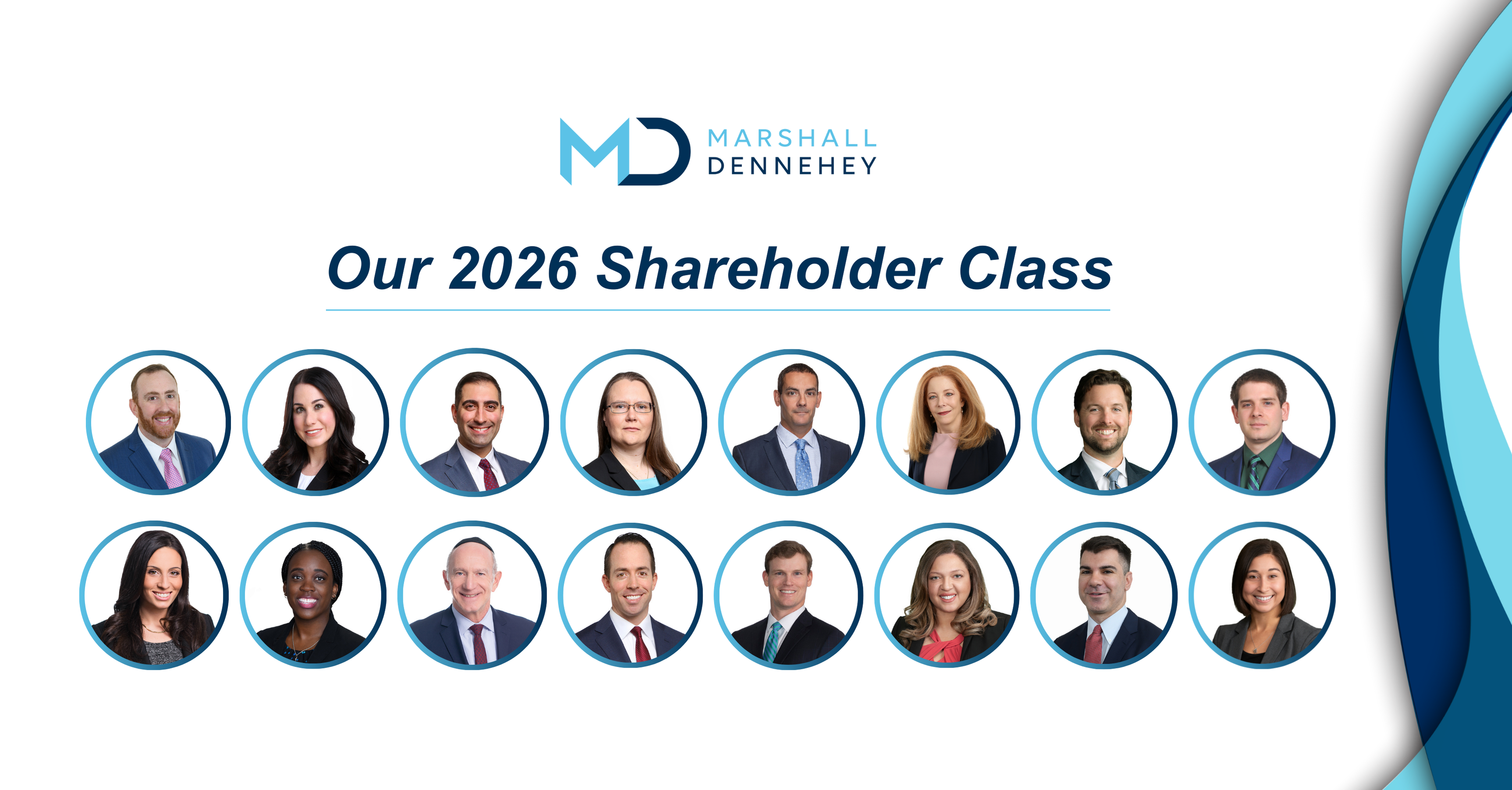
Marshall Dennehey is pleased to announce that 16 attorneys have been elected shareholders of the firm effective Jan. 1, 2026. Additionally, two attorneys have been promoted from associate to special counsel. These new shareholders and special counsel represent the firm’s four core departments – Casualty, Professional Liability, Health Care and Workers’ Compensation – and come from 11 of the firm’s 19 offices.
“We are delighted to welcome this outstanding class of newly elected shareholders,” said G. Mark Thompson, President & CEO of Marshall Dennehey. “Each of them has demonstrated exceptional skill, dedication, and leadership in advancing the interests of our clients and strengthening our firm. We look forward to the impact these individuals will make as leaders in our profession and contributors to our collective success.”
Promoted to Shareholder
PHILADELPHIA, PENNSYLVANIA
Holli K. Archer, Health Care Department (former Associate)
Holli defends health care practitioners, medical providers, and dental providers, against all manner of medical and dental malpractice suits. She also handles licensure matters before State Boards of Medicine, Dentistry and Nursing. She is a member of the Pennsylvania and Philadelphia Bar Associations and is recognized as a Pennsylvania Super Lawyer Rising Star and a Best Lawyers: Ones to Watch. She is a graduate of the University of Scranton and Loyola University New Orleans School of Law. Holli is admitted to practice in Pennsylvania.
Jack A. Bennardo, Jr., Casualty Department (former Associate)
Jack primarily focuses his practice on construction injury and construction defect litigation, and trucking and transportation litigation. He provides legal counsel to construction companies and contractors, commercial property owners/managers, trucking companies, amusement parks and recreational facilities, and insurance companies in Pennsylvania. Jack also handles a wide array of serious loss cases where there is often catastrophic injury or death in the areas of premises liability, product liability, construction accident, construction defect, commercial trucking, insurance coverage, and sports, amusement and entertainment litigation. He is a graduate of Fordham University and Villanova University Charles Widger School of Law and is admitted to practice in Pennsylvania and New York.
Julianne M. Curry, Casualty Department (former Special Counsel)
Julianne has over 20 years of experience representing clients in a wide variety of high-exposure trucking, motor vehicle, construction accident, premises liability and construction defect litigation. She frequently litigates multiparty matters and has served as a certified arbitrator for the Philadelphia Court of Common Pleas. She is a graduate of Rutgers, the State University of New Jersey, and Rutgers Law School. Julianne is admitted to practice in Pennsylvania.
KING OF PRUSSIA, PENNSYLVANIA
Michael R. Duffy, Workers’ Compensation Department (former Associate)
Michael focuses his practice on defending employers and insurance carriers in matters related to workers’ compensation. He represents employers across numerous industries including trucking, construction, landscaping, manufacturing, hospitality and long-term care. Michael is a member of the Pennsylvania Workers’ Compensation Coalition, Brehon Law Society, Philadelphia Bar Association and Judge Alexander F. Barbieri Workers’ Compensation Inn of Court. He earned his Bachelor of Arts in Political Science from Pennsylvania State University and his juris doctor from Widener University Delaware Law School. He is admitted to practice in Pennsylvania and New Jersey.
Robert A. Morton, IV, Casualty Department (former Associate)
Rob concentrates his practice in the areas of construction accident and construction defect litigation, premises liability, trucking and commercial motor carrier liability, and veterinary malpractice and licensure defense. He regularly provides legal counsel to developers, general contractors, subcontractors, and hotel operators, as well as trucking companies and a national bus company. He is a graduate of Saint Joseph’s University and Widener University School of Law and is admitted to practice in Pennsylvania and New Jersey.
PITTSBURGH, PENNSYLVANIA
Nicholas A. Cerimele, Health Care Department (former Associate)
Nicholas devotes the entirety of his practice to the defense of physicians, nurses, hospitals, physicians assistants and physician practice groups in professional liability litigation. He has more than 20 years of experience representing health care providers in medical malpractice cases. Nicholas is a graduate of Pennsylvania State University and the Thomas R. Kline School of Law of Duquesne University. He is admitted to practice in Pennsylvania.
MOUNT LAUREL, NEW JERSEY
Brielle K. Winkler, Casualty Department (former Associate)
Brielle provides legal counsel and representation in the areas of automobile liability, underinsured/uninsured motorists claims, premises liability and condominium/community association law. Her clients include small businesses, condominium associations, large public companies and insurance carriers. Brielle also handles personal injury matters related to auto liability on behalf of retail establishments, building owners, homeowners, drivers and businesses. She is a graduate of Towson University and Rutgers Law School, and she is admitted to practice in New Jersey and Pennsylvania.
ROSELAND, NEW JERSEY
Nataliana A. Guida, Health Care Department (former Associate)
Nataliana (Talia) devotes her practice to medical malpractice litigation, defending the interests of physicians, dentists, nurses, hospitals, and other healthcare providers and institutions. Talia is also experienced in handling licensing and disciplinary board matters. She is a graduate of Quinnipiac University and New York Law School, and is admitted to practice in New Jersey.
PURCHASE, NEW YORK
Sanford G. Jacobs, Casualty Department (former Special Counsel)
Sanford has over 30 years of experience in trucking and transportation liability, general liability, premises liability, motor vehicle liability, construction injury litigation, product liability and toxic torts. His extensive experience includes handling cases from inception through jury trial throughout the New York Metropolitan area, upstate New York and the state of Florida. He is a graduate of the State University of New York at Oneonta and Western Michigan University Thomas M. Cooley Law School. He is admitted to practice in New York, the District of Columbia and Florida.
FORT LAUDERDALE, FLORIDA
Seth B. Altman, Professional Liability Department (former Associate)
Seth focuses his practice on representing and defending clients in insurance coverage and first-party property matters. Prior to joining Marshall Dennehey, Seth served as in-house counsel for two insurance companies where he litigated first-party property cases and was a member of the assignment of benefits and catastrophe (hurricane) divisions. Seth is also experienced in investigation, and he counseled and instructed his former claims departments in pre-suit matters. He is a graduate of the University of Florida and Albany Law School and is admitted to practice in Florida and New York.
Holly M. Hamilton, Professional Liability Department (former Associate)
Holly focuses on a wide variety of professional liability litigation matters in state and federal court. A significant portion of her practice includes the defense of a variety of employment matters, including discrimination, harassment, and retaliation claims from the administrative (i.e., EEOC) stage through litigation. Another significant part of her practice consists of director and officer disputes in not-for-profit condominium and other community associations. She is a graduate of Florida International University and the Maurice A. Dean School of Law at Hofstra University. Holly is admitted to practice in Florida, New Jersey and New York.
Matthew J. Wildner, Professional Liability Department (former Associate)
Matthew focuses his practice on commercial litigation, construction defect litigation and a wide variety of professional liability litigation matters. Litigating in both state and federal courts, he defends design and construction professionals independently as well as through their insurance carriers in complex construction defect suits involving a variety of claims, such as building and design-related deficiencies, code violations, negligence, breach of contract and fraud, as well as insurance coverage claims under GL policies. Matthew additionally represents condominium associations, directors, officers, and property managers in matters involving breach of fiduciary duty, violations of governing documents, and construction and maintenance obligations. He is a graduate of the University of Florida and Stetson University College of Law and is admitted to practice in Florida.
JACKSONVILLE, FLORIDA
Kathleen A. Carlson, Casualty Department (former Associate)
Kathleen focuses her practice on automobile liability matters with an emphasis on uninsured/underinsured motorist claims. She also represents a wide array of clients in general liability matters. She is a graduate of the University of Florida and the University of Florida Levin College of Law. She is admitted to practice in Florida.
Taylor A. Naughton, Professional Liability Department (former Associate)
Taylor focuses his practice on construction defect litigation, representing contractors, subcontractors, material suppliers, developers and design professionals when claims are made against them. He routinely counsels clients in construction disputes, handling pre-suit investigations, multi-party claims, code violations, negligence and breach of contract claims. He is a graduate of Jacksonville University and Florida Coastal School of Law. Taylor is admitted to practice in Florida.
ORLANDO
Carolin A. Pacheco, Professional Liability (former Associate)
Carolin defends insurance carriers in first-party insurance coverage claims and complex matters pertaining to coverage and bad faith claims. She also represents condominium association boards in directors and officers suits, as well as real estate agents, brokers, and appraisers in errors and omissions claims. She also litigates FDCPA claims and suits brought by debtors against the collection services assigned to recover the debt. Carolin is a graduate of the University of Central Florida and Stetson University College of Law. She is admitted to practice in Florida.
TAMPA, FLORIDA
Sean P. Greenwalt, Casualty Department (former Associate)
Sean focuses his practice on amusement, sports, and recreation matters as well as fraud and personal injury protection (PIP) disputes. He litigates a variety of complex matters on behalf of corporations involving premises liability, commercial auto liability, catastrophic loss, wrongful death and commercial contract disputes. He also has experience defending first-party auto coverage suits and conducting examinations under oath. Sean is a member of the Florida Defense Lawyers Association and Claims Litigation Management Alliance. A graduate of Old Dominion University and Ave Maria School of Law, he is admitted to practice in Florida.
Associates Promoted to Special Counsel
MELVILLE, NEW YORK
Ian L. Glick, Casualty Department
Ian handles cases from inception through resolution involving New York State Labor Law, construction accidents, premises liability, product liability, auto liability, general liability and subrogation claims. He is a graduate of the University of Wisconsin and St. John’s University School of Law. Ian is admitted to practice in New York and New Jersey.
Noriel L. Sta. Maria, M.D., Casualty Department
Noriel concentrates his practice in the areas of asbestos and toxic tort litigation. As both a physician and an attorney, he leverages his deep medical expertise to strengthen legal defenses, offering a distinct advantage in cases where medicine plays a critical role. Noriel is a graduate of the SUNY Downstate College of Medicine and obtained his juris doctor from Fordham University School of Law. He is admitted to practice in New York.