.

Marshall Dennehey Earns Prestigious Chambers USA Rankings

June 5, 2025

Marshall Dennehey Earns Prestigious Chambers USA Rankings

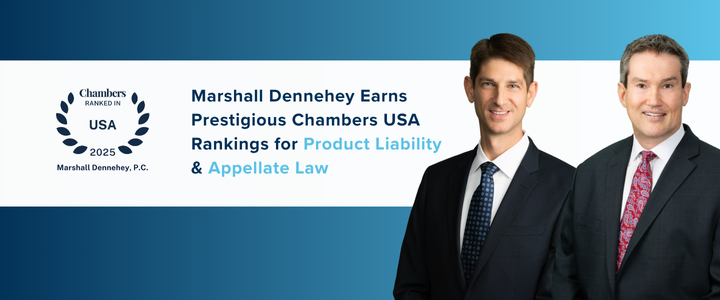
Marshall Dennehey is proud to announce that two of the firm’s practices have received top recognition in the 2025 edition of Chambers USA.

The firm’s Pennsylvania Product Liability Department was recognized for the first time, earning a Band Two ranking in the statewide category. Attorneys within this department defend cases alleging defects in the manufacture, design, failure to warn and breach of warranty of every imaginable product variety, including mass tort and asbestos litigation. Representing foreign and domestic manufacturers, they also act as national coordinating counsel and regional counsel in a number of state and federal courts.

“Marshall Dennehey is very responsive to client needs and questions. It’s decisively proactive in case strategy,” one client commented about the department.

“The team is extraordinarily knowledgeable and thorough, and prepared us for every step in the litigation process,” said another. 

Additionally, Vlada Tasich, who Co-Chairs the firm’s Product Liability Practice Group with Bradley D. Remick, was individually ranked for the first time in Band Two for his work defending clients in complex product liability litigation. His experience encompasses all aspects of motor vehicle design and manufacture, including product litigation involving Advanced Driver Assistance Systems. He additionally defends cases involving consumer goods, appliances and electronics, residential and industrial fires, durable medical equipment, industrial equipment, exercise equipment and more. 

Speaking of Vlada’s approach, clients commented: “Product liability defense work requires the intellect and desire to understand the product details and its science and investigative thinking to solve the case. He has all of those qualities.”

“Vlada is a go-to for us when it comes to product liability matters,” said another.

Additionally, John J. Hare, Chair of the firm’s Appellate Advocacy & Post-Trial Practice Group, has been ranked for the first time in Band One in Pennsylvania for Appellate Law. Hare was recognized for his extensive appellate experience and strategic insight in complex litigation matters. He has litigated more than 500 appeals in state and federal appellate courts and regularly submits amicus curiae briefs to Pennsylvania state and federal courts on behalf of a diverse clientele. 

Hare and his Pennsylvania team are widely regarded for their advocacy in high-stakes appeals across multiple industries. Members of the group are involved in some of Pennsylvania’s most high-profile litigation in recent years, including the March 2023 chocolate factory explosion in Reading, PA, and numerous cases with eight, nine, and ten-figure verdicts.

“We’re incredibly proud of John, Vlada, and our Pennsylvania product liability and appellate teams,” said G. Mark Thompson, Marshall Dennehey’s President & CEO. “Being recognized in the top tiers our first year of submission to Chambers USA is a testament to the quality of work our attorneys deliver and the trust our clients place in us.”

Chambers USA rankings are among the most respected legal rankings in the industry. Rankings are compiled through the assessment of firms’ work and opinions from external market sources, with an emphasis on client feedback. Firms and lawyers must demonstrate sustained excellence to be ranked in the guide. 

To view Marshall Dennehey's rankings, please click here
 

MD Earns Prestigious Chambers USA

Firm Highlights

Thought Leadership

Pennsylvania Supreme Court Takes Up the Gist of the Action Doctrine

The gist of the action doctrine has been a hot topic in legal malpractice cases in Pennsylvania over the last several years.  Beginning in 2014, the Pennsylvania courts applied the gist of the action doctrine to professional liability actions, following the Pennsylvania Supreme Court’s opinion in Bruno v. Erie Ins. Co., 106 A.3d 48 (Pa. 2014).  In Bruno, the court applied the gist of the action doctrine to a professional negligence claim, and found that a negligence claim was not barred simply because the parties were in a contractual relationship where the gist of the claim sounded in negligence. Thereafter, courts in Pennsylvania applied the gist of the action doctrine to breach of contract claims as well, finding that where the allegations sounded in negligence, a plaintiff could not recast a negligence claim as one for breach of contract. This was important because of the distinction between statutes of limitations: negligence claims must be brought within two (2) years, while breach of contract claims can be brought within four (4) years.  Then, last year, the Pennsylvania Superior Court held that the gist of the action doctrine does not apply to breach of contract claims as seen through two opinions. These opinions were Swatt v. Nottingham Village, 342 A.3d 23 (Pa. Super. 2025) and Poteat v. Asteak, et al., 350 A.3d 198 (Pa. Super. 2025). That is, the gist of the action doctrine can bar a negligence claim but it cannot bar a breach of contract claim.  This month, the Pennsylvania Supreme Court granted the petition for allowance of appeal in Poteat.  The Supreme Court phrased the issue for consideration as follows: Whether the Superior Court majority’s holding conflicts with this Court’s holding in Bruno v. Erie Insurance Co., 160 A.3d 48 (Pa. 2014), as well as Superior Court opinions that applied Bruno, and departs from almost 200 years of controlling precedent that distinguishes between causes of action in contract and tort based upon the nature of the duty that was allegedly breached? Attorneys on both sides of legal malpractice matters no doubt look forward to clarification on these issues from our Supreme Court.

Thought Leadership

Delaware Superior Court Clarifies Pleading Standard for Legal Malpractice Claims

In the matter of Edelstein v. Kirschner, No. N25C-09-018 FJJ, 2026 Del. Super. LEXIS 45, at *1 (Super. Ct. Jan. 29, 2026), the plaintiff law firm sued its former client for unpaid legal fees in the amount of $4,399.35. The former client asserted a counterclaim alleging legal malpractice. More, specifically, the former client claimed that his lawyer committed malpractice be recommending that he settle an underlying lawsuit by entering into a stipulated judgment for an excessive amount with interest that was accruing at “an outlandish” interest rate. The law firm moved to dismiss the counterclaim on the basis that its former client had not alleged facts reflecting that he could prove the case within the case. That is, facts reflecting that his attorneys caused him to lose the underlying case. The Superior Court held that while a legal malpractice plaintiff in cases arising from underlying litigation must prove the case within the case to survive a summary judgment motion, he does not need to plead facts reflecting as much in order to survive a motion to dismiss. While this case addresses the pleading requirements of a legal malpractice case in Delaware, it also serves as reminder that chasing unpaid legal fees from a former client can often give rise to a legal malpractice counterclaim. Attorneys seeking to collect unpaid legal fees should ensure that the fees they seek are for a significant amount, which would be recoverable if a judgment is obtained. Otherwise, the effort could backfire.

Thought Leadership

Appellate Division Affirms Dismissal of Legal Malpractice Counterclaim Against Martin Law Firm

In Martin v. Loury, 2026 N.J. Super. Unpub. LEXIS 1617 (App. Div. July 15, 2026), Martin Law Firm represented Kirk Loury in an employment matter Mr. Loury filed against his former employer, Concord Equity Group Advisors LLC (“Concord”). The allegations included, among other things, that Loury was not fairly compensated for his employment with Concord. After a bench trial finding in Loury’s favor, the Appellate Division remanded this matter in February 2016 for a second trial. During the second trial, Concord CEO, Lee Argush, testified to lower compensation estimate than first trial. On remand, the second trial judge awarded Mr. Loury the same damages as the first judge, finding Mr. Argush not credible. After the findings during the second trial, Martin Law Firm filed an action against Mr. Loury to recover legal fees and costs of representing Mr. Loury in a second bench trial and Mr. Loury filed a counterclaim against Martin Law Firm for legal malpractice, alleging he should have received an even higher award in the second bench trial. In this allegation, Mr. Loury, through his expert, claimed that Martin Law Firm should have recalled Mr. Loury to the stand to rebut Mr. Argush’s testimony to allege an alternative theory of damages. Mr. Loury’s expert admitted that the second judge already rejected Mr. Argush's theory and accepted Loury's damages theory. The trial court barred Mr. Loury’s expert and dismissed Loury's counterclaim with prejudice before convening the collection trial, and the jury ruled in Martin Law Firm’s favor. Mr. Loury appealed the trial court's pretrial rulings barring his liability expert from testifying in support of his legal malpractice counterclaim, denying his motion for summary judgment on that counterclaim, and denying his motion to amend his counterclaim by adding attorney Joseph A. Martin as a codefendant. In affirming the trial court’s decision, the Appellate Division held that the trial court properly excluded Loury’s expert testimony in the counterclaim against Martin Law Firm because the expert could not explain how calling Loury as a rebuttal witness would have increased damages when the second judge already rejected Mr. Argush's testimony and accepted Loury's damages theory, making the expert’s causation opinion speculative. The Appellate Division also held that the trial court properly denied Mr. Loury's summary judgment motion on his malpractice counterclaim because reasonable minds could differ on whether Mr. Martin's alleged failures would have changed the second judge's damages award, given the judge already found Mr. Argush not credible, creating genuine factual disputes precluding summary judgment. Also, the Appellate Division held that the trial court properly denied Loury's May 2023 motion to add Joseph Martin individually because the statute of limitations expired in February 2022, six years after the 2016 appellate remand when Mr. Loury incurred new legal costs, and relation back did not apply because Mr. Loury knew Mr. Martin's identity throughout and strategically chose to sue only Martin Law Firm in his 2019 counterclaim.

Result

No-Cause Jury Verdict Secured in Wrongful Death Trial

We successfully obtained a no-cause jury verdict in a 13-day wrongful death trial. The decedent, a 59-year-old man, was admitted to the emergency room on February 15, 2019, with complaints of abdominal pain, decreased appetite, and constipation, despite the use of laxatives. The patient did not complain of any nausea, vomiting, or diarrhea. He had a significant medical history including diabetes, hypertension, prior coronary artery stenting, morbid obesity (with past gastric bypass surgery), longstanding ventral hernia, and back pain. A CT scan revealed multiple hernias and a potential closed-loop bowel obstruction, leading to a surgery consultation. Our client, an emergency general surgeon, interpreted that the patient did not have a closed loop or any significant obstruction and recommended non-surgical management. The patient was approved to have clear liquids, and had a vomiting incident shortly after, but our client was not notified. The patient was returned to NPO status, and after improving overnight, he was returned to “clears” and additional medical and renal consults were ordered. Our client did not receive any communications from the residents/nurses of any changes in the patient’s condition. On February 18, 2019, two rapid responses were called due to increased heart rate and vomiting. It is believed that the vomiting resulted in aspiration, causing sepsis, ultimately leading to the patient’s death. During the trial, the plaintiff’s sole medical expert highlighted imaging on the wrong hernia, which called into question all of his opinions in the case. We made key objections related to the expert testimony, limiting what the allegations were, and preventing new allegations from being made. After approximately two and a half hours of deliberating, the jury returned a no-cause verdict.