
.

Marshall Dennehey Bolsters Florida Casualty Practice With Addition of Litigation Trio in Orlando

July 25, 2024

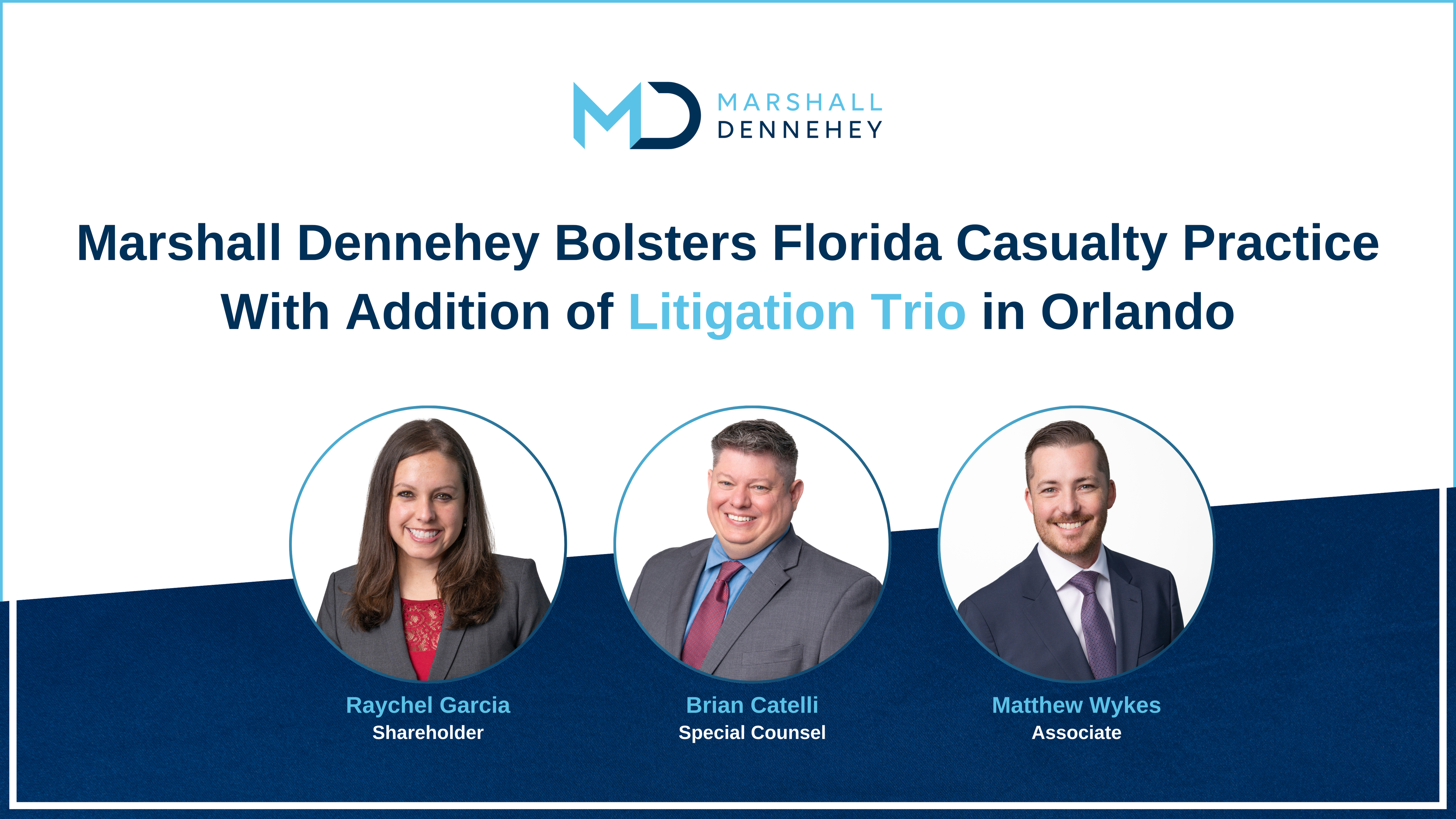
A trio of attorneys – two with extensive trial experience in casualty litigation matters – has joined Marshall Dennehey’s Orlando office. Trial attorney Raychel Garcia joins as Shareholder; Brian Catelli as Special Counsel; and Matthew Wykes as Associate. All three previously practiced at Quintairos, Prieto, Wood & Boyer, P.A. in Orlando.

“With great pleasure, we welcome Raychel, Brian and Matthew to our Orlando casualty practice,” said Matthew S. Schorr, Director of Marshall Dennehey’s Casualty Department. “Raychel and Brian bring exceptional trial prowess and litigation skills to the firm, and their reputation for advocacy and client service aligns perfectly with our firm's values. Supported by Matthew, we are confident that all three attorneys will enhance our team’s capabilities and greatly contribute to the continued success and growth of our Florida casualty practice."

Shareholder Raychel Garcia has 13 years of experience in the defense of complex, catastrophic litigation stemming from motor vehicle negligence, premises liability, retail liability, bodily injury, wrongful death, and other general liability claims. Representing clients in the state and federal courts, she has served as first chair in multiple trials on behalf of the world's leading theme park and resort, an arts and crafts retailer, a national convenience store chain, and an upscale hotel franchise. Garcia’s practice also includes high profile sex abuse and negligent security cases, as well as a variety of other matters.   

She is a former assistant attorney with the Orange County State Attorney's Office, where she tried more than 75 criminal jury trials and received the Orange County Sheriff's Office Citizen Award. A graduate of the University of Florida and Stetson University College of Law, she is a member of the Orange County Bar Association, the Seminole County Library Board and the City of Altamonte Springs Zoning Board. 

Special Counsel Brian Catelli has 14 years of courtroom experience, focused largely on general liability cases involving property and personal injury claims, automobile liability, premises liability, nursing home defense matters, negligent security cases, as well as a variety of other matters. Well known in the Orlando legal community, he previously founded his own law practice and was an assistant state attorney with the Orange County Prosecution Office where he gained extensive trial experience. He is a graduate of Walla Walla College in Washington, and Florida A& M University College of Law.

Associate Matthew Wykes was recently admitted to the Florida bar and brings a wealth of experience to his new role. He has nine years of paralegal litigation experience and worked directly with Raychel Garcia as her law clerk for two years. He focuses his practice on personal injury defense, premises liability, motor vehicle accidents, catastrophic injury, and wrongful death cases. Matthew is a graduate of the University of Central Florida and Florida A&M University College of Law.
 

Litigation Trio 2024

Firm Highlights

Thought Leadership

Congress Passes Financial Exploitation Prevention Act

On June 25, 2026, the House passed the Financial Exploitation Prevention Act of 2025 (“the Act”) by a vote of 414 to 2. The Act allows financial advisors and firms to delay suspicious transactions regarding the accounts of clients who are 65 or older, if they believe financial exploitation has occurred or is about to take place. With the advancement of technology and AI, the House’s overwhelming bipartisan passage of the Financial Exploitation Prevention Act represents an important step in strengthening the financial industry’s ability to combat the growing threat of elder financial exploitation. The Act recognizes what advisors have long known that financial professionals are often the first to detect suspicious behavior but have historically lacked clear legal authority to intervene before irreversible financial harm occurs. From the industry’s perspective, the bill accomplishes several important objectives, including the following: (1) Provides a practical “pause button” by allowing financial professionals to temporarily delay certain transaction requests when there is a reasonable belief that a senior or vulnerable adult is being financially exploited; (2) Empowers financial professionals to act by providing greater certainty that firms can act in good faith to protect clients without unnecessary legal risk; and (3) Strengthens investor protection without sacrificing client rights by allowing temporary delays based on a reasonable suspicion of exploitation, which is intended only to allow additional review and not to deny clients access to their money indefinitely. In sum, the Financial Exploitation Prevention Act will equip financial professionals with practical, carefully tailored tools to stop suspected financial exploitation before client assets are lost. By allowing firms to temporarily delay suspicious transactions under defined circumstances, Congress is recognizing the critical role advisors play as the first line of defense against increasingly sophisticated fraud schemes. The Act strikes an appropriate balance between protecting vulnerable investors and preserving individual financial autonomy, while reinforcing collaboration among advisors, families, and law enforcement to combat financial exploitation. The bill now awaits Senate action.

Thought Leadership

New Jersey Expands Family Leave Protections Effective July 17, 2026

On January 17, 2026, Governor Murphy signed into law legislation expanding the New Jersey Family Leave Act (NJFLA). Beginning July 17, 2026, significant amendments to the NJFLA will expand job-protected family leave to smaller businesses and more employees across the state. The new law broadens coverage by lowering the threshold for private employers from 30 employees to 15 employees, meaning many smaller businesses will now be subject to the NJFLA. Employees of state and local government agencies will continue to be covered regardless of the size of the employer. The amendments also make it easier for employees to qualify for leave. Under the revised law, an employee will be eligible after three months of employment and at least 250 hours worked during the preceding 12 months, replacing the previous requirement of 12 months of employment and 1,000 hours worked. Currently, New Jersey's Temporary Disability Insurance (TDI) and Family Leave Insurance (FLI) programs provide eligible employees with wage replacement while they are on leave but do not independently guarantee job protection. The recent amendments to the New Jersey Family Leave Act (NJFLA) expand these protections by extending job-protected leave to additional employees. Under the amended law, employees receiving TDI or FLI benefits may be entitled to return to the same position they held before taking leave, or to an equivalent position with the same seniority, status, pay, and benefits. Although the legislation also states that it does not expand or modify an employee's reinstatement rights under the NJFLA, the amendments appear to provide job protection to eligible employees receiving TDI or FLI benefits without requiring them to separately satisfy the eligibility requirements of the NJFLA or the federal Family and Medical Leave Act (FMLA). As a result, some employees may be entitled to longer periods of job-protected leave than were previously available under existing law. With these amendments, New Jersey continues to strengthen workplace protections by expanding access to job-protected family leave for eligible employees. These changes significantly expand access to job-protected family leave and may require employers to update their leave policies, employee handbooks, and HR practices. Notably, employers who were previously not required to administer NJFLA may need to amend their policies and/or create new protocols to come into compliance with the NJFLA. Failure to do so would prove costly, as the penalties for non-compliance are significant.

Result

No-Cause Jury Verdict Secured in Wrongful Death Trial

We successfully obtained a no-cause jury verdict in a 13-day wrongful death trial. The decedent, a 59-year-old man, was admitted to the emergency room on February 15, 2019, with complaints of abdominal pain, decreased appetite, and constipation, despite the use of laxatives. The patient did not complain of any nausea, vomiting, or diarrhea. He had a significant medical history including diabetes, hypertension, prior coronary artery stenting, morbid obesity (with past gastric bypass surgery), longstanding ventral hernia, and back pain. A CT scan revealed multiple hernias and a potential closed-loop bowel obstruction, leading to a surgery consultation. Our client, an emergency general surgeon, interpreted that the patient did not have a closed loop or any significant obstruction and recommended non-surgical management. The patient was approved to have clear liquids, and had a vomiting incident shortly after, but our client was not notified. The patient was returned to NPO status, and after improving overnight, he was returned to “clears” and additional medical and renal consults were ordered. Our client did not receive any communications from the residents/nurses of any changes in the patient’s condition. On February 18, 2019, two rapid responses were called due to increased heart rate and vomiting. It is believed that the vomiting resulted in aspiration, causing sepsis, ultimately leading to the patient’s death. During the trial, the plaintiff’s sole medical expert highlighted imaging on the wrong hernia, which called into question all of his opinions in the case. We made key objections related to the expert testimony, limiting what the allegations were, and preventing new allegations from being made. After approximately two and a half hours of deliberating, the jury returned a no-cause verdict. 

Thought Leadership

SIU Gets a Boost: NJ Supreme Court Affirms Insurers' Right to Litigate, Not Arbitrate, Fraud Claims

In a significant win for insurers' Special Investigation Units, the New Jersey Supreme Court clarified that statutory insurance fraud and racketeering claims may proceed in court rather than through PIP arbitration. At issue was whether insurance fraud claims brought under New Jersey's Insurance Fraud Prevention Act (IFPA) and the state's Anti-Racketeering Act (NJ RICO) are subject to mandatory arbitration under the Automobile Insurance Cost Reduction Act’s (AICRA) PIP dispute-resolution framework. Allstate had sued a network of medical practices, physicians, and related corporate entities, alleging a scheme to extract more than $1.7 million in PIP benefits through fraudulent and misleading billing. The trial court dismissed Allstate's complaint and compelled arbitration, reading AICRA's arbitration clause — which covers "any dispute regarding the recovery of... benefits" under PIP coverage, N.J.S.A. 39:6A-5.1(a) — as sweeping in fraud and racketeering claims along with routine benefit disputes. The Supreme Court affirmed the Appellate Division's reversal, adopting Judge Gilson's opinion below (480 N.J. Super. 566 (App. Div. 2025)) as its own reasoning. The Court held that IFPA and RICO claims fall outside the scope of AICRA's PIP arbitration mechanism because that "streamlined and specialized" process cannot grant the relief those statutes contemplate — treble damages, injunctive relief, broad discovery, and joinder of third parties — and because arbitrators lack authority to award compensatory or treble damages to an insurer. The Court also rejected the argument that Allstate's own Decision Point Review Plans independently compel arbitration, finding those plan provisions no broader than AICRA's own arbitration clause. Notably, the Court expressly disagreed with the Third Circuit's contrary holding in GEICO v. Mt. Prospect Chiropractic Center, 98 F.4th 463 (3d Cir. 2024), concluding it is not bound by that federal interpretation of New Jersey law. Insurers retain the right to pursue IFPA and RICO claims in the Law Division, with a jury trial. For SIU units and NJ insurance carriers, this decision is a significant win: it forecloses defense clinics' primary procedural tool for shunting fraud investigations into limited-scope PIP arbitration, where treble damages, RICO relief, and meaningful discovery were never realistically available. Carriers building cases against fraudulently structured clinics, straw-owned practices, or coordinated billing networks can now proceed with confidence that a well-pleaded IFPA/RICO complaint stays in the Law Division rather than being diverted to arbitration on a motion to compel. Practically, this strengthens SIU's leverage in settlement negotiations, preserves civil discovery tools (subpoenas, depositions, joinder of related corporate entities) critical to unwinding complex ownership and referral schemes, and resolves the split with the Third Circuit in favor of NJ insurers — at least as a matter of state law. Expect increased reliance on IFPA civil actions, rather than PIP arbitration demands, as SIU's primary enforcement vehicle going forward.