
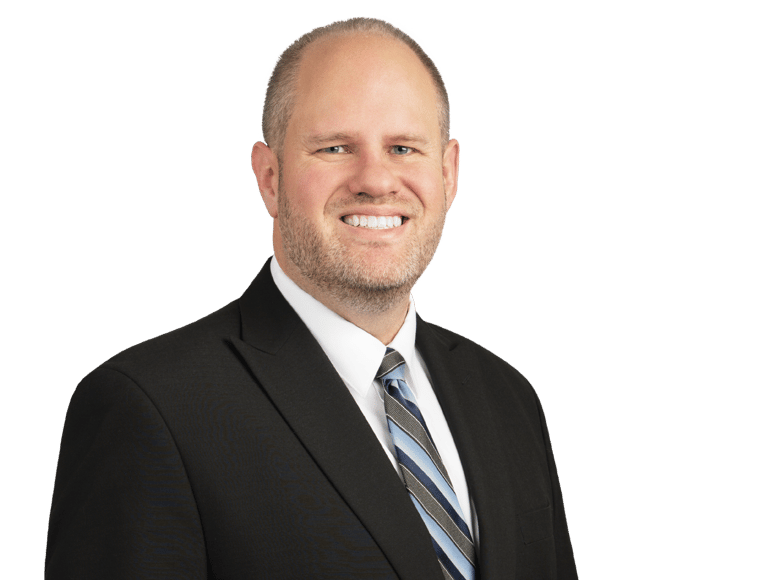
Jared is a member of the Professional Liability Department, where he focuses his practice on the defense of professionals, contractors, and businesses in complex civil litigation. His work spans a variety of areas including professional liability, insurance agents and brokers liability, architectural, engineering, and construction defect litigation, miscellaneous professional liability, commercial litigation, insurance coverage and bad faith litigation, intellectual property, technology and media litigation, and consumer financial services litigation.
Before joining the firm, Jared practiced with another Florida-based defense firm, where he represented a range of clients in construction defect, professional liability, and insurance-related matters. He also previously served as an Assistant Public Defender for over 14 years in the Ninth Judicial Circuit, where he tried numerous jury and bench trials and handled a wide variety of felony and misdemeanor cases. His extensive courtroom and trial experience provide a strong foundation for his current litigation practice.
Jared earned his Juris Doctor from the University of Miami School of Law and his Bachelor of Arts from the University of Central Florida. He is admitted to practice law in the State of Florida.
Outside of his legal practice, Jared is actively involved in the Teen Court Program, a juvenile diversion initiative providing youth an alternative to the traditional justice system. He also supports local dog rescues. A lifelong sports enthusiast and devoted Miami Marlins fan, he additionally enjoys reading, exploring Orlando’s vibrant community, and spending time at the area’s theme parks.
Thought Leadership
Legal Updates for Insurance Agents & Brokers
Florida Second DCA Clarifies the Timing of Negligence Claims Against Insurance Brokers
August 25, 2026
One of the recurring issues in insurance broker malpractice litigation is determining when a negligence claim against a broker becomes ripe. The Florida Second District Court of Appeal recently addressed that question in Bullington Insurance Group, LLC v. Gordon, 427 So. 3d 632 (Fla. 2d DCA 2026), reaffirming that a negligence claim against an insurance broker does not accrue while a related coverage dispute with the insurer remains pending. In Bullington, the plaintiff was employed as a driver and was involved in an auto accident. His employer's insurance broker had requested that he be added to the employer's commercial policy, and the insurer confirmed the addition. However, when the policy renewed, the plaintiff was not listed as a driver and was not covered at the time of the accident. Default judgments were entered against the plaintiff and his employer in litigation arising from the accident. The plaintiff then filed suit against the insurer for breach of contract and policy reformation, and separately against the broker for negligence. The broker moved to dismiss the negligence count as premature, arguing the coverage dispute with the insurer had to be resolved first. The trial court denied the motion. The Second District granted certiorari and quashed the order. Applying its 2014 decision in Wells Fargo Insurance Services USA, Inc. v. Blackshear, 136 So. 3d 1235 (Fla. 2d DCA 2014), the court held that the negligence claim against the broker was entirely dependent on a finding that the accident was not covered under the employer's policy. If coverage were established, the claim against the broker would fail as a matter of course. Because the breach of contract and reformation claims against the insurer remained pending, the negligence count against the broker had not yet accrued. The court further addressed the appropriate remedy, rejecting the plaintiff's argument that abatement was warranted. The court distinguished cases holding that abatement is proper in the bad faith context, where an insured brings both an underlying coverage claim and a bad faith claim against the same insurer. Here, the broker and insurer were separate defendants, and Blackshear squarely held that dismissal without prejudice, not abatement, is the proper remedy for a premature broker negligence claim. This decision reinforces the practical significance of sequencing in insurance-related litigation. Where a plaintiff asserts simultaneous claims against both a carrier and a broker, defense counsel for the broker should promptly move to dismiss the broker negligence count as premature. Failure by the trial court to grant such relief constitutes a departure from the essential requirements of law.
Florida’s Sixth District Clarifies Limits of Binger and Strengthens Enforcement of Pretrial Deadlines
March 4, 2026
In a new opinion from the Sixth District Court of Appeal in Crecelius v. Rizzitano, 2026 WL 555031 (Fla. 6th DCA Feb. 27, 2026), the Sixth District held that Binger v. King Pest Control, 401 So. 2d 1310 (Fla. 1981), has been interpreted too broadly by the Florida courts and clarified that a trial court is not required to make an express finding of prejudice before excluding a witness or expert testimony that was disclosed late. Trial courts retain broad discretion to enforce pretrial disclosure deadlines and case management orders, including excluding untimely disclosed witnesses. In Crecelius, the Sixth District examined how Florida courts have interpreted Binger since it was decided. The court explained that Binger addressed a relatively narrow issue involving whether a trial court erred by allowing testimony from an undisclosed expert witness where the opposing party was prejudiced. The Florida Supreme Court emphasized the importance of full disclosure in discovery and recognized that trial courts have discretion to exclude witnesses who are not disclosed in compliance with pretrial orders. At the same time, the court noted that trial courts should consider whether the nondisclosure creates surprise or prejudice when deciding whether to allow such testimony. Over time, district courts expanded Binger beyond its original scope. Many courts interpreted Binger to require trial judges to conduct a prejudice analysis before excluding late-disclosed testimony. Courts also began applying Binger more broadly to disclosure disputes involving fact witnesses, expert witnesses, and other evidence. According to the Sixth District, this interpretation significantly limited trial courts’ ability to enforce pretrial disclosure deadlines and case management orders. The Sixth District rejected that expansion, explaining that the language in Binger discussing prejudice was dicta rather than part of the holding. In the Sixth District’s view, Binger addressed circumstances in which a trial court allowed undisclosed testimony, not situations where a court excluded testimony for violating a pretrial disclosure order. As a result, Binger did not require a trial court to conduct a formal prejudice analysis before excluding untimely disclosed witnesses or expert testimony. The court also identified practical problems caused by the expanded interpretation. Trial judges were often forced to stop proceedings and conduct quick hearings on prejudice whenever late-disclosed evidence was offered. This placed the burden on the surprised party to immediately demonstrate prejudice with little notice, which the court found inconsistent with the purpose of discovery rules designed to prevent trial by ambush. The Sixth District, therefore, clarified that a trial court may exclude untimely disclosed witnesses or expert testimony without first conducting a prejudice analysis or holding a hearing to determine prejudice. Although the dispute in Crecelius involved testimony rather than documentary evidence, the court’s reasoning could potentially extend to the late disclosure of exhibits in future cases. The court certified conflict with several district court decisions that had interpreted Binger differently. While the Florida Supreme Court will have to weigh in on these issues, the Sixth District’s opinion in Crecelius highlights the importance of compliance with case deadlines, case management orders and trial orders.

