.

Director, Professional Liability Department

Chair, First Party Property Practice

Co-Chair, Fraud/Special Investigation Practice

Portrait of James H. Cole

Marshall Dennehey Promotes James Cole and Sunny Sparano to Lead The Firm’s Professional Liability Department and Announces New Board of Directors Appointments

January 5, 2026

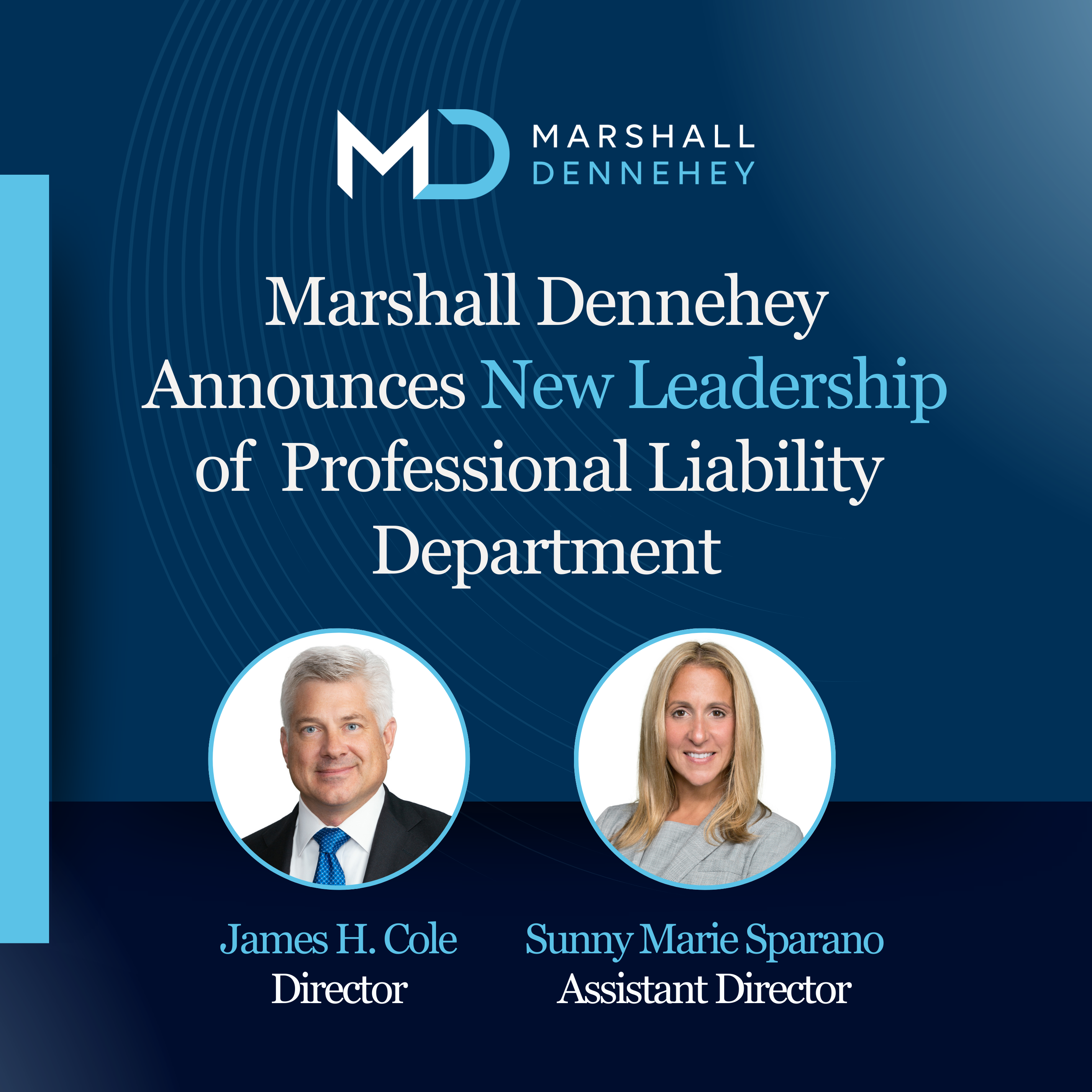
Marshall Dennehey announced today that James H. Cole has been appointed Director of the firm’s 140+ attorney Professional Liability Department and Sunny Marie Sparano has been appointed Assistant Director. Cole is succeeding Craig S. Hudson as department director as well as a member of the firm’s Board of Directors. Hudson will remain with the firm in an Emeritus role. The announcements were made following the firm’s shareholders’ meeting on December 9 and take effect January 1, 2026.

“There is no doubt in my mind that Jim and Sunny will be successful in leading and growing our award-winning Professional Liability Department,” said Marshall Dennehey President & CEO, G. Mark Thompson. “Their proven expertise and the respect they command within the department and across the firm ensures we will continue delivering exceptional results for our professional liability clients.”

Cole, who has served as the department’s assistant director since 2021, joined Marshall Dennehey in 1999 after nearly a decade as a claims professional with a national insurance carrier. His first-hand understanding of property and casualty insurance afforded him a true head start in the nuances of claims settlements, insurance risk and litigation, and he ascended to lead the firm’s Insurance Services; Property Litigation; and Fraud/Special Investigation Practice Groups.

Resident in the firm’s Philadelphia office, Cole is a nationally recognized authority on insurance law, frequently speaking at leading conferences on property damage, insurance fraud, and bad faith topics. For the past several years, he has been a featured presenter at many prominent insurance industry events including the Pennsylvania Insurance Fraud Conference and the Property & Liability Resource Bureau (PLRB) conference. An active member of the Claims & Litigation Management Alliance (CLM), he serves as faculty for CLM’s Claims College, School of Property, where he helped shape curriculum on good faith claims handling and coverage issues. Cole holds an AV‑Preeminent rating from Martindale‑Hubbell and is listed among the Best Lawyers in America for Insurance Law. He earned his law degree from Temple University Beasley School of Law in 1999 and his undergraduate degree from Indiana University of Pennsylvania in 1990, and is admitted to practice in New Jersey and Pennsylvania.

Sparano joined Marshall Dennehey’s Roseland, NJ office in 2005 and chairs the firm’s Architectural, Engineering and Construction Defect Litigation Practice Group where she oversees a firm-wide team of attorneys who defend design and construction professionals in complex construction defect suits. She is additionally a member of the firm’s Board of Directors. 

Among her numerous professional activities, Sparano is a member of the New Jersey State, New York State and Essex County Bar Associations, and is a frequent speaker at various construction defect conferences, including the annual West Coast Casualty Construction Defect Conference.
 
Rated AV Preeminent by Martindale-Hubbell, she is recognized by the Best Lawyers in America organization for Construction Litigation. A graduate of Seton Hall University and Widener University School of Law, she is admitted to practice in New Jersey and New York.

Additional Board Appointments
Matthew S. Schorr, Executive Committee member and Director of the firm’s Casualty Department, replaces Hudson as Chairman of the firm’s Board of Directors. Since joining the firm in 2008, Schorr has held a series of key leadership roles, including Regional Managing Attorney of the Casualty Department for Northern New Jersey and New York; Assistant Director of the Casualty Department; Director of the Casualty Department; and ultimately Executive Committee member in 2024.

Additionally, shareholders Steven M. Christman and Michael A. Packer have been elected to the firm’s Board. They will serve three-year terms effective January 1, 2026.

Christman is the Managing Attorney of the firm’s New York City office where he defends insureds and self-insureds in a variety of complex casualty liability matters. His background in insurance coverage litigation encompasses the representation of both reinsurers and excess insurers. He also serves as supervisor of the office’s casualty litigation. A graduate of Providence College and the University of Dayton School of Law, he is admitted to practice in New York. 

Packer is the Managing Attorney of the firm’s Fort Lauderdale office and co-chairs the firm’s Insurance Services Practice Group. He has almost 25 years of experience defending property insurers throughout Florida in first party coverage matters, and provides coverage analysis and opinions of third party claims. He is a graduate of the State University of Albany and the University of Miami School of Law. He is admitted to practice in Florida.
 

2026 PL New Leadership

Firm Highlights

Thought Leadership

Commonwealth Court Holds That a Claimant Who Was Struck By a Car While Crossing the Street During an Unpaid Break Was In the Course and Scope of Employment

This case involved a claim petition filed by a claimant who sustained injuries after being struck by a vehicle while crossing the street in front of the employer’s premises. The employer denied the claim based on course and scope, as the accident occurred during one of two mandatory fifteen (15) minute breaks provided to the claimant. The claimant would punch out at the beginning of a break and punch back in when the break was over.  On the date of the incident, the claimant punched out and left the building to get lunch at a restaurant, which required her to cross the employer’s parking lot, and then a public street, where the injury occurred. The Workers Compensation Judge (WCJ) dismissed the petition, noting that that during the two mandatory fifteen-minute breaks per shift allowed by the employer, the claimant was free to leave the employer’s premises, and during breaks, permitted to engage in whatever activity she desired. The WCJ found that at the time of the accident, the claimant was on her own time, in the middle of the street, and going to get lunch.   The claimant filed an appeal with the Worker’s Compensation Appeal Board (Board), and the Board reversed.  According to the Board, the claimant’s location was still on the employer’s premises, as the claimant was taking her customary route while using a reasonable ingress/egress from the employer.  Further, the Board found that the “Personal Comfort Doctrine” applied, as the claimant was on a momentary departure to take care of her personal comfort, within the window of time she was allotted for her break.  The Board remanded the case, and a WCJ granted the claim petition.  The Board affirmed, and the employer appealed to the Commonwealth Court. Before the Court, the employer argued that the claimant was not in the course and scope of her employment, because the injury did not occur on its premises, and the claimant was outside the bounds of the Personal Comfort Doctrine. The Court, however, rejected these arguments, and dismissed the employer’s appeal.  The Court noted that the break given to the claimant was so cursory, when she set out to relieve her hunger for her own personal comfort,  she remained in the course of her employment when she sustained her injuries.  A Petition for Allowance of Appeal in the Supreme Court has been filed by the Employer, Giant Eagle.

Thought Leadership

New Jersey Workers’ Compensation Legislation Updates

Since June 1, 2026, there have been no new New Jersey workers’ compensation related cases from the Appellate or Supreme Courts. As such, below will highlight any new legislative updates since February. A1023 | S3984 - Medical Use of Cannabis Under Certain Circumstances This requires workers’ compensation, PIP, and health insurance coverage for the medical use of cannabis under certain circumstances. It was introduced on January 13, 2026 and referred to the Assembly Financial Institutions and Insurance Committee. It was also introduced on March 19, 2026 and referred to the Senate Commerce Committee. A1045  - Certain Injuries to Volunteer and Professional Public Safety and Law Enforcement Personnel This revises workers’ compensation coverage for certain injuries to volunteer and professional public safety and law enforcement personnel. It was introduced on January 13, 2026 and referred to the Assembly Labor Committee. A1384 | S2757 - Reduce Statute of Limitations in Medical Fee Disputes This reduces statute of limitations from six years to two years in medical fee disputes in workers’ compensation matters. It was introduced on January 13, 2026 and referred to the Senate Labor Committee. It was also introduced on the same day and referred to the Assembly Labor Committee. A1870 | S1379 - Workers' Compensation Benefits For Certain Workers Due to September 11, 2001 Terrorist Attacks This provides workers’ compensation benefits for certain public safety workers who developed illness or injury as result of responding to September 11, 2001 terrorist attacks. It was introduced on January 13, 2026 and referred to the Assembly Labor Committee. It was also introduced on the same day and referred to the Senate Labor Committee. On February 5, 2026, it was reported from the Senate Committee, 2nd Reading, and referred to the Senate Budget and Appropriations Committee. A2779 | S1521 - Excludes Certain Illegal Aliens This excludes certain illegal aliens from workers’ compensation and temporary disability benefits. It was introduced on January 13, 2026 and referred to the Senate Labor Committee. It was also introduced on the same day and referred to the Assembly Labor Committee. A2792 | S1555 -  Prevent Intoxicated Employees from Workers’ Compensation This prevents intoxicated employees from receiving workers’ compensation. It was introduced on January 13, 2026 and referred to the Senate Labor Committee. It was also introduced on the same day and referred to the Assembly Labor Committee. A3167 | S2372 - Workers’ Compensation Insurance Requirements for Certain Corporations and Partnerships This concerns workers’ compensation insurance requirements for certain corporations and partnerships. It was introduced on January 13, 2026 and referred to the Senate Labor Committee. It was also introduced on the same day and referred to the Assembly Labor Committee. A3548 | S3571 – Maximum Benefits for Certain Volunteers This provides certain volunteer and other workers with maximum compensation benefit for workers' compensation claim regardless of outside employment. It was introduced on January 13, 2026 and referred to the Senate Labor Committee. On March 2, 2026, it was reported from the Senate Committee, 2nd Reading, and referred to the Senate Budget and Appropriations Committee. It was also introduced on the same day and referred to the Assembly Labor Committee. On May 7, 2026, it was reported and referred to Assembly State and Local Government Committee. A3724 - Personal Liability to Employer Officers for Failure to Pay for Coverage This provides personal liability for owner, executive officer, or executive director of employer for failure to pay for workers' compensation coverage. It was introduced on January 13, 2026 and referred to the Assembly Labor Committee. On May 7, 2026, it was reported and referred to Assembly Judiciary Committee. A4617  - Certain Workers' Compensation Supplemental Benefits and Funding Method This concerns certain workers' compensation supplemental benefits and funding method. For a permanently and totally disabled worker or surviving dependents after December 31, 1979, with some exceptions, this bill provides for an annual cost of living adjustment in the weekly workers’ compensation benefit rate. It was introduced on March 10, 2026 and referred to the Assembly Labor Committee. S241 - Inclusion in Database of Appointed Officials This requires that workers’ compensation judges and administrative law judges be included in database of appointed officials. It was introduced on January 13, 2026 to the Senate, Referred to Senate State Government, Wagering, Tourism & Historic Preservation Committee. S2290 -  Mandatory Retirement Age This increases statutory mandatory retirement age for Supreme Court Justices, Superior Court Judges, Tax Court Judges, Administrative Law Judges, and Workers’ Compensation Judges from 70 to 72. It was introduced on January 13, 2026 and referred to the Senate Judiciary Committee. S3144 - Testimony in Workers’ Compensation This concerns submission of testimony in workers’ compensation claims. It was introduced on January 13, 2026 and referred to the Senate Labor Committee. S3342  - Increase Mandatory Retirement Age This increases statutory mandatory retirement age for Supreme Court Justices, Superior Court Judges, Tax Court Judges, Administrative Law Judges, and Workers’ Compensation Judges from 70 to 75. It was introduced on February 5, 2026 and referred to the Senate Judiciary Committee.

Thought Leadership

Appellate Court Rejects Horizontal Immunity Defense to Company Not Acting as Statutory Subcontractor

The First District Court of Appeal held that a property management company was not entitled to horizontal immunity under section 440.10(1)(e), Florida Statutes, in a negligence action brought by an employee of another company working on the property. The claimant was injured while servicing a swimming pool at an apartment complex. His employer had contracted with the property owner to maintain the pool. Following the accident, the claimant received workers' compensation benefits through his employer’s carrier. The claimant subsequently filed a negligence action against the property management company, alleging that it failed to maintain the premises in a reasonably safe condition and failed to warn him of a dangerous condition that caused his injuries. The property management company had been retained by the property owner to maintain the complex in good operating condition and to perform routine maintenance and repair work. The property management company argued that it was immune from suit under section 440.10(1)(e) of Florida’s Workers’ Compensation Law. That provision grants immunity to a subcontractor providing services in conjunction with a contractor on the same project or contract work from civil actions brought by employees of another subcontractor, subject to limited exceptions. According to the property management company, it qualified as a subcontractor working on the same project as the claimant’s employer and was therefore entitled to horizontal immunity. The trial court agreed and entered summary judgment in its favor. On appeal, however, the claimant argued, and the appellate court agreed, that horizontal immunity applies only when a contractor has sublet work arising from a contractual obligation owed to a third party. The court noted that prior decisions consistently held that an entity acting solely on its own behalf as the owner of property, rather than pursuant to a contract with a third party, is not a “contractor” under section 440.10(1), even when it hires other companies to perform work on the property. In Teed, the property management company could not establish that the property owner had a primary contractual obligation to a third party to maintain either the apartment complex or the swimming pool, which it then delegated to the claimant’s employer or the property management company. As a result, the property owner did not qualify as a statutory contractor, and the property management company was not a subcontractor entitled to horizontal immunity under section 440.10(1)(e). The First District therefore reversed the lower court’s ruling and remanded the case for further proceedings on the claimant’s negligence claim.

