
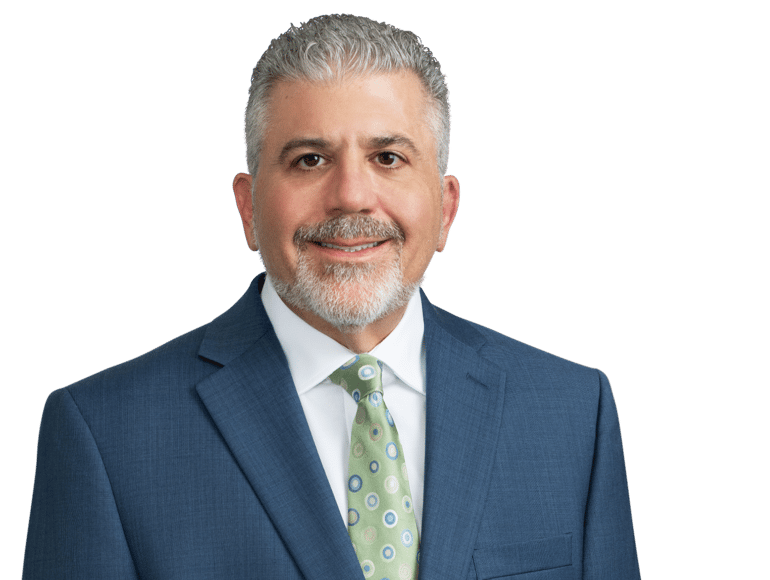
Michael is the firm's supervising attorney for the Insurance Services Practice Group in the state of Florida and a member of the firm's Board of Directors. The group assists insurers in all aspects of a coverage dispute, including responses to civil remedy notices of insurer violations, pre-suit investigations and coverage evaluations, declaratory judgment and bad faith litigation. In particular, Michael defends property insurers throughout Florida in first party coverage matters, where he responds to claims for sinkhole, windstorm, fire, mold, theft, and water losses. Michael's group also conducts examinations under oath and SIU investigations.
In both the state and federal courts, Michael has participated in a number of bench and jury trials through verdict, all of which resulted in either a defense verdict or a verdict which was less than the amount demanded.
In addition, Michael is often asked to serve as coverage and bad faith counsel in third party actions, including monitoring the defense of litigation, as well as trial. As part of this role, Michael is often asked to draft reservation of rights, declinations and prosecute declaratory relief actions.
Michael has substantial experience in alternative dispute resolution, having represented clients in thousands of mediations, neutral evaluations and arbitration proceedings. Michael routinely advises clients on the evaluation and resolution of multi-claimant matters, often times where the injuries and damages exceed the available policy limits.
Over the past ten years, Michael and his group have defended in excess of three hundred sinkhole lawsuits, as well as hundreds of other first party lawsuits. The group has defended a number of cases through trial and appeal, including four sinkhole trials during recent years. In addition, the group represents more than ten statewide insurance carriers in first party property damage lawsuits, including many of the largest insurance carriers in Florida.
Michael routinely speaks at regional and nationwide industry conferences, specifically addressing coverage issues under first party property and third party liability policies. He has also presented a number of seminars on auto negligence, uninsured motorist and bad faith claims. Michael frequently travels around the country to provide in-house claims seminars with claims professionals. In addition, he has lectured on defending first party property damage claims including sinkhole and mold claims, which included review and analysis of claims handling procedures, as well as recommendations for the same. Michael has also written numerous articles for industry publications addressing Florida-specific claim handling issues and insurance companies’ rights and obligations in defending first and third party coverage actions.
In 1994 Michael earned his Bachelor of Arts from the State University of New York at Albany. Subsequently, Michael obtained his juris doctor in 1997 from the University of Miami School of Law, Coral Gables, Florida, where he graduated cum laude.
Michael is married to Nicole Packer and they live with their three children in Weston, Florida.
Results
Thought Leadership
Legal Updates for Florida Coverage and Property Litigation
Late Notice - Policy Language Controls Burden to Prove Prejudice
October 5, 2026
Despite the fact the insured failed to provide notice to its insurance company until more than 1,000 days after it sustained damage as a result of Hurricane Irma, the Second District Court of Appeals reversed summary judgment in favor of the insurer. While the appellate court agreed with the trial court that the insured clearly failed to provide timely notice of the loss, summary judgment was nonetheless reversed as the trial court improperly presumed prejudice to the insurance company without examining the relevant policy language. Further, the trial court failed to properly consider evidence submitted by the plaintiff to overcome the presumed prejudice. The appellate court analyzed the duties after loss, which stated: The relevant provision of Wild Oak Bay's insurance policy, Duties in the Event of Loss or Damage, provides that pursuant to section 627.70132, Florida Statutes (2016), "loss or damage caused by the peril of windstorm or hurricane is not covered unless notice of the claim . . . is provided to [American Coastal] in accordance with the policy conditions, within three (3) years from the date the hurricane made landfall or the windstorm caused damage" and that "[i]n the case of a loss to covered property, [American Coastal] ha[s] no duty to provide coverage under this Policy if the failure to comply with the following [listed] duties is prejudicial to [American Coastal]." (Emphasis added.) The listed duties include that Wild Oak Bay "give [American Coastal] prompt notice of the loss or damage," including a description of the property, and that Wild Oak Bay, "[a]s soon as possible, give [American Coastal] a description of how, when and where the loss or damage occurred." Also included in the list of duties is cooperation in the investigation of the claim. Based on the above language which includes, “if the failure to comply with following listed duties is prejudicial to American Coastal,” the Second DCA agreed with the Fourth DCA’s decision in Perez v. Citizens Property Insurance Company, 345 So. 3d 893 (Fla. 4th DCA 2022), which found that identical policy language placed the burden on the insurer to prove prejudice. Id. at 896. This analysis is contrary to the Third DCA analysis of the same policy language, where it found “there is no " `policy language exception' to the presumption of prejudice that arises when an insured fails to promptly notify the insurer of a claim." Arce v. Citizens Property Insurance Co., 388 So. 3d 205, 212 (Fla. 3d DCA 2024). The Second DCA relied on the Fourth DCA’s reasoning and concluded that based on the policy language, the burden was on the insurance company to prove it had been prejudiced by the late notice. The Second DCA further certified conflict with the Third DCA’s opinion in Arce. As such, the question of who’s burden it is to prove/disprove prejudice may ultimately be decided by the Florida Supreme Court.
Defense Digest
On the Pulse… Profile of the Insurance Services – Coverage and Bad Faith Litigation Practice Group
June 30, 2026
The Insurance Services – Coverage and Bad Faith Litigation Practice Group delivers comprehensive, end-to-end litigation and advisory services to national and global insurance carriers. While the group is deeply experienced in coverage and bad faith litigation, its capabilities extend well beyond traditional legal defense. Through its broader Insurance Services practice, the firm has built a dynamic suite of innovative, client-focused solutions tailored to the evolving needs of insurers operating in complex and high-risk environments. With attorneys present in jurisdictions spanning from Florida to New York, the practice group approaches each matter with a strategic, solutions-oriented mindset. Its attorneys focus not only on resolving disputes, but on proactively managing risk by developing creative strategies to control exposure, avoid litigation where possible, and transfer risk effectively. In doing so, the group remains mindful of the broader business implications for its clients, including the protection of brand integrity and competitive positioning within the insurance industry. The group’s experience encompasses the full spectrum of insurance products, including commercial, personal property, and casualty policies, professional liability coverage, health and life insurance, and workers’ compensation policies. This breadth allows the team to provide nuanced, industry-specific counsel across a wide array of coverage issues and claims scenarios. Leadership within the practice group reflects both geographic reach and subject-matter depth. Todd Leon, who has offices in Philadelphia and Mount Laurel, serves as the Northeast head, with Allison Krupp of the Camp Hill office serving as vice-chair. Michael Packer, based in Fort Lauderdale, oversees operations in the Southeast, with Danielle Robinson, also of Fort Lauderdale, as the vice chair. Together, they guide a team of approximately 20 attorneys who provide consistent, coordinated legal services across jurisdictions. The Southeast team, in particular, brings a sophisticated understanding of the unique legal and regulatory challenges associated with Florida’s insurance landscape. Across all offices, attorneys are supported by a strong network of associates, paralegals, and professional staff, enabling the group to efficiently manage even the most complex coverage disputes, including first-party property and automobile litigation. The group also benefits from the leadership and insights of Jim Cole, the former group chair, who is now the Director of the firm’s Professional Liability Department. The practice group has a proven track record of successfully representing insurers in both state and federal courts in first-party and bad faith litigation and in providing opinions on coverage issues in jurisdictions around the country. Its attorneys are well-versed in the intricacies of institutional discovery, including corporate designee, apex, and employee depositions, as well as the litigation tactics often employed by plaintiffs to drive settlement pressure. By offering strategic guidance at every stage – both pre-litigation and during active disputes – the group helps clients evaluate coverage positions, mitigate risk, and make informed decisions about resolution or trial. When litigation is unavoidable, the firm’s seasoned trial attorneys are prepared to vigorously defend even the most complex and high-exposure matters. Beyond litigation, the group offers a wide array of services designed to support insurers’ operational and strategic objectives. These include coverage consultation, coordinating counsel services, catastrophe (CAT) operation coverage strategies, and specialized support for first-party property and automobile claims. The team also provides SIU and fraud-related investigation and litigation services, indemnification and risk transfer strategies, and comprehensive bad faith evaluation and defense. Additional offerings include policy language review, representation before administrative and insurance departments, claims practices consultation, and institutional discovery support. The group also works closely with clients to develop best practices, internal guidelines, and customized training and educational programs tailored to the full range of insurance products. With 19 offices across Pennsylvania, New Jersey, New York, Delaware, Florida, Ohio, and Connecticut, and an active presence in neighboring jurisdictions such as Maryland, West Virginia, and Kentucky, the Insurance Services Practice Group is positioned to provide seamless, regional, and national support. Its integrated approach ensures that clients receive not only skilled legal representation but also practical, forward-looking guidance designed to meet the demands of today’s insurance landscape.


