
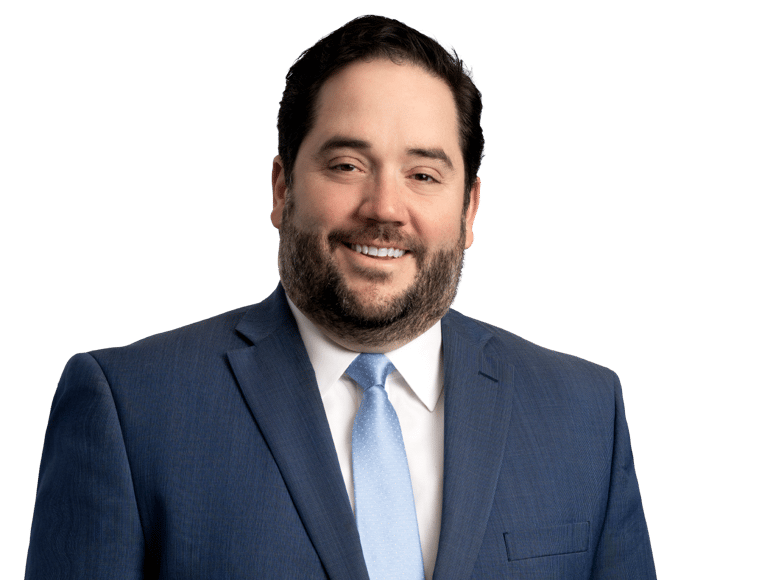
Jim is a member of the Professional Liability Department where he focuses his practice in municipal liability, civil rights law, commercial litigation, homeowners' association litigation, as well as the defense of architects and engineers and various professionals in errors and omissions cases.
Throughout his career he has concentrated in civil litigation representing businesses in various commercial matters, premises liability and products liability matters. He also has experience advising clients with respect to employment issues as well as businesses’ engagements and interactions with independent contractors. Prior to joining Marshall Dennehey, he represented clients in various professional liability matters, including construction and legal malpractice.
Jim earned a Bachelor of Science degree from the College of Business Administration of Fordham University and graduated cum laude from the Western Michigan Thomas M. Cooley School of Law. After completing law school, he clerked for the Hon. Irvin J. Snyder in the Superior Court of New Jersey.
Jim is involved in the local legal community, previously serving as a Board Member of the Young Lawyers Division of the Lackawanna County Bar Association since 2015, most recently as President in 2021. He is admitted to practice in Pennsylvania State Courts, as well as in the United States District Court for both the Middle and Eastern District of Pennsylvania.
Thought Leadership
Legal Updates for Insurance Agents & Brokers
Misrepresentations of the Next Degree: Expanding Broker Liability After Penn Outdoor
May 7, 2026
Services v. Harleyville Insurance Co. There has been a noticeable increase in claims against insurance brokers over recent years, with plaintiffs beginning to frame coverage disputes as actions sounding in negligence and negligent misrepresentations. In this ever-shifting world, disputes regarding coverage have devolved into claims that brokers failed to secure, explain, or accurately advise as to coverage. Such claims, requiring no proof of intent, allow insureds facing scrutiny to look beyond the spoken word of brokers and into the text of standard transaction documents. Pennsylvania’s Superior Court’s decision in Penn Outdoor Servs., LLC v. Harleysville Ins. Co. of New Jersey, 323 A.3d 231 (Pa. Super. Ct. 2024), reargument denied (Sept. 6, 2024), highlights the evolution of the misrepresentation claims against brokers. There, Penn Outdoor Services, LLC subcontracted for snow removal services at an apartment complex it owned with Longford Landscape and Excavation. The contract between Penn and Longford included a hold harmless clause in favor of Penn with respect to the services to be provided by Longford, which specifically stated: Subcontractor agrees to indemnify and save and hold harmless Penn and Penn's clients/customers from and against all claims for damages arising out of the performance of Subcontractor's duties under this Agreement and agrees to, at Subcontractor's expense, defend any suit or action brought against Penn or Penn's clients/customers on account of such claim or damage. Consistent with the parties’ agreement, Longford’s insurance broker, Wharton, Lyon & Lyon provided Penn with a certificate of insurance, naming Penn as an additional insured under Wharton’s insurance policy with Harleysville Insurance Company. Specifically, the subject policy included an endorsement relating to Penn’s coverage as an additional insured, endorsement CG-7524, which provided, If specifically required by the written contract or agreement referenced in Paragraph A above, any coverage provided by this endorsement to an additional insured shall be primary and any other valid and collectible insurance available to the additional insured shall be non-contributory with this insurance. While the contract between Penn and Longford was in effect, a woman was injured in a slip and fall at the complex where Longford provided snow removal services. The woman filed suit and named Penn as a defendant. With the impression it was an additional insured under Longford policy, Penn sought a defense in the matter from Longford and Harleysville; a request that was denied because, as per Harleysville, the coverage provided under Penn’s policy was excess coverage, not primary. After settling the underlying action and incurring extensive legal fees in the course of the same, Penn filed an action against Harleysville and Wharton, including a claim for negligent misrepresentation against Wharton. After a jury verdict was rendered in favor of Penn, Wharton filed a motion for j.n.o.v. arguing that the evidence established that it made no negligent misrepresentation. The trial court disagreed, pointing out that the contract between Penn and Longford required Penn to be named as an additional insured, however, it did not specify that such coverage be primary as required by the applicable endorsement to the Harleysville policy. Wharton’s representative testified that she did not review the complete language of the endorsement in question, thus creating the negligent misrepresentation. By providing the COI naming Penn as an additional insured, Wharton represented that to be the status of insurance extended to Penn. The endorsement of the Harleysville policy provided that “if specially provided” by the contract between the parties, the coverage afforded would be primary, correlating with the text of the COI. The contract in question, however, did not specifically call for the coverage to be primary. Therefore, it was not. While reading like a choose your own adventure novel, Penn Outdoor highlights the need for attention to detail in the issuance of COI’s by brokers. In a world where a broker’s spoken word can get them into hot water, the case casts a light on a new potential pathway to broker liability. While the COI in the present matter contained the necessary buzz words, i.e. “additional insured,” that language alone could not carry the day. Penn Outdoor evidences how critical it is for brokers to choose their words wisely, but also carefully ensures the text of the COI, policy language, and other transaction documents provide the coverage reasonably expected by the insured. By making it ones practice to always reconcile the policy language with the COI, and any applicable contracts, brokers can avoid potential liability in an increasingly litigious world.
Defense Digest
Offensive, But Not Actionable: The Limits of Pennsylvania’s Real Estate Seller Disclosure Law
March 1, 2026
Key Points: Objectively-quantifiable flaw is needed in order to assert a claim for violation of the RESDL. Nazi floor design did not constitute a physical or structural problem with the property. Subjectivity cannot drive RESDL claims. As is well known among real estate agents and brokers, Pennsylvania’s Real Estate Seller Disclosure Law, 68 Pa.C.S. §§ 7301, et seq., places responsibility on sellers to disclose material defects with respect to their property during a real estate sale. Specifically, the RESDL states: Any seller who intends to transfer any interest in real property shall disclose to the buyer any material defects with the property known to the seller by completing all applicable items in a property disclosure statement which satisfies the requirements of [§] 7304 (relating to disclosure form). A signed and dated copy of the property disclosure statement shall be delivered to the buyer in accordance with [§] 7305 (relating to delivery of disclosure form) prior to the signing of an agreement of transfer by the seller and buyer with respect to the property. 68 Pa.C.S. § 7303. Liability under the RESDL is extended to agents of the seller where they have actual knowledge of such defect. While plaintiffs have attempted to expand the reach of the RESDL to more subjective claims, courts throughout the Commonwealth have historically limited permissible claims. Claims are restricted to those regarding defects that substantively impact the value of the real estate, while still being capable of recognition and quantification by objective standards. The foregoing limitation was recently analyzed in Wentworth v. Steinmetz, 2025 WL 3157571 (Pa. Super. Nov. 12, 2025), which analyzed whether a symbol tiled into a floor of a home constituted a “material defect.” Wentworth involved a dispute between the buyers and seller of a residence in Beaver County, Pennsylvania. After closing, the buyers found the basement floor to be tiled with a swastika and what they believed to be a Nazi eagle. This area of the floor had been covered by a rug when they initially viewed the home, thus, the buyers were not aware of it until after the closing. The buyers claimed they could not be expected to live in a home with such condition and asserted that it would cost $30,000.00 to replace the floor, arguing that the seller was liable for compensatory and punitive damages for failing to disclose the condition. The trial court found for the seller, determining that the symbols did not constitute a material defect, which the buyers appealed. The Superior Court looked to Milliken v. Jacono, 103 A.3d 806 (Pa. 2014), as modified on reconsideration (Nov. 12, 2014) (Milliken II), where the Pennsylvania Supreme Court held that purely psychological stigmas are not material defects of property that sellers must disclose. Milliken II involved a claim for violation of the RESDL for the sellers’ failure to disclose a murder-suicide that took place in the residence. If such a duty was to be created, the Milliken II court opined, it should be imposed by the legislature. Applying the analysis set forth in Milliken II, the Superior Court reiterated that an objectively-quantifiable flaw is needed in order to assert a claim for violation of the RESDL, agreeing with the trial court’s position that the floor design did not constitute a physical or structural problem with the property. The court further reiterated that this objective standard is necessary in order to not only apply the law with consistency, but also to limit the burden placed on sellers. Since the floor in question was sound and functional, the presence of the symbols, no matter how abhorrent, did not constitute a material defect. While not involving real estate agents, Wentworth is instructive of how Pennsylvania’s courts analyze the wide variety of claims under the RESDL, and the fact that the court appears disinclined to permit subjectivity to drive such claims. Thus, sellers and agents alike can take solace in the fact that claims based on how a party feels about a feature or fixture of a property, without any physical or structural issue, does not pass muster when it comes to the RESDL. Certainly, this is helpful to real estate agents and brokers who are not only bound by the RESDL where they have actual knowledge of an alleged defect, but also owe a duty to their clients to represent them in a professional manner during the sale of the real estate, including advising sellers as to the information that needs to be disclosed. Indeed, the RESDL does encompass a broad set of areas with respect to the necessary disclosures. However, the courts’ analyses in Milliken II and, more recently, Wentworth, limit the subjective nature of such claims, placing the onus on the legislature if there is to be any expansion with respect to the same. James works in our Scranton, PA office. He can be reached at (570) 496-4662 or JDGreco@mdwcg.com.


