
.

Marshall Dennehey Expands Leading Pennsylvania Appellate Practice With Addition of Shareholder Casey Coyle

June 29, 2026
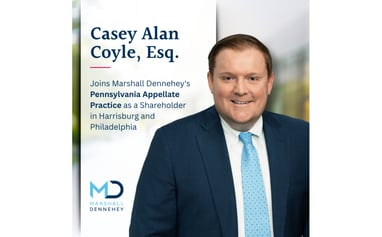
Casey Alan Coyle Joins Marshall Dennehey's PA Appellate Practice as a Shareholder in Harrisburg and Philadelphia

Marshall Dennehey announced today that Casey Alan Coyle, a highly accomplished trial and appellate attorney with extensive experience litigating in state and federal trial and appellate courts, has joined the firm’s Harrisburg and Philadelphia offices as a shareholder in the Appellate Advocacy & Post-Trial Practice.

“Having someone with Casey’s command of both commercial and appellate litigation is a tremendous advantage for our clients,” said James H. Cole, Director of Marshall Dennehey’s Professional Liability Department, which includes the Appellate Advocacy & Post-Trial Practice. “His experience strengthens our ability across both practice areas and allows us to further support trial teams through every stage of litigation that may evolve into complex appeals.”

“Casey is widely regarded as one of the most talented appellate advocates in Pennsylvania, with a deep understanding of appellate procedure and a proven ability to deliver results in high-stakes matters,” said John J. Hare, Chair of the firm’s Appellate Advocacy & Post-Trial Practice Group and member of the firm’s Executive Committee. “His extensive experience before Pennsylvania’s appellate courts and his thoughtful, strategic approach to complex legal issues will be invaluable assets to our clients and further strengthen our deep appellate bench at Marshall Dennehey.”

Over the course of his 17-year career, Coyle has developed an active commercial litigation practice, representing businesses in high-stakes, “bet-the-company” disputes in state and federal courts nationwide.  As appellate counsel, he has represented parties and amici curiae in more than 15 appeals before the Supreme Court of Pennsylvania and successfully secured discretionary review, or “allocatur,” from the Supreme Court on six occasions. He has also presented oral argument before the U.S. Court of Appeals for the Sixth Circuit, the Pennsylvania Commonwealth Court, and the Pennsylvania Superior Court.  Before joining private practice, Coyle served as a law clerk to legendary Justice and later Chief Justice Thomas G. Saylor of the Supreme Court of Pennsylvania.

“I’m excited for the opportunity to join the firm’s Professional Liability Department and work with my friend John Hare and his distinguished appellate team,” said Coyle. “I’m eager to jump in and support clients as they work through some of their most challenging cases and issues.” Coyle’s addition comes on the heels of Marshall Dennehey winning Litigation Department of the Year, Appellate at The Legal Intelligencer’s Pennsylvania Legal Awards for the third year in a row.

Coyle is deeply engaged in the legal community and is Chair of the Supreme Court of Pennsylvania’s Civil Procedural Rules Committee, where he assists in the development and administration of the Pennsylvania Rules of Civil Procedure. He is also a Board Member of the Pennsylvania Commonwealth Court Historical Society; Co-Chair of the Pennsylvania Defense Institute’s Amicus Curiae Committee; a member of the Pennsylvania Bar Association’s Appellate Advocacy Committee; and a member of the James S. Bowman American Inn of Court.

He is an elected Fellow of the Foundation of the Federal Bar Association, an honor held by fewer than 300 attorneys nationwide, and is recognized in the 2026 edition of The Best Lawyers in America® for Appellate Practice and Administrative/Regulatory Law. He was also named one of The Legal Intelligencer’s “2024 Lawyers on the Fast Track.”

A graduate of The Pennsylvania State University, Coyle earned his J.D. from Temple University Beasley School of Law. He is admitted to practice in Pennsylvania and New Jersey.

*Marshall Dennehey’s award-winning Appellate Advocacy & Post-Trial Practice Group–recognized by Law.com and The Legal Intelligencer as the Pennsylvania “Litigation Department of the Year” for Appellate Law in 2026, 2025, 2024 and 2016–is one of the largest and most accomplished appellate practice groups in the Commonwealth of Pennsylvania.


Firm Highlights

Thought Leadership

Appellate Division Affirms Dismissal of Legal Malpractice Counterclaim Against Martin Law Firm

In Martin v. Loury, 2026 N.J. Super. Unpub. LEXIS 1617 (App. Div. July 15, 2026), Martin Law Firm represented Kirk Loury in an employment matter Mr. Loury filed against his former employer, Concord Equity Group Advisors LLC (“Concord”). The allegations included, among other things, that Loury was not fairly compensated for his employment with Concord. After a bench trial finding in Loury’s favor, the Appellate Division remanded this matter in February 2016 for a second trial. During the second trial, Concord CEO, Lee Argush, testified to lower compensation estimate than first trial. On remand, the second trial judge awarded Mr. Loury the same damages as the first judge, finding Mr. Argush not credible. After the findings during the second trial, Martin Law Firm filed an action against Mr. Loury to recover legal fees and costs of representing Mr. Loury in a second bench trial and Mr. Loury filed a counterclaim against Martin Law Firm for legal malpractice, alleging he should have received an even higher award in the second bench trial. In this allegation, Mr. Loury, through his expert, claimed that Martin Law Firm should have recalled Mr. Loury to the stand to rebut Mr. Argush’s testimony to allege an alternative theory of damages. Mr. Loury’s expert admitted that the second judge already rejected Mr. Argush's theory and accepted Loury's damages theory. The trial court barred Mr. Loury’s expert and dismissed Loury's counterclaim with prejudice before convening the collection trial, and the jury ruled in Martin Law Firm’s favor. Mr. Loury appealed the trial court's pretrial rulings barring his liability expert from testifying in support of his legal malpractice counterclaim, denying his motion for summary judgment on that counterclaim, and denying his motion to amend his counterclaim by adding attorney Joseph A. Martin as a codefendant. In affirming the trial court’s decision, the Appellate Division held that the trial court properly excluded Loury’s expert testimony in the counterclaim against Martin Law Firm because the expert could not explain how calling Loury as a rebuttal witness would have increased damages when the second judge already rejected Mr. Argush's testimony and accepted Loury's damages theory, making the expert’s causation opinion speculative. The Appellate Division also held that the trial court properly denied Mr. Loury's summary judgment motion on his malpractice counterclaim because reasonable minds could differ on whether Mr. Martin's alleged failures would have changed the second judge's damages award, given the judge already found Mr. Argush not credible, creating genuine factual disputes precluding summary judgment. Also, the Appellate Division held that the trial court properly denied Loury's May 2023 motion to add Joseph Martin individually because the statute of limitations expired in February 2022, six years after the 2016 appellate remand when Mr. Loury incurred new legal costs, and relation back did not apply because Mr. Loury knew Mr. Martin's identity throughout and strategically chose to sue only Martin Law Firm in his 2019 counterclaim.

Thought Leadership

Delaware Superior Court Clarifies Pleading Standard for Legal Malpractice Claims

In the matter of Edelstein v. Kirschner, No. N25C-09-018 FJJ, 2026 Del. Super. LEXIS 45, at *1 (Super. Ct. Jan. 29, 2026), the plaintiff law firm sued its former client for unpaid legal fees in the amount of $4,399.35. The former client asserted a counterclaim alleging legal malpractice. More, specifically, the former client claimed that his lawyer committed malpractice be recommending that he settle an underlying lawsuit by entering into a stipulated judgment for an excessive amount with interest that was accruing at “an outlandish” interest rate. The law firm moved to dismiss the counterclaim on the basis that its former client had not alleged facts reflecting that he could prove the case within the case. That is, facts reflecting that his attorneys caused him to lose the underlying case. The Superior Court held that while a legal malpractice plaintiff in cases arising from underlying litigation must prove the case within the case to survive a summary judgment motion, he does not need to plead facts reflecting as much in order to survive a motion to dismiss. While this case addresses the pleading requirements of a legal malpractice case in Delaware, it also serves as reminder that chasing unpaid legal fees from a former client can often give rise to a legal malpractice counterclaim. Attorneys seeking to collect unpaid legal fees should ensure that the fees they seek are for a significant amount, which would be recoverable if a judgment is obtained. Otherwise, the effort could backfire.