Harrisburg
Marshall Dennehey established its first office in Harrisburg in 1984. The office is comprised of civil litigation attorneys who maintain practices in all four of our litigation departments: Casualty, Health Care, Professional Liability and Workers' Compensation. In addition to the longstanding professional relationships in the practice of defense litigation our Harrisburg attorneys also provide our clients with educational lectures and risk management seminars.
Located in Camp Hill, Pennsylvania, the office is strategically located less than five miles from the Capitol and has ready access to Interstate 81, Interstate 83 and other major highways, which allows the office to efficiently access its service regions.
Harrisburg courts serve as the focal point of law in Central Pennsylvania and include the United States District Court for Central Pennsylvania, Supreme Court of Pennsylvania, Superior Court of Pennsylvania, Commonwealth Court of Pennsylvania, Dauphin County Common Pleas Court, the State Capitol Building and Pennsylvania Administrative Courts.
The Harrisburg office provides services throughout Central Pennsylvania including the following counties: Adams, Centre, Clinton, Cumberland, Dauphin, Franklin, Fulton, Huntingdon, Juniata, Lancaster, Lebanon, Mifflin, Northumberland, Perry, Snyder, Union and York. Some of the office's attorneys are barred in neighboring West Virginia and Maryland as well, and handle matters in the state and federal courts of those states.
The Harrisburg office provides our clients with a dedicated defense litigation team of professionals backed by the intellectual property and broad-based experience of the entire firm, permitting localized and economical representation of insurers and self-insured clients.
Thought Leadership
Case Law Alerts
Superior Court Upholds Stacking Waiver Despite Substituted‑Vehicle Policy Amendment
July 21, 2026
In this non-precedential decision, the Pennsylvania Superior Court confirmed the precedent set by prior decisions of the Pennsylvania Supreme Court that substitution of an automobile on an insurance policy does not require that a new waiver of stacked underinsured motorist coverage in order for the previously, valid stacking waiver to remain valid. In this case, Erie had issued an insurance policy to Beutler insuring four vehicles and Beutler had signed a waiver of stacked UIM coverage. Later, Beutler had purchased a new vehicle, replacing one of the four previously listed on the policy. Erie issued an amended policy indicating that the prior auto had been “deleted” and the new auto had been “added.” Beutler later died in a motor vehicle accident and his estate made a claim for stacked UIM benefits under the Erie Policy. Erie brought a declaratory judgment action asking the court to confirm that Beutler’s estate was not entitled to stacked UIM coverage. The court affirmed the trial court’s grant of summary judgment in favor of Erie where the trial court had held that the original stacking waiver signed by Beutler remained in effect on the date of the accident because when he had substituted the new auto, no new UIM coverage was purchased and a new waiver was not required. The estate argued that Erie’s usage of “deleted” and “added” on the amended declarations page rendered the amendment a purchase of new UIM coverage and not a substitution, requiring Erie to obtain a new executed stacking waiver. However, the Superior Court noted, “[r]egardless of the language used by the amendment, the policy covered four vehicles prior to the amendment and covered four vehicles after the amendment, with exactly the same amount of monetary coverage.” The Superior Court also affirmed the trial court’s granting of a protective order in favor of Erie, protecting Erie from discovery sought by the estate that would “answer the question of why the . . . amendment indicated ‘AUTO 3 DELETED. AUTO 5 ADDED’ as opposed to using the word ‘replacement’ or ‘replaced’.” While the estate argued that such discovery was reasonably calculated to lead to the discovery of admissible evidence, the Superior Court disagreed and noted that the estate failed to explain how Erie using the word “replacement” would constitute a purchase of UIM coverage and thereby requiring a new stacking waiver. While this decision of the Superior Court has been marked as “non-precedential,” it is nonetheless available to be cited as persuasive authority. The decision here confirms that the relevant analysis as to whether a new UIM stacking waiver required is the amount of UIM coverage at issue, and whether there has been an expansion or not. What the Superior Court makes clear, however, is that the language used in the policy amendments has no bearing on this analysis.
Case Law Alerts
Court Allows Recklessness and Punitive Damages Claims to Proceed After Work‑Zone Crash
July 21, 2026
In a case where a defendant filed preliminary objections against allegations of recklessness and punitive damages, the Susquehanna County Court of Common Pleas denied these preliminary objections. This case stems from a motor vehicle accident, where the defendants car struck the plaintiffs car after the defendant allegedly fell asleep at the wheel, going at a high rate of speed, through a construction work zone. Defendant first objected to the general allegations throughout the plaintiff’s complaint pertaining to “reckless” conduct contending that there were insufficient factual allegations to support the claim of reckless conduct. Defendant next objected to the plaintiffs claim for punitive damages, as punitive damages may only be assessed against a motorist for falling asleep while driving if there is further evidence to prove driver was aware of their drowsiness and risk of falling asleep. Lastly, defendant objected to plaintiffs complaint, claiming it lacked specificity. The court here found that the plaintiff had included in the complaint specific allegations related to the defendant’s alleged recklessness, including allegations regarding speeding in a work zone, almost striking the flagger, falling asleep at the wheel, and striking the plaintiffs vehicle which was stopped. Additionally, the court noted that falling asleep does not come without warning. The court found that these allegations were sufficient to support an allegation of recklessness at the pleadings stage.
Results
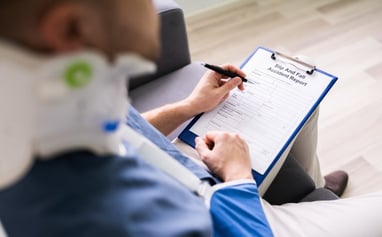
Favorable Decision Secured in a Wage-Loss Workers’ Compensation Matter
Summary Judgment Won in a Premises Liability Action
We obtained summary judgment on behalf of two homeowners in a premises liability action. One of the homeowners called his father, the plaintiff, asking him to come to his house because he was having his roof replaced and had concerns about the work being done. The plaintiff arrived at the home and observed nails and other debris strewn about the entire property. Nonetheless, he entered the property to assess the roofing work and took care to avoid stepping on any nails. As he was leaving the property, he stepped on a nail, which went through his foot. The plaintiff asserted claims of negligence against both homeowners and also attempted to assert that, because his son requested that he come to inspect the roofing work, he was a business invitee rather than a licensee. We argued that the plaintiff was a licensee as he was a social guest who was merely providing advice to his son. They further argued that the homeowners owed no duty to the plaintiff as he knew the nails were strewn about the property and he understood the risk involved in walking there. We also argued that the plaintiff’s claim was barred by assumption of risk because as he was aware of the nails on the property and, nonetheless, voluntarily proceeded to walk onto the property. The court agreed and granted summary judgment in favor of the homeowners.
News
106 Marshall Dennehey Attorneys Recognized in the 2027 Editions of The Best Lawyers in America® and the Best Lawyers: Ones to Watch® in America
August 20, 2026
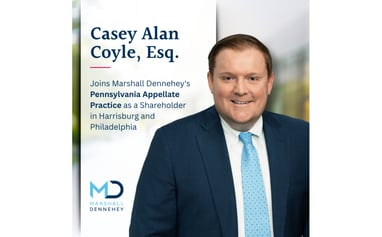
Marshall Dennehey Expands Leading Pennsylvania Appellate Practice With Addition of Shareholder Casey Coyle
June 29, 2026
Marshall Dennehey Again Earns Recognition in Distinguished Chambers USA
June 4, 2026