.

Case Law Alerts

Texas Supreme Court to Determine if a Shipper Owes a Duty to a Third-Party Motorist Injured by a Freight Carrier

In re Home Depot U.S.A., Inc., ___ S.W.3d ___, 2025 WL 899848 (Tex. App. Houston [14th Dist.] 2025), argument granted on pet. for writ of mandamus (Feb. 6, 2026) [25-0317]

April 1, 2026

by Charles L. Sutter

This case arises from an accident in which a driver hired by a freight carrier ran a red light and fatally struck a motorcyclist. The decedent’s parents sued both the freight carrier and the shipper, Home Depot, alleging negligence, negligence per se, and gross negligence. The carrier accepted vicarious liability given the driver was acting within the scope of his employment. Home Depot moved to dismiss the plaintiffs’ claims as baseless, given they did not owe a duty to a third-party motorist for the actions of a freight carrier’s drivers. The Texas trial court denied the motion, and the court of appeals denied Home Depot’s mandamus petition.

However, the Texas Supreme Court granted Home Depot’s petition for a writ of mandamus. Home Depot again argued that it did not have a duty to a third-party motorist in the event of negligent actions by the freight carrier’s driver. Home Depot further argued that Texas does not recognize negligent hiring as a valid cause of action for an independent contractor, claiming the plaintiffs failed to adequately allege that Home Depot’s hiring of the freight carrier proximately caused the accident. Home Depot argued that the court should adopt and apply a rule that would absolve an employer of liability for a derivative claim if the employer accepts vicarious liability.

The Texas Supreme Court held oral arguments on March 4, 2026, and has yet to issue a decision.

Firm Highlights

Thought Leadership

What’s Hot in Workers’ Comp - News and Results*

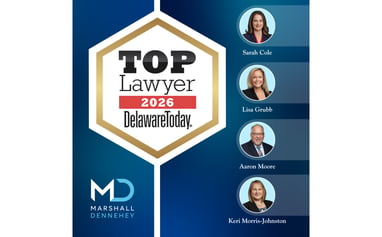
RESULTS* Anthony Natale III (King of Prussia) obtained a defense verdict in a workers’ compensation matter where the court granted the employer’s Termination Petition. The claimant sustained a work-related low back injury but later suffered a fractured femur in a non-work-related accident at home after being released to return to work. The defense initially pursued a Suspension Petition based on the claimant’s refusal to return to work for reasons unrelated to the accepted injury, and subsequently filed a Termination Petition supported by medical evidence establishing a full recovery from the low back condition. Anthony Natale III (King of Prussia) obtained a defense verdict in a workers’ compensation matter where the court denied and dismissed the claimant’s Reinstatement Petition. The claimant sustained a judicially recognized injury in the form of L5-S1 discogenic pain and later alleged that she became totally disabled following spinal surgery. The defense successfully demonstrated that the surgery involved the L4-5 disc, not the accepted work injury, and challenged the credibility of the claimant’s medical evidence during cross-examination of her surgeon. The defense further established that the claimant had previously left work for reasons unrelated to her accepted injury. Anthony Natale III (King of Prussia) obtained a defense verdict in a workers’ compensation matter where the court granted the employer’s Termination Petition and denied and dismissed the claimant’s Review Petition. The claimant sustained an Achilles tendon injury during the course of her employment and sought to expand the accepted injury to include an Achilles tendon rupture and/or tendinosis. The defense presented medical evidence establishing a full recovery, while cross-examination of the claimant’s medical expert revealed that his treatment notes consistently documented normal gait, strength, and reflexes and that he had failed to review the claimant’s most recent MRI, which showed normal findings. Although the expert attempted to explain the discrepancies by claiming his reports were erroneous, the court rejected that testimony, found the defense evidence more credible. Anthony Natale III (King of Prussia) obtained a defense verdict in a workers’ compensation matter where the court granted the employer’s Suspension Petition and suspended both indemnity and medical benefits. The claimant sustained a work-related lower leg fracture after stepping into a hole and being struck by a gravestone. Although the claimant was released to return to work, he repeatedly failed to attend a court-ordered independent medical evaluation. On behalf of the employer, the defense argued that the claimant’s refusal to cooperate with the evaluation warranted suspension of all benefits. Relying on rare but controlling precedent permitting the suspension of medical benefits under such circumstances, the court granted the suspension petition and suspended both indemnity and medical benefits. *Prior Results Do Not Guarantee a Similar Outcome NEWS Keri L. Morris-Johnston has been selected as a 2026 “Top Lawyer” by Delaware Today magazine. Each year, the publication invites all practicing attorneys in the Delaware Bar to participate in a peer nomination process to select Top Lawyers in numerous practice areas across the state. Keri was recognized in the area of Workers’ Compensation Employer Defense. Congratulations to our 2027 Pennsylvania Super Lawyers in Workers' Compensation! We are proud to recognize Perry D. Merlo, Anthony Natale III, Michele R. Punturi, and A. Judd Woytek for earning this distinguished honor. Their dedication to delivering exceptional client service, deep industry knowledge, and commitment to excellence in workers' compensation law continue to set them apart. Congratulations on this well-deserved recognition! Congratulations to Linda Wagner Farrell on being named among the Florida Trend Legal Elite Notable Women Leaders in Law for 2026. This distinguished recognition honors accomplished attorneys who have demonstrated exceptional professional achievement, strong leadership, and a lasting impact on the legal profession and their communities. We are proud to celebrate Linda on this well-deserved honor and their continued contributions to the firm and the legal industry.

Thought Leadership

Pennsylvania HB 2307: Special Education Contingency Fund Reform

Pennsylvania school districts and school law attorneys are aware of the increasing cost of special education services. In an effort to address this growing squeeze on school district budgets, a bi-partisan group of Pennsylvania House Representatives introduced House Bill 2307. The bill is a special education funding measure intended to reform Pennsylvania's reimbursement system for extraordinarily high-cost special education students. As written, HB 2307 would increase funding dedicated to Pennsylvania's Extraordinary Special Education Program Expenses reimbursement program. Beginning with the 2026-27 school year, the bill would increase the set-aside from 1% to 2% of the annual Special Education appropriation. The increased funding is aimed at assisting school districts and charter schools address the costs of serving students whose needs generate exceptionally high special education expenses. The proposal specifically targets situations involving students whose annual special education costs exceed the state's highest cost threshold and represent a significant burden on a district's special education budget. HB 2307 includes key eligibility requirements such as: 1) extraordinary special education expenses approved by the Secretary of Education; 2) student costs exceeding the state's highest Category 3A threshold; 3) costs representing at least 1% of the district's total special education expenditures; 4) student enrolled in the district for no more than two consecutive school years for the proposed reimbursement category; and 5) application and documentation requirements for districts and charter schools. HB 2307 successfully passed the Pennsylvania House of Representatives on June 16, 2026, by a unanimous vote of 202-0. It was subsequently transmitted to the Senate and was referred to the Senate Education Committee on June 22, 2026, where it currently remains pending. While there is currently no scheduled Senate committee or floor vote publicly listed for HB 2307, the next step would be for the Senate Education Committee to consider the bill and determine whether to report it to the full Senate for consideration. If approved by the committee, the bill would proceed through the Senate's three-consideration process before a final vote. Because the General Assembly is still within the 2025-26 legislative session, the bill remains eligible for action during the remainder of the session. However, absent committee action, it will not become law before the start of the 2026-27 school year. If enacted, HB 2307 could have several important effects: Greater financial stability for districts serving students with exceptionally expensive educational and related-service needs. Increased reimbursement opportunities for high-cost placements, specialized transportation, intensive behavioral supports, and other extraordinary services. Reduced pressure on local special education budgets, particularly in smaller districts where one or two high-cost students can significantly affect annual expenditures. Potential reduction in litigation and placement disputes driven by financial constraints, although the bill does not alter substantive IDEA rights or district obligations to provide FAPE.