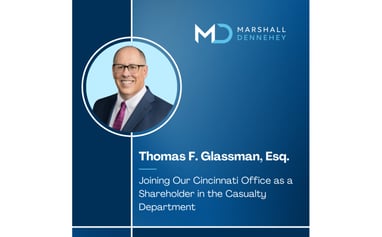
.

Jeremy J. Zacharias RPLU

Portrait of Jeremy  J.  Zacharias

Jeremy is a member of the Professional Liability Department where he represents and defends attorneys, accountants, insurance producers, corporate directors and officers, and financial institutions, among other clients.

Jeremy handles various cases involving insurance agents and brokers liability. In connection with the same, Jeremy defends clients facing allegations of professional negligence, breach of fiduciary duty and breach of contract and routinely works with clients in an advisory capacity regarding best practices in consulting with insureds. In connection with handling insurance agents and brokers liability claims, Jeremy frequently publishes materials with the Professional Liability Underwriting Society (PLUS) through the PLUS Blog and offers various risk management tips through the PLUS podcast series.

Jeremy also represents clients in privacy and data breach matters and handles cases involving intellectual property, copyright and trademark infringement, as well as trade secret, trade dress technology and media-related litigation.

He is an active member of PLUS where he currently serves on the Board of Trustees. He is an alumnus of its Leadership and Mentoring Program (LAMP). Through PLUS, Jeremy achieved his Registered Professional Liability Underwriting (RPLU) Certification. He also serves on the PLUS Mid Atlantic Chapter Committee.

Jeremy graduated magna cum laude from Drexel University's LeBow College of Business. He earned his juris doctor from Rutgers University School of Law, graduating cum laude and in the top 15 percent of his class.

He is an active member of the New Jersey State, Camden County, and Burlington County Bar Associations. He is a frequent guest speaker at his alma mater, Rutgers University School of Law and at Drexel University’s LeBow College of Business, on topics including professionalism and career development. He is also active in the Knights of Columbus organization in his community. 

Jeremy is admitted to the bars of the states of New Jersey and Pennsylvania and is admitted to practice in federal court in both the District of New Jersey and the Eastern District of Pennsylvania.

    • Rutgers Law School (J.D., cum laude, 2014)
    • Drexel University (B.S., magna cum laude, 2011)
    • New Jersey, 2014
    • Pennsylvania, 2014
    • U.S. District Court District of New Jersey, 2014
    • U.S. District Court Eastern District of Pennsylvania, 2023
    • The Best Lawyers: Ones to Watch®, Commercial Litigation (2021-2025)
      The Best Lawyers list is issued by Woodward & White. A description of the selection methodology can be found here. No aspect of this advertisement has been approved by the Supreme Court of New Jersey.
    • New Jersey Super Lawyer Rising Stars (2024)
      The Super Lawyers list is issued by Thomson Reuters. A description of the selection methodology can be found here. No aspect of this advertisement has been approved by the Supreme Court of New Jersey.
    • PLUS Emerging Leader Award, from the Professional Liability Underwriting Society (2021)
    • Burlington County Bar Association
    • Camden County Bar Association
    • New Jersey State Bar Association
    • Professional Liability Underwriting Society
    • PLUS Podcast: Insurance Agent E&O - Top Ten Tips for Risk Management SeriesEpisode 3, October 13, 2025
    • PLUS Podcast: Insurance Agent E&O - Top Ten Tips for Risk Management Series, Episode 2, August 7, 2025
    • Solving Problems in Commercial Real Estate Transactions - 21st Century Ethical Issues in Commercial Real Estate Transactions, NJICLE Seminar, July 17, 2025
    • PLUS Podcast: Insurance Agent E&O - Top Ten Tips for Risk Management SeriesEpisode 1, June 9, 2025
    • From Interview to Offer: Navigating Clerkships, Networking & Career Success - Panelist, Rutgers Law School Minority Student Program, February 12, 2025
    • Solving Problems in Commercial Real Estate Transactions - 21st Century Ethical Issues in Commercial Real Estate Transactions, NJICLE Seminar, July 18, 2024
    • The Defense of Appellate Counsel in Legal Malpractice Actions, Client Webinar, June 4, 2024
    • Commercial Real Estate Transactions: From Handshake to Closing - Ethical Considerations with Commercial Real Estate Transactions, NJICLE Seminar, September 8, 2023
    • Strategic Approaches to Handling Lost Profit Claims Under New Jersey's New Business Rule, Client Webinar, September 7, 2023
    • Virtual Jury Trials in New Jersey: The Good, The Bad and The Ugly, Client Webinar, March 25, 2022
    • Jeremy represented an indigent defendant facing prison time for violating a final restraining order for contacting his ex-girlfriend in Gloucester County, New Jersey. Jeremy was able to obtain a dismissal of this case since his client had no prior violations and was able to maintain steady employment. 

Results

Thought Leadership

New Jersey Appellate Division Clarifies Limits of Transactional Attorneys’ Duties and Proof of Damages in Legal Malpractice Claims

April 21, 2026

On April 15, 2026, the New Jersey Appellate Division issued an important decision in Gonzalez v. DiBello, et al., A‑2334‑24 (App. Div. Apr. 15, 2026), affirming summary judgment in favor of a transactional attorney accused of legal malpractice and breach of fiduciary duty. Marshall Dennehey’s Jack Slimm and Jeremy Zacharias successfully represented the attorney‑defendant. The decision provides significant guidance to both the malpractice defense bar and transactional practitioners, particularly regarding the scope of an attorney’s duty of care, the role of expert testimony, and the proof required to establish causation and damages. The malpractice action stemmed from an underlying federal lawsuit arising out of a failed transaction to purchase a Kia dealership. An investor alleged that the purchasers and their counsel engaged in a fraudulent scheme, asserting claims including fraud, breach of contract, breach of fiduciary duty, aiding and abetting, and conspiracy. Although the federal complaint named the transactional attorney, the claims against her were dismissed, and she was never found liable. The attorney neither represented the investor nor provided him with legal advice and was unaware that he was the ultimate source of investment funds. Her role was limited to preparing transaction documents required by the manufacturer to reflect a transfer of ownership interests. Following dismissal of the federal action, purchaser Christopher Gonzalez filed a legal malpractice and breach of fiduciary duty action against the attorney. Gonzalez relied on expert reports asserting that the attorney had a duty to investigate the source of funds, determine whether her client was financially capable of consummating the transaction, and uncover any disqualifying relationships among investors. The trial court rejected those opinions, holding that New Jersey law does not impose upon transactional attorneys a duty to investigate the origins of funds passing through a trust account or to assess a client’s financial capacity absent specific circumstances. The Appellate Division affirmed, reiterating that an attorney’s duty in a transaction is “to exercise that degree of reasonable knowledge and skill that lawyers of ordinary ability and skill possess and exercise,” and that alleged violations of the Rules of Professional Conduct do not, standing alone, create a cause of action. The Appellate Division also affirmed dismissal based on the plaintiff’s failure to establish damages and causation through competent expert testimony. Gonzalez sought, among other things, to recover all legal fees incurred defending the federal action and alleged loss of investment. However, his expert offered what the courts deemed a classic “net opinion,” failing to analyze the reasonableness of the fees, allocate which fees were allegedly caused by the claimed malpractice, or quantify any lost benefit of the bargain. The court emphasized that when damages are an essential element of a legal malpractice claim, expert testimony must do more than assert conclusions—it must explain how and why specific damages were proximately caused by the attorney’s conduct. Absent such an analysis, allowing a jury to award all defense fees would impermissibly convert compensatory damages into speculative or liquidated damages. Finally, the Appellate Division rejected Gonzalez’s attempt to salvage his claims through a “suit‑within‑a‑suit” theory or a parallel breach of fiduciary duty claim. Citing Morris Properties, Inc. v. Wheeler, the court reaffirmed that plaintiffs cannot avoid their prima facie proof requirements by invoking trial methodologies, and that expert testimony remains necessary in esoteric malpractice cases. The court further held that Gonzalez could not show he would have recovered in the underlying federal action, particularly where he and the attorney were dismissed from that case. The fiduciary duty claim was properly dismissed as duplicative of the malpractice claim and failed for the same lack of proof on causation and damages. This decision is a significant reaffirmation of rigorous proof standards in transactional malpractice cases and provides meaningful protection against expansive and speculative damages theories.

Legal Updates for Lawyers' Professional Liability

New Jersey Defines When Attorneys Owe Duties to Non-Client

March 1, 2026

Christakos v. Boyadjis, 262 N.J. 447 (2026) When does an attorney owe a non-client a duty of care? And when can that non-client bring forth an action for legal malpractice? Christakos v. Boyadjis, 262 N.J. 447 (2026), undertakes these questions and considers the appropriate standard. In the present matter, the plaintiffs brought suit against the attorney that prepared the wills of their two family members, alleging legal malpractice. The two plaintiffs were the sister-in-law and niece to the decedents. The decedents were brothers and, in 2003, they executed mirror image wills, along with completing powers of attorney (POA) documents in 2001. As a result of these documents, the plaintiffs stood to inherit part of the estate, and one plaintiff was attorney-in-fact under the POA. However, the plaintiffs had no knowledge of this or the testamentary documents. In 2017, the brothers sought to make changes to their wills, expressing a strong desire to disinherit their nephew and nieces, wanting to leave their estate to their church and local community members that were supporting them in their advanced age. In 2018, their health began to decline, and the attorney made the final changes to their wills. The will for the first brother was completed in January 2018, leaving everything to the surviving brother, and the alternative residuary was to be split equally between two neighbors, their church, and then their sister-in-law, which is one of the plaintiffs. The other brother was not competent to execute the will and continued to have cognitive decline. This brother executed his will on April 7, 2018, after a home health aide determined that he was in a lucid state and had testamentary capacity. A few days letter, that brother was confirmed to be incompetent and needed a legal guardian appointed. Both brothers died in 2018, and the niece filed two caveats, challenging both wills among other probate actions. In 2020, the plaintiffs sued the attorney for legal malpractice, breach of fiduciary duty, and other claims, arguing that the attorney owed them a duty of care because they were beneficiaries to the brothers' estate. After years of motion practice and appeals, the Supreme Court of New Jersey expressly adopted the provisions of Section 51 of the Restatement (Third) of the Law Governing Lawyers to determine when a lawyer owes a duty of care to a non-client. In doing so, the court determined that the standard hinges upon reliance and clear, convincing evidence of intention.

Firm Highlights

Thought Leadership

Appeals Court Reverses Trial Court Order Striking Complaint as Sanction for Violating Discovery Order

All Dry USA v. Savell, 2026 WL 816093 (Fla. 1st DCA 2026) The First District Court of Appeal reversed the trial court’s order denying All Dry USA’s complaint as a sanction for violating a discovery order. The appellate court found that All Dry USA’s failure to comply with the trial court’s case management order did not give the trial court the authority to strike All Dry USA’s pleadings. All Dry USA provided water mitigation, mold remediation, and a restorative tarp at the property owned by the Savells. The property had been damaged by Hurricane Sally. All Dry USA provided invoices for the three services it performed in the amount of $90,130.61. The Savells refused to pay the invoices, stating that while they had retained All Dry USA, there was no agreement reached regarding the cost of the services. All Dry USA proceeded to file a lawsuit against the Savells, alleging breach of contract and unjust enrichment. The Savells answered the lawsuit and served discovery upon All Dry USA. All Dry USA failed to respond to the discovery requests and the Savells moved for an order compelling discovery. The trial court issued an order compelling All Dry USA to respond to Savells discovery requests and comply with all outstanding discovery deadlines per the case management order. On the day its responses were due, All Dry USA filed a motion to extend the deadline to comply with the court’s order. Before the motion was ruled upon, the Savells filed a motion to have All Dry USA’s complaint stricken for violating the trial court’s order compelling All Dry USA’s responses. The trial court granted the motion to strike, and then granted the Savell’s request for entry of default final judgment, based upon there no longer being an operative complaint. The First District Court of Appeal reversed, ruling that an order striking pleadings is justified if it is found that a party has violated numerous discovery orders, or has shown a “deliberate and contumacious disregard of the court's authority.” Mercer v. Raine, 443 So. 2d 944, 946 (Fla. 1983). The appellate court stated that a trial court’s authority to strike pleadings is not unbridled and that the situation before the court did not justify the striking of All Dry USA’s pleadings. In reaching its decision, the First District focused on the fact that the trial court only addressed the potential prejudice to Savell by All Dry USA failing to respond to discovery and seeking an extension of the deadline. The appellate court stated that prejudice is not the only factor to be considered and that the trial court needed to address if All Dry USA’s behavior in failing to comply with the discovery order was willful and deliberate.  The First District also stated that nothing in rule 1.200 or 1.380 grants a trial court the authority to strike a pleading because certain case management deadlines are not met. The appellate court held that the Florida Rules of Civil Procedure allow trial courts to bring the parties in, order them to comply with the case management discovery deadlines, and then strike pleadings if the subsequent discovery orders are disobeyed. This ruling shows the importance of understanding the authority that is binding on the trial court a party is appearing in front of. The First District’s view on a trial court’s ability to strike pleadings is in contrast with other appellate court’s throughout Florida.

News

Marshall Dennehey’s John J. Hare Brings Home Attorney of the Year Honors; Firm Named Litigation Department of the Year in Two Categories

Marshall Dennehey took home top honors in three categories at the The Legal Intelligencer’s 2026 Pennsylvania Legal Awards, held June 11 in Philadelphia. The first place awards include: Attorney of the Year: John J. Hare, Chair of the firm’s Appellate Advocacy & Post-Trial Practice Group and Executive Committee member, together with Charles “Chip” Becker of Kline & Specter Litigation Department of the Year, Appellate – Third Win in a Row! Litigation Department of the Year, Product Liability/Mass Torts “There is no one more deserving of Attorney of the Year honors than John. This award is a testament to his exceptional skill, dedication, and leadership—qualities that truly exemplify the very best of our firm,” said G. Mark Thompson, Marshall Dennehey’s President & CEO. “These honors also reflect the strength and depth of our product liability, mass torts, and appellate practices across Pennsylvania and beyond, underscoring our ongoing commitment to delivering outstanding results for our clients.” Attorney of the Year – John J. Hare, Marshall Dennehey, together with Charles “Chip” Becker, Kline & Specter Over the past year, John and Charles were opposing counsel in many of the highest-profile civil appeals in Pennsylvania. John is renowned as a preeminent appellate lawyer on the defense side, and Chip on the plaintiff's side. They have opposed each other repeatedly, exhibiting peerless professionalism and exceptional civility, while zealously litigating under the unremitting pressure of high-profile litigation and record-setting verdicts totaling more than $3.5 billion. They have also collaborated, outside of litigation, on many commissions, committees, and projects of importance to the Pennsylvania judiciary and legal community. Litigation Department of the Year – Appellate Law, Winner (previous winner, 2025 and 2024) 2025 was another standout year for the firm’s Appellate Advocacy & Post‑Trial Practice Group, led by John J. Hare, which was retained to challenge many of Pennsylvania’s “nuclear” verdicts—awards exceeding $10 million. Notably, the department persuaded the Pennsylvania Superior Court to reverse a Philadelphia judgment of $1.09 billion, the largest judgment ever overturned by a Pennsylvania appellate court. The group’s 11 full‑time Pennsylvania‑based appellate lawyers are at the center of Pennsylvania’s most high-profile matters, bringing more than 150 years of combined appellate experience. They routinely handle post‑trial and appellate matters and are frequently engaged to participate in and monitor trials in high‑exposure cases to ensure that critical legal issues are properly raised and preserved for appeal. Litigation Department of the Year – Product Liability/Mass Torts, Winner This marks the first win for the firm’s Pennsylvania Product Liability and Mass Torts practices, which operate within our Casualty Department, managed by Matthew Schorr and Jeff Rapattoni. For almost five decades, Fortune 500 product manufacturers/distributors and their insurers have turned to these groups to defend their litigation. Led by Bradley D. Remick and Vlada Tasich, our Product Liability group’s success can be attributed to its commitment to keeping abreast of ever-changing legal theories, judicial viewpoints, and evolving technology impacting the product liability landscape. Our attorneys have successfully handled thousands of product liability matters in all jurisdictions across the state. Likewise, our mass tort litigation practice – divided into Asbestos & Mass Tort, and Environmental & Toxic Tort Litigation –  has defended manufacturers, distributors, contractors, and premises owners in thousands of personal injury and other claims. Led by Kevin E. Hexstall and Patrick T. Reilly, most attorneys in these groups have more than 20 years of experience, and our seasoned trial team has tried hundreds of cases to verdict, consistently achieving strong results through both trials and settlements. In addition to these awards, Marshall Dennehey was a Litigation Department of the Year finalist for Professional Liability.

Thought Leadership

Unanimous New Jersey Supreme Court Holds That Personal Emails of Public Employees and Officials are Subject to OPRA

In Rosetti v. Ramapo-Indian Hills Regional High School Board of Education, the New Jersey Supreme Court unanimously held that government-related emails, which are contained within personal email accounts, are government records under the Open Public Records Act (OPRA), and a log of those emails must be produced when requested. In reaching this decision, the court conducted an analysis of the OPRA and cited previous cases that held that emails do in fact fall within OPRA’s definition of a record and must be produced when requested pursuant to the Act. The court in Rosetti then had to answer the question as to whether public officials’ personal email accounts that are used for government purposes are subject to OPRA, and found that they are. In this case, Rosetti made an OPRA request to the Board of Education seeking email logs from Board members’ personal email accounts. The Board refused to produce the logs and indicated that it was not under any obligation to produce personal email account logs, only from government-related email accounts. The issue was whether a log had to be produced for Board members’ personal email accounts, which they used to conduct Board business. The Board argued that while it was possible to create a log for government-related email accounts through its IT Department, it was not possible to do so for personal email accounts. The court rejected this argument and ruled that Board members are required to search their personal email accounts and create a log of government-related emails housed in those accounts. Once completed, each Board member then must submit a certification detailing the searches that were conducted. The court went one step further with a suggestion to government employees and officials, stating, “[g]overnment agencies should strongly advise their employees, elected officials, and others engaged in government-related business to refrain from using their personal email accounts when conducting government-related business.”  Please do not hesitate to contact me with any questions regarding this case and others pertaining to the OPRA. 

Thought Leadership

Perlmutter Provides Predictability for Punitive Damages Claims in Florida

In a much anticipated decision, the Florida Supreme Court provided clarity for the standards of proof for punitive damages claims in Perlmutter v. Federal Insurance Company, SC2024-0058 (Fla. June 11, 2026). Litigants and trial judges must be mindful of the standards laid out by the Court. And, defense practitioners must be prepared to alter their strategies to defend against such claims. Perlmutter came to the Court from the Fourth District, based on conflict jurisdiction with decisions from the Second and Fifth District and on certification of a question of great public importance as to the standard of proof for punitive damages claims at the pleading stage. Fed. Ins. Co. v. Perlmutter, 376 So. 3d 24, 29 (Fla. 4th DCA 2023). In the underlying case, the Fourth District made two conclusions. First, it held that a “trial court must consider the evidentiary showing by all parties at the hearing on the motion to amend, that is, evidence ‘in the record’ and evidence ‘proffered by the claimant.’”  376 So. 3d at 33. Second, the Fourth held that it “interpreted section 768.72(1) and (2) to require the trial court to make a preliminary determination of whether a reasonable jury, viewing the totality of proffered evidence in the light most favorable to the movant, could find by clear and convincing evidence that punitive damages are warranted.  Id. at 34 (underscoring in the original). In making these conclusions, the court cautioned trial courts that the “preliminary determination” analysis did not entitle the trial court to decide whether the evidence is clear and convincing and noted that the trial court should not weigh evidence and should not determine witness credibility. Id. The Florida Supreme Court accepted jurisdiction and answered the certified question in the negative. It quashed the decision below and remanded the case for application of the following standards: The trial court should consider only the evidence identified or proffered by the claimant; it should not entertain an evidentiary counter-submission from the opponent. The trial court should consider whether a reasonable person could conclude based on the claimant’s evidence, that the defendant committed “intentional misconduct” or “gross negligence” as defined in section 768.72(2) or section 768.72(3). The trial court must review the request for punitive damages in the context of the underlying claims. The trial court should not apply the clear and convincing standard of proof in reviewing the sufficiency of the evidence at the pleading stage. The trial court does not act as a fact-finder; the trial court must not weigh the claimant’s evidence—it cannot decide the truth of the matter. The trial court must consider the record evidence and the proffered evidence in the light most favorable to the plaintiff, but the allegations in the proposed amended complaint are not themselves evidence. Perlmutter, SC2024-0058 at 13-15 (emphasis added). In explaining these standards, the Court interpreted the text of the statute and compared it to a related statute which governs punitive damages in the nursing home context. The nursing home statute expressly calls for evidentiary submissions by “the parties” and expressly tells the trial court to determine whether there is a reasonable basis to believe the claimant could satisfy the “clear and convincing evidence” standard at trial. Id. at 17-18 (comparing the text of section 768.72(1), Florida Statutes, with section 400.0237, Florida Statutes). Without that express language in section 768.72, the statute could not be applied in the same manner. With these standards specially delineated for the trial courts, the Court is “confident that its interpretation of section 768.72(1) will not frustrate the effectiveness of the statute in accomplishing the Legislature’s textually evident purposes.” Id.  at 22 (cleaned up). This remains to be seen. While Perlmutter provides predictability and clarity for trial courts when reviewing the evidentiary submissions in support of a punitive damages claim, the decision will not likely impact the numbers of punitive damages motions filed. Rather, these new parameters will change the way claims are defended, reminiscent of a time when rulings on punitive damages were only subject to certiorari review and appellate courts were limited in reviewing procedural errors. This decision will likely deflate the level-playing field that Florida Rule of Appellate Procedure 9.130(a)(3)(G) addressed by allowing appeals of orders granting and denying punitive damages amendments. Further, Perlmutter may have impliedly created a call to action for the Legislature to amend section 768.72(1) in the same manner it amended section 400.0237 to allow the courts to analyze “admissible evidence submitted by the parties” and determine at a hearing whether there is a reasonable basis to believe the claimant at trial would be able to demonstrate by “clear and convincing evidence” that the recovery of punitive damages is warranted. Until then, defendants must adjust their strategies. To adapt to these new standards, defense practitioners will need to tailor their strategy for defending punitive damages claims since they can no longer submit a counter-proffer or urge a court to apply the clear and convincing standard at the pleading phase. Instead, defendants will need to attack the deficiencies in the claimant’s pleadings and proffer. If the trial court fails to serve as a gatekeeper, and does not apply the above standards, then defendants can pursue an interlocutory appeal under Rule 9.130(a)(3)(G). If a nonfinal appeal is taken, then defendants should move to stay any intrusive financial discovery while the appellate court analyzes the issues on appeal. Finally, defendants should utilize Florida Rule of Civil Procedure 1.510 to serve as a screening device to allow the trial court to analyze all evidence and prevent nonmeritorious punitive damages claims from proceeding to a jury.

Result

No-Cause Jury Verdict Secured in Wrongful Death Trial

We successfully obtained a no-cause jury verdict in a 13-day wrongful death trial. The decedent, a 59-year-old man, was admitted to the emergency room on February 15, 2019, with complaints of abdominal pain, decreased appetite, and constipation, despite the use of laxatives. The patient did not complain of any nausea, vomiting, or diarrhea. He had a significant medical history including diabetes, hypertension, prior coronary artery stenting, morbid obesity (with past gastric bypass surgery), longstanding ventral hernia, and back pain. A CT scan revealed multiple hernias and a potential closed-loop bowel obstruction, leading to a surgery consultation. Our client, an emergency general surgeon, interpreted that the patient did not have a closed loop or any significant obstruction and recommended non-surgical management. The patient was approved to have clear liquids, and had a vomiting incident shortly after, but our client was not notified. The patient was returned to NPO status, and after improving overnight, he was returned to “clears” and additional medical and renal consults were ordered. Our client did not receive any communications from the residents/nurses of any changes in the patient’s condition. On February 18, 2019, two rapid responses were called due to increased heart rate and vomiting. It is believed that the vomiting resulted in aspiration, causing sepsis, ultimately leading to the patient’s death. During the trial, the plaintiff’s sole medical expert highlighted imaging on the wrong hernia, which called into question all of his opinions in the case. We made key objections related to the expert testimony, limiting what the allegations were, and preventing new allegations from being made. After approximately two and a half hours of deliberating, the jury returned a no-cause verdict.