Mount Laurel
Our firm established its first office in New Jersey in 1984. Since that time, the office has experienced consistent growth. The Mount Laurel office is staffed by many long-time residents of New Jersey who handle professional liability, product liability, property and casualty and workers' compensation litigation. The counties covered by this office include Mercer, Monmouth, Ocean, Burlington, Camden, Middlesex, Gloucester, Atlantic, Salem, Cumberland and Cape May.
The Mount Laurel office provides our clients with a dedicated defense litigation team of professionals backed by the intellectual property and broad-based experience of the entire firm, permitting localized and economical representation of insurers and self-insured clients.
Thought Leadership
The Quarterly Dose
Medical Malpractice and AI: How the Federal Court’s Holding in United States v. Heppner Impacts HealthCare Litigation
August 26, 2026
For more than a century, civil law in the United States has protected the communications of litigants under a number of protections, including attorney client privilege and the work-product doctrine. That longstanding framework began to shift on February 17, 2026, when Judge Rakoff of the United States District Court for the Southern District of New York took the first step toward modernizing privacy and confidentiality rules to address the ever looming issue of generative AI. In the landmark case of United States of America v. Bradley Heppner, 820 F. Supp. 3d 292 (2026), Judge Rakoff held that the documents a criminal defendant generated using Claude, a publicly available generative AI platform operated by Anthropic, were not privileged or protected as work product. The facts of Heppner include an indictment for a variety of alleged frauds and falsification of corporate records, which arose out of his alleged misconduct as an executive of multiple corporate entities. In conjunction with Mr. Heppner’s arrest, the FBI executed a search warrant of his home and seized numerous documents, including 31 documents which memorialized his communications with Claude. These documents covered particularly pertinent topics, such as defense strategies, possible arguments to specific facts or law he anticipated to be included in the indictment, and were prepared without any suggestion from his counsel to do so. By and through his counsel, Mr. Heppner asserted privilege over the documents generated by Claude. He argued (1) that the documents included information he had learned from his attorney; (2) were created for the purpose of speaking with counsel to obtain legal advice; and (3) had all been shared with counsel after they were created. Following oral argument on the government’s motion seeking a determination that the AI-generated documents were neither protected nor privileged, the court granted the motion on February 10, 2026. In issuing his opinion, Judge Rakoff determined that the AI documents lacked two, “if not all three,” of the elements required for attorney-client privilege—namely that the communications were not “between a client and his or her attorney,” the documents were not “intended to be” or were “in fact” kept confidential, and the AI documents were not prepared by Mr. Heppner “for the purpose of obtaining legal advice.” Put simply, Judge Rakoff noted that, “Because Claude is not an attorney, that alone disposes of Heppner’s claim of privilege.” Ultimately, Judge Rakoff concluded that, as the generated documents were not prepared at the request of Mr. Heppner’s counsel and did not disclose his attorney’s strategies, they failed to merit protections as work-product and were thus discoverable by the government. The ramifications of Heppner will likely cause many changes in litigation practices as a direct result of the increased use of generative AI. Indeed, use of generative AI has exploded as of late. Recent data from Sciencedirect.com shows that the top 40 generative AI tools received nearly 3 billion monthly visits worldwide in March 2024 alone. Even Judge Rakoff noted the ever-growing prevalence of AI use, stating that “more than half of United States households have adopted AI in some form.” While Heppner involved a criminal case, the holding will similarly be applicable to civil matters. It is incumbent on health care litigators to thoughtfully engage in discovery to determine whether plaintiffs consulted a generative AI platform in relation to their case. In practical use, this could be completed by questioning plaintiffs at deposition regarding whether they have asked ChatGPT, Claude, or one of the dozens of other generative AI platforms regarding the possible value of their cases, advice on what to say during a deposition, or a number of other queries. Likewise, these questions could be directed to a plaintiff via an Interrogatory or Request for Admissions. Regardless the avenue of questioning, it is paramount for attorneys to test the boundaries of courts across the country which are only now braving the new world intersections of AI, privacy, and privilege.
What's Hot in Workers' Comp
New Jersey Workers’ Compensation Legislation Updates
August 13, 2026
Since June 1, 2026, there have been no new New Jersey workers’ compensation related cases from the Appellate or Supreme Courts. As such, below will highlight any new legislative updates since February. A1023 | S3984 - Medical Use of Cannabis Under Certain Circumstances This requires workers’ compensation, PIP, and health insurance coverage for the medical use of cannabis under certain circumstances. It was introduced on January 13, 2026 and referred to the Assembly Financial Institutions and Insurance Committee. It was also introduced on March 19, 2026 and referred to the Senate Commerce Committee. A1045 - Certain Injuries to Volunteer and Professional Public Safety and Law Enforcement Personnel This revises workers’ compensation coverage for certain injuries to volunteer and professional public safety and law enforcement personnel. It was introduced on January 13, 2026 and referred to the Assembly Labor Committee. A1384 | S2757 - Reduce Statute of Limitations in Medical Fee Disputes This reduces statute of limitations from six years to two years in medical fee disputes in workers’ compensation matters. It was introduced on January 13, 2026 and referred to the Senate Labor Committee. It was also introduced on the same day and referred to the Assembly Labor Committee. A1870 | S1379 - Workers' Compensation Benefits For Certain Workers Due to September 11, 2001 Terrorist Attacks This provides workers’ compensation benefits for certain public safety workers who developed illness or injury as result of responding to September 11, 2001 terrorist attacks. It was introduced on January 13, 2026 and referred to the Assembly Labor Committee. It was also introduced on the same day and referred to the Senate Labor Committee. On February 5, 2026, it was reported from the Senate Committee, 2nd Reading, and referred to the Senate Budget and Appropriations Committee. A2779 | S1521 - Excludes Certain Illegal Aliens This excludes certain illegal aliens from workers’ compensation and temporary disability benefits. It was introduced on January 13, 2026 and referred to the Senate Labor Committee. It was also introduced on the same day and referred to the Assembly Labor Committee. A2792 | S1555 - Prevent Intoxicated Employees from Workers’ Compensation This prevents intoxicated employees from receiving workers’ compensation. It was introduced on January 13, 2026 and referred to the Senate Labor Committee. It was also introduced on the same day and referred to the Assembly Labor Committee. A3167 | S2372 - Workers’ Compensation Insurance Requirements for Certain Corporations and Partnerships This concerns workers’ compensation insurance requirements for certain corporations and partnerships. It was introduced on January 13, 2026 and referred to the Senate Labor Committee. It was also introduced on the same day and referred to the Assembly Labor Committee. A3548 | S3571 – Maximum Benefits for Certain Volunteers This provides certain volunteer and other workers with maximum compensation benefit for workers' compensation claim regardless of outside employment. It was introduced on January 13, 2026 and referred to the Senate Labor Committee. On March 2, 2026, it was reported from the Senate Committee, 2nd Reading, and referred to the Senate Budget and Appropriations Committee. It was also introduced on the same day and referred to the Assembly Labor Committee. On May 7, 2026, it was reported and referred to Assembly State and Local Government Committee. A3724 - Personal Liability to Employer Officers for Failure to Pay for Coverage This provides personal liability for owner, executive officer, or executive director of employer for failure to pay for workers' compensation coverage. It was introduced on January 13, 2026 and referred to the Assembly Labor Committee. On May 7, 2026, it was reported and referred to Assembly Judiciary Committee. A4617 - Certain Workers' Compensation Supplemental Benefits and Funding Method This concerns certain workers' compensation supplemental benefits and funding method. For a permanently and totally disabled worker or surviving dependents after December 31, 1979, with some exceptions, this bill provides for an annual cost of living adjustment in the weekly workers’ compensation benefit rate. It was introduced on March 10, 2026 and referred to the Assembly Labor Committee. S241 - Inclusion in Database of Appointed Officials This requires that workers’ compensation judges and administrative law judges be included in database of appointed officials. It was introduced on January 13, 2026 to the Senate, Referred to Senate State Government, Wagering, Tourism & Historic Preservation Committee. S2290 - Mandatory Retirement Age This increases statutory mandatory retirement age for Supreme Court Justices, Superior Court Judges, Tax Court Judges, Administrative Law Judges, and Workers’ Compensation Judges from 70 to 72. It was introduced on January 13, 2026 and referred to the Senate Judiciary Committee. S3144 - Testimony in Workers’ Compensation This concerns submission of testimony in workers’ compensation claims. It was introduced on January 13, 2026 and referred to the Senate Labor Committee. S3342 - Increase Mandatory Retirement Age This increases statutory mandatory retirement age for Supreme Court Justices, Superior Court Judges, Tax Court Judges, Administrative Law Judges, and Workers’ Compensation Judges from 70 to 75. It was introduced on February 5, 2026 and referred to the Senate Judiciary Committee.
Results
News
Marshall Dennehey Announces 2027 New Jersey Super Lawyers And Rising Stars
October 1, 2026

106 Marshall Dennehey Attorneys Recognized in the 2027 Editions of The Best Lawyers in America® and the Best Lawyers: Ones to Watch® in America
August 20, 2026
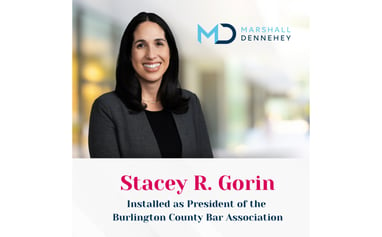
Stacey R. Gorin Installed as President of the Burlington County Bar Association
June 9, 2026