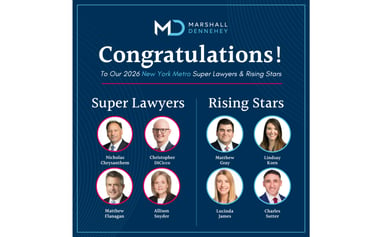
Matt is a highly skilled litigator with over 30 years of trial and appellate experience and serves as Co-Chair of the firm's Disciplinary Board Representation Practice Group. His practice is concentrated on the defense of lawyers against malpractice actions, Judiciary Law 487 claims and grievances. He also defends other professionals and handles general litigation matters on behalf of corporate clients. He has successfully tried cases in New York City and its surrounding counties and has secured dozens of victories in attorney liability cases in New York State’s appellate courts.
With a career-long focus on professional liability litigation, Matt lectures throughout the state on legal malpractice prevention and defense, ethics and professional responsibility. His articles relating to attorney ethics have been cited in the authoritative codification of the laws of New York, as well as New York’s leading treatise on the Rules of Professional Conduct.
Among his numerous professional memberships, he is the past President of the Theodore Roosevelt American Inn of Court and is a member of the New York State Bar Association's Law Practice Management and Insurance Committees. He is a longtime member of the Nassau County Bar Association and served as Chair of the Association’s Ethics Committee from 2019 to 2022. He is also a longtime member of the American Bar Association.
Matt has been recognized annually as a New York Metro Area Super Lawyer for over a decade and is rated AV Preeminent™ by Martindale-Hubbell, the highest peer-review ranking for an attorney's professional and ethical competence. A graduate of St. John's University School of Law and Fordham University, he is admitted to practice before the courts of the State of New York, the United States District Courts for the Southern and Eastern Districts of New York and the United States Court of Appeals for the Second Circuit.
Results
Summary Judgment Secured for Law Firm
We secured summary judgment for a law firm by successfully arguing that its role in implementing and overseeing a client’s anti-money laundering policies did not encompass the accounting functions the accounting firm had agreed to perform, and that there was no evidence the law firm acted negligently. The underlying malpractice claim was brought by a check cashing company against its accountants, alleging that the accounting firm failed to detect thefts committed by one of the company’s employees. The accounting firm, in turn, filed a third-party contribution claim against the law firm, contending that the firm should have detected the employee’s thefts through its work overseeing the company’s anti-money laundering policies. The Court rejected the accounting firm’s arguments, granted our motion for summary judgment, and dismissed the contribution claim.
Dismissal Secured in New York Legal Malpractice Matter
We secured a decision granting our motion to dismiss an attorney malpractice matter in Orange County, NY. The plaintiff and daughter of the co-defendants sued her parents and our client for breach of contract, breach of fiduciary duty denominated as promissory estoppel, and constructive trust and sought damages of $800,000. The co-defendants allegedly purchased a property for the plaintiff to live and work in and agreed to deed the property to the plaintiff once she paid the mortgage in full. Our client created a family trust naming the plaintiff as trustee, in which the property would be transferred to the plaintiff following the death of both parents. However, following a family dispute, the co-defendants replaced the plaintiff as trustee with our client. Upon the request of the co-defendants and in accordance with the terms of the trust, our client transferred the house to another beneficiary. We filed a motion to dismiss on all counts which the court granted in full.
Thought Leadership
Legal Updates for Lawyers' Professional Liability
Courts in New York Continue to Crack Down on Attorneys’ Faulty Reliance on Generative Artificial Intelligence
July 29, 2026
The latest instance occurred in Landberg v. City of New York, 2026 NY Slip Op 03935, 2026 LX 36495 (2d Dept., June 23, 2026), which was a fairly simple trip and fall case. The plaintiff tripped and fell on a loose brick on a sidewalk and brought an action against the City of New York and the abutting landlord, both of which were awarded summary judgment. The Appellate Division, Second Department, affirmed the grant of summary judgment in a relatively short decision issued in early June. The court spent far more time later in the month addressing the contents of the brief submitted on behalf of the plaintiff and the conduct of plaintiff’s attorney. In a lengthy decision, the court dissected the plaintiff’s brief, finding that it cited and/or quoted from three cases which did not exist, and then misrepresented the holdings of cases which actually did exist. One of the fictious quotes purported to be from the court of appeals, but was “directly contrary to what the court of appeals has actually said.” After being confronted with the non-existent cases at the oral argument, the plaintiff’s attorney was offered an opportunity to take a 15-minute recess to come up with an explanation of where the nonexistent cases came from, but he declined the opportunity and said that he had “found them either on Westlaw or Lexis or in a book, a previous case, or another brief.” The court concluded that the attorney was not being candid, and that he should have said (as he later admitted) “that the cases were hallucinated by artificial intelligence.” The court imposed a monetary sanction of $8,000 on the attorney, but the court did not stop there. Although the handling attorney’s actions were contrary to the policies of the law firm he worked for, the firm was sanctioned, too (for $2,500). The attorneys for the defendants, while not sanctioned, were chastised for not alerting the court to the AI hallucinations in plaintiff’s brief. The court wrote: “Although the attorneys for the owner and the City, who are officers of the court, submitted respondents’ briefs, neither of them alerted this Court about the fabricated citations, fabricated quotations, misstatements of law, and misrepresentations regarding the holdings of real cases contained in the plaintiff’s brief.” Not surprisingly, the sanction exceeded the sanction which the same court had assessed a few weeks earlier against a pro se litigant. In Matter of Julien v. Arthur, 2026 NY Slip Op 03308, 2026 LX 287806 (2d Dep.t, May 27, 2026), the Second Department sanctioned a pro se litigant in the amount of $250 for his reliance on generative AI. The pro se litigant cited only one nonexistent case, but the court ruled that that was sufficient to warrant the imposition of a sanction. The Julien court noted that the pro se litigant (a father in a custody dispute) acknowledged responsibility for his conduct and that it only occurred once, which undoubtedly factored into the lower monetary sanction. The following month, in distinguishing the much lower sanction awarded in Julien, the Landberg court said: “This case is obviously much more egregious in that the person who filed the subject brief is a trained attorney with access to legal research materials, including Westlaw, and who is bound by the Rules of Professional Conduct.” Attorneys practicing in the Second Department can expect a sanction greater than $250 for even a single AI hallucination or fabricated citation in a brief. The court made it clear in Landberg that attorneys are on notice of the unreliability of generative AI: “stories about the unreliability of GenAI in performing legal work, leading to fictitious citations, misrepresentations of the law, and sanctions, have been widespread in the media for years.” The court also made it clear that attorneys are expected to alert the court to the AI hallucinations and fabricated cases and quotations in their adversary’s briefs. The foregoing cases coincide with the New York State Unified Court System’s adoption of a new rule, Part 161, regulating the use of AI. The new rule provides that attorneys cannot be prohibited from using artificial intelligence tools in preparing papers submitted to a court, but the tools must be used “in accordance with the duties and responsibilities that apply to individuals who submit papers to a court.” The rule goes on to suggest that individual judges should adopt a Part Rule which provides: “Every attorney or party who uses an artificial intelligence (AI) tool in preparing any paper submitted to this court is expected to understand that tool's capabilities and limitations. Attorneys and parties need to be aware that AI tools, among other risks and limitations, can generate fabricated information or fictitious citations to authority (commonly known as hallucinations)… Accordingly, any attorney or party who uses an artificial intelligence tool, as defined in 22 NYCRR 161.2(a), in preparing any paper, as defined in 22 NYCRR 161.2(b), filed in or submitted to this court or served on another party in a case before this court is required to carefully review the paper and independently ensure that it contains no fabricated or fictitious cases, statutes, or other material.” Attorneys are on notice of the pitfalls of blind reliance on generative AI and can expect to be sanctioned if they mis-cite or misquote cases in submissions which are prepared with the assistance of AI tools.
Legal Updates for Lawyers' Professional Liability
California Supreme Court Rejects Automatic Expungement of Attorney Disciplinary Records
January 1, 2026
Last year, we reported on a California State Bar initiative to expunge attorney discipline records, other than disbarment, after eight years. See Legal Updates for Lawyers’ Professional Liability – February 2025. The proposed change was intended to lessen the impact of what was perceived as racial disparities in attorney discipline in California. A 2019 State Bar-commissioned study had found that Black male attorneys in California were more than three times as likely to be placed on probation than white male attorneys. This past October, the California Supreme Court rejected the expungement proposal, without any explanation. The court may have been persuaded by opponents of the measure, many of whom felt that the public is entitled to complete transparency when hiring an attorney. The court may have also been influenced by more recent studies which showed that the racial disparities highlighted in the 2019 study were already narrowing. A study released by the California State Bar in May of 2025 found that while some racial gaps remained, “the discipline system is trending in the right direction.” Whether relied on by the California Supreme Court or not, the report from the 2025 study has some interesting findings which could benefit all attorneys faced with disciplinary complaints. The report suggested that sending letters to encourage attorneys who are subject to disciplinary proceedings to retain counsel may have helped narrow the racial disparities found in the 2019 study. Any attorney facing a disciplinary complaint is well-advised to consult an attorney who is experienced in handing such complaints. Many attorneys are not aware that their lawyers’ professional liability policy likely includes supplemental coverage to pay attorney fees incurred in responding to grievances. The carrier can also help find an attorney to help defend against the grievance should the responding attorney need one. The California Supreme Court’s rejection of the expungement proposal opens the door to the expanded use of the less controversial (and, perhaps, more effective) methods highlighted in the report from the 2025 study, including sending letters to attorneys subject to disciplinary complaints. In addition to encouraging attorneys to retain counsel, the letters could also advise them of the supplemental coverage available under their LPL policies. Legal Update for Lawyers’ Professional Liability – January 2026 is prepared by Marshall Dennehey to provide information on recent legal developments of interest to our readers. This publication is not intended to provide legal advice for a specific situation or to create an attorney-client relationship. We would be pleased to provide such legal assistance as you require on these and other subjects when called upon. ATTORNEY ADVERTISING pursuant to New York RPC 7.1 Copyright © 2026 Marshall Dennehey, all rights reserved. No part of this publication may be reprinted without the express written permission of our firm. For reprints or inquiries, or if you wish to be removed from this mailing list, contact MEDeSatnick@MDWCG.com.