Long Island, NY – Melville
Marshall Dennehey established an office on Long Island in October 2011, first opening in Hauppauge and then relocating in 2014 to Melville to accommodate the firm's clients and growth. Located in the heart of Suffolk County, the office services its clients' needs throughout all of New York State.
The lawyers in the Melville office have lived and worked on Long Island throughout their careers and are familiar with the needs of its business and professional communities. Melville is located within close proximity to all the major airports and traffic arteries, providing the attorneys with easy access to all of Long Island, as well as the entire state of New York.
Well known for its businesses in the technology and service industries, Long Island has a varied and vast business community. The firm's location in Suffolk County gives it the ability to service all types of industries throughout the area.
Thought Leadership
Defense Digest
A Tale of Two Departments: Can a Motor Vehicle Defendant Assert Counterclaims Sounding in Fraud in Actions Involving Staged Accidents in Matters Venued in the Second and First Departments of the New York Appellate Division?
June 30, 2026
Key Points: The Second and First Departments of the New York Appellate Division have recently issued divergent decisions affecting a defendant’s entitlement to leave to amend its answer to assert counterclaims sounding in fraud where it appears that the accident at issue was staged/intentionally caused by the plaintiff depending on where the matter is venued. Based on these recent decisions, a defendant in a matter venued in a court in the Second Department is entitled to leave to amend its answer to assert counterclaims sounding in fraud based on mere allegations that the accident at issue was staged/intentionally caused by the plaintiff, the plaintiff knowingly made false representations to assert claims against the defendant, and that the defendant suffered damages consisting of its costs and fees incurred in investigating and litigating plaintiff’s claims. However, a defendant in a matter venued in a court in the First Department is only entitled leave to amend its answer to assert counterclaims sounding in fraud where it submits prima facie evidence that the plaintiff staged/intentionally caused the accident and made false representations, and where the defendant alleges damages beyond those associated with its costs and fees incurred in investigating and litigating plaintiff’s claims. The Second and First Department of the New York Appellate Division both recently issued decisions addressing a defendant’s entitlement for leave to amend its answer to assert counterclaims sounding in fraud arising from an accident that is apparently staged and/or intentionally caused by a plaintiff. Specifically, despite the underlying similarities between Gimenez v. Pepsi-Cola Bottling Company of New York, Inc., 225 N.Y.S.3d 691 (NY 2d Dept. 2025) and Anguisaca-Morales v. St. Paul and St. Andrew United Methodist Church, 234 N.Y.S.3d 42 (NY 1st Dept. 2025), the respective decisions of the Second Department and First Department substantially diverged. As a result of these contrasting decisions, the venue of a matter will affect a defendant’s ability to successfully obtain leave to amend its answer to assert counterclaims sounding in fraud against a plaintiff. Both Gimenez and Anguisaca-Morales involved plaintiffs whose alleged injuries resulted from accidents where liability would normally and presumably be decided against the defendants. In Gimenez, the plaintiffs allegedly were injured due to their vehicle being rear-ended by the defendants’ vehicle. In Anguisaca-Morales, the plaintiff allegedly fell from an unsecured ladder while working at a construction site. Both actions involved appeals from lower court decisions on the plaintiffs’ motions for summary judgment on liability and the defendants’ corresponding motions for leave to amend their answers to assert counterclaims for fraud against the plaintiffs based on allegations that the accident was staged/intentionally caused by the plaintiffs. With respect to the motions for summary judgment on liability, the Second and First Department both found issues of fact resulting in the plaintiffs not being entitled to summary judgment on liability. In Gimenez, the Second Department found that the defendants raised issues of fact as to the existence of a non-negligent explanation for the alleged accident and whether the plaintiffs staged the accident. In Anguisaca-Morales, the First Department found there were issues of fact as to whether the plaintiff intentionally fell and was the sole proximate cause of his alleged accident. Turning to the respective motions for leave to amend their answers filed by the defendants in Gimenez and Anguisaca-Morales, the defendants in both actions submitted proposed amended answers that asserted similar allegations of fraud in support of their respective counterclaims, including that: 1) the respective plaintiffs staged/intentionally caused the accidents; 2) that the respective plaintiffs knowingly made false representations against the respective defendants; and 3) that the respective defendants suffered damages as a result, consisting of incurring investigation and legal costs and fees. In both cases, the Second and First Department also reviewed evidence that they respectively determined had been sufficient to raise a question of fact as to whether the respective plaintiffs intentionally caused their accidents. However, despite the above similarities, the reasonings in these decisions regarding the respective defendants’ entitlement to leave to amend their answers diverged. In Gimenez, the Second Department held that the defendants were entitled to leave to amend their answer because the allegations asserted in their proposed amended answer were sufficient on their face to plead a counterclaim for fraud. However, in Anguisaca-Morales, the First Department held that the defendants were not entitled to leave to amend their answer because their proposed amended answer failed to sufficiently plead a counterclaim for fraud. In doing so, the First Department held that the counterclaim asserted in defendants’ proposed amended answer was premised on unproven allegations and the defendants failed to plead justifiable reliance or resulting damages. Thus, based on the Second Department’s decision in Gimenez, a defendant in an action venued in any of the lower courts in the ten counties that comprise the Second Department (Kings, Queens, Richmond, Nassau, Suffolk, Westchester, Dutchess, Orange, Rockland, and Putnam) is entitled to leave to amend its answer to assert a counterclaim for fraud against a plaintiff in an action based on mere allegations that the plaintiff staged and/or intentionally caused the accident at issue. Conversely, pursuant to the First Department’s decision in Anguisaca-Morales, a defendant in an action venued in any of the lower courts in the two counties that comprise the First Department (New York and Bronx) is not entitled to leave to amend its answer to assert a counterclaim for fraud against a plaintiff based on similar allegations. Even when the defendants submits evidence that that the plaintiff intentionally caused the accident that is sufficient to defeat a motion for summary judgment on liability. Instead, in order to be entitled to leave to amend its answer to assert a counterclaim for fraud against the plaintiff in a matter venued in the First Department, a defendant is effectively required to make a prima facie demonstration that the plaintiff staged/intentionally caused the accident and that the defendant sustained damages. In doing so, the damages must be in addition to what the defendant incurred in relation to investigating and litigating the plaintiff’s claims. The decisions in Gimenez and Anguisaca-Morales have not yet been cited in any subsequent decisions involving cases where the plaintiff allegedly staged/intentionally caused the accident. Instead, these decisions have only been discussed in multiple decisions by one judge in the New York Supreme Court, Kings County, in cases that do not involve allegations of staged accidents. This judge has inserted identical language in five decisions that appear to be a concerted attempt to limit the application of Gimenez to cases where there is “concrete evidence” that the accident was staged. Ian works in our Melville, NY office. He can be reached at (631) 227-6389 or ILGlick@mdwcg.com.
Legal Updates for Insurance Agents & Brokers
New York Court Rejects Tolling Argument in Negligent‑Procurement Suit Filed After Coverage Litigation
May 7, 2026
Johnson v. Northeast Agencies, Inc., 242 A.D.3d 414 (1st Dep’t 2025) One of the recurring challenges in professional liability litigation—especially in claims against insurance brokers—is determining exactly when a claim “accrues” for purposes of the statute of limitations. The case of Johnson v. Northeast Agencies, Inc., 242 A.D.3d 414 (1st Dep’t 2025), presented a twist on this familiar issue. It raised the question of when the statute of limitations began to run on a negligent‑procurement claim against an insurance broker. In this case, a claim under a general liability policy was made in March 2018, following the commencement of a personal injury action against the owner of a rental property. A month later, the insurer issued a disclaimer of coverage, explaining that, among other reasons, the property where the injury occurred was not listed as an “insured location” under the policy. Ordinarily, such a disclaimer would start the clock on any negligent‑procurement claim against the broker, but here, despite disclaiming coverage, the insured was not immediately negatively impacted by the coverage disclaimer because the insurer agreed to provide a defense to the insured while the parties litigated the validity of the disclaimer in a separate declaratory judgment action. Eventually, the court in the declaratory judgment action upheld the insurer’s disclaimer, confirming that the property was indeed not an insured location under the policy. Only after that ruling—more than five years after the original disclaimer—did the insured file suit against the broker for negligent failure to procure the requested coverage. However, the statute of limitations for negligent failure to procure claims in New York State is three years. The insured argued that the insurer’s continued defense during the declaratory judgment action effectively masked the significance of the disclaimer and should be treated as tolling the statute of limitations. The insured contended that it was reasonable to wait for the outcome of the coverage litigation before pursuing a claim against the broker, because the insurer’s defense created uncertainty about whether the disclaimer would ultimately stand. Both the trial court and the Appellate Division rejected this argument. The courts held that the claim accrued when the disclaimer letter was issued, because that was the moment the insured was placed on notice of the broker’s alleged negligence. The insurer’s voluntary defense during the declaratory judgment action did not create ambiguity about the disclaimer or delay the accrual of the claim. Going forward, insureds will likely not wait for a final coverage determination before pursuing a negligent‑procurement claim against insurance brokers. Insureds who prefer to wait for the outcome of a coverage dispute will need to secure tolling agreements to avoid losing their claims against brokers due to expired statute of limitations periods.
Results
Notable Victory Obtained in a New York Labor Law Action
We obtained a significant win in a New York Labor Law action, securing partial summary judgment for a municipal library and defeating the plaintiff’s motion for summary judgment on liability. The plaintiff alleged negligence and violations of Labor Law §§ 200, 240 and 241(6) after sustaining injuries when roof trusses collapsed on a construction project managed by a co-defendant on property owned by the municipal library. He claimed the collapse resulted from inadequate bracing. Following discovery, the plaintiff sought summary judgment under Labor Law § 240, asserting absolute liability against the library as the property owner. We opposed the motion and sought partial summary judgment dismissing all claims against the non-property-owning clients, all but the § 240 claim against the library, dismissal of the co-defendant’s cross-claims, and contractual and common law indemnification from the plaintiff’s employer. The court denied the plaintiff’s motion after finding questions of fact as to whether the plaintiff was the sole proximate cause of the accident. The court also granted our motion, dismissing all claims against the non-property-owning clients, all but the § 240 claim against the library, dismissing the co-defendant’s cross-claims, and granting the library unconditional contractual indemnification from the plaintiff’s employer prior to any finding of liability.
Arbitration Win Secured in a Case Involving Allegedly Unpaid Medical Bills
We secured an arbitration win, slashing a $83,000 claim to $625. The applicant, a major medical provider, filed an arbitration matter in the total amount of $83,625, alleging our client owed it for the claimant’s unpaid medical bills following a major motor vehicle accident. The claimant had been involved in the motor vehicle accident and sought payment for a series of medical treatments rendered post-accident. Counsel for the medical provider argued that the medical billing was never properly paid, therefore, payment of the claims was overdue. However, we successfully argued at the arbitration hearing that the applicant’s demand amount was greatly over exaggerated and that the amount in dispute must be limited to the appropriate fee schedule limit of $625.82. After arguments were heard, the arbitrator ruled in our client’s favor.
News
106 Marshall Dennehey Attorneys Recognized in the 2027 Editions of The Best Lawyers in America® and the Best Lawyers: Ones to Watch® in America
August 20, 2026
Marshall Dennehey Again Earns Recognition in Distinguished Chambers USA
June 4, 2026

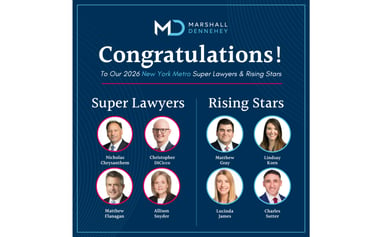
Marshall Dennehey Announces 2026 New York Metro Super Lawyers and Rising Stars
April 27, 2026