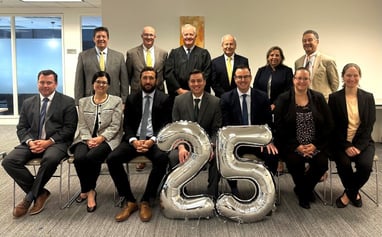
As a member of the firm's Professional Liability Department, Corey focuses her practice on representing and defending insurance companies in insurance coverage disputes and first-party property litigation.
Corey is a 2005 graduate of Florida Atlantic University where she received her bachelors' degree in History and Political Science. She received her juris doctor in 2011 from Nova Southeastern University's Shepard Broad Law Center. While in law school, Corey was a subscriptions and articles editor for the ILSA Journal for International and Comparative Law. She also interned at the Broward County Court Family Law division under Judge Melinda Kirsch-Brown.
Outside of the office, Corey is a passionate ultra marathon runner. In May 2019, she was the #1 overall female finisher and the second overall finisher in the Dunes 50 Miler, an off-road running race in Hobe Sound, Florida. The course includes hard-packed single track trails and several miles of rolling loose sugar sand dunes. Corey finished the 50-mile course in a little over 14 hours.
Results
Thought Leadership
Legal Updates for Florida Coverage and Property Litigation
First DCA Reverses Excessive Jury Award Unsupported by the Evidence
October 5, 2026
In December 2019, the plaintiffs filed a claim with Universal for damages caused by a water and sewage back up through the plumbing system and existing through multiple fixtures including the washing machine drain, kitchen sink, dishwasher, bathtub and toilet. Universal investigated the claim, issued payment for resulting water damage totaling $7,000.00 in actual cash value ($12,000.00 in replacement cost value). The plaintiffs sought additional benefits for work needed to access the below-slab cast iron plumbing system due to the failure of the system from rust, deterioration, corrosion and breaks in the line. Universal denied any additional benefits for access. In 2021, the plaintiffs filed suit. During litigation, Universal sent a plumber to inspect the home and the plumber concluded the pipes were clogged but could be cleaned. The plaintiffs’ plumber testified that the plumbing system needed to be replaced due to holes and openings in the pipes. The plaintiffs introduced two estimates prepared by Triad Restoration services totaling $79,680.22 in replacement cost value and $50,219.97 in actual cash value and an executed contract with another company for repairs with the amounts of repair redacted. Since the insurance policy did not provide coverage for repair or replacement of the plumbing system, the jury only had to decide whether the plumbing system needed to be replaced, and if it did, Universal would owe for the access costs; the jury verdict form required the jury to determine both the replacement cost value and actual cash value amounts. The jury asked if it had to rely on the Triad estimates for their amounts. The trial court advised the amount awarded had to be based on the evidence presented at trial and the law given by the trial court. The jury awarded $335,000.00 in replacement cost value or $305,000.00 in actual cash value. Universal motioned for a new trial arguing the amount awarded was unsupported by the evidence and then moved for remittitur. The trial court denied both motions and this appeal followed. The court found that while a jury’s verdict should only be disturbed with caution and discretion, the trial court must give the properly challenged award close scrutiny and determine whether it bears a reasonable relation to the damaged provided, is supported by the evidence, and could have been reached in a logical manner by reasonable means §768.74(3), (5)(d)-(e), Fla. Stat. The court found the trial court did consider the statutory requirements at the hearing on Universal’s remittitur motion and was concerned about a reasonable relation to the amount of damages proved and injury suffered and whether the award was supported by the evidence, but ultimately denied the motion, reasoning that the jury had been properly instructed to fairly and adequately compensate the plaintiffs. The court noted the only evidence providing the basis for the jury verdict was Triad’s estimates and those valued the plaintiffs' claimed loss at $79,680.22 in replacement cost value and $50,219.97 in actual cash value; no valuation evidence reasonably supported the jury verdict. The plaintiffs argued that the jury was entitled to consider more than the estimates, but the court conveyed the evidence provided did not give the jury a way to reach the amounts they awarded. The court was also not swayed by the plaintiffs’ argument regarding inflation and later price increases, but the court noted that no evidence via the contract, nor testimony regarding increase in labor, material, fuel or construction costs were entered into the record. The court concluded the jury may draw reasonable inferences from the evidence, but it may not supply a damages number by speculation. The court did not find any of the plaintiffs’ remaining argument persuasive either. The court reversed the denial of Universal’s remittitur motion and motion for new trial as to damaged and remanded the case. The court ended its opinion with advising the trial court must determine whether replacement cost value or actual cash value is the property measure of damages under the policy and order remittitur in an amount consistent with that determination and the evidence.
Legal Updates for Florida Coverage and Property Litigation
Court Reaffirms That Actual Cash Value Includes Labor and Overhead, Not Just Materials
June 11, 2026
Greenaker v. Universal Prop. & Cas. Ins. Co., Case No. 2D2024-1964, (Fla. 2nd DCA May 8, 2026). The plaintiffs filed a breach of contract suit against Universal for refusal to pay for all of plaintiffs’ damages from a storm in November 2020. Universal filed a motion in limine to prevent the plaintiffs from introducing evidence concerning both actual cash value and replacement cost value of the loss. They argued that the plaintiffs did not complete repairs or incur any expenses in repairing the damaged property, thus being limited to actual cash value as their measure of damage and the plaintiffs’ submitted estimate of damages contained labor costs necessary for repair and, therefore, not an actual cash value estimate. Universal further asked for a directed verdict at the hearing because the plaintiffs would have no evidence to support the claim for damages. The trial court agreed and granted Universal’s motion, entering a final judgment in Universal’s favor. The plaintiffs filed a motion for rehearing and reconsideration due to the court improperly converting Universal’s motion in limine to a motion for final summary judgment. The court denied plaintiffs’ motion and the plaintiffs appealed. The Second District Court of Appeal agreed with the plaintiffs and determined that the trial court improperly entered a final judgment based on a pretrial ruling in limine, advising there was recognized procedures, including summary judgment, judgment on the pleadings, and default judgment that could have been exercised. Further, the court continued that the improper procedure was not the only reason for the judgment to be reversed. They noted the insurance policy did not provide a definition of actual cash value nor how to calculate it, and the parties disputed the definition and calculation of such. Universal argued that actual cash value is defined as the value of the property that suffered the direct physical loss less depreciation and deductible, i.e. costs of physical materials that were damaged. The plaintiffs argued that actual cash value includes the amount of repair costs in addition to the value of the property that suffered direct physical loss because it is calculated as the replacement cost minus depreciation. The court agreed with the plaintiffs, noting that Universal’s definition was not supported by the insurance contract, the statute governing replacement value insurance contracts, nor decisional authority. The court noted that Universal “cherry-picked” the phrase “direct physical loss” from the perils insured against provision and applied it to the loss settlement provision, which doesn’t state “direct physical loss,” but instead states “insured loss.” Further, the court conveyed that application of “direct physical loss” would be used on both actual cash value and replacement cost value, as they are both present in the loss settlement provision, which would mean insureds never got payments beyond costs of physically damaged material, which is contradictory to the replacement cost value definition. The court advised that the Florida Supreme Court had approved the court’s interpretation of actual cash value as including costs other than damaged physical property, including overhead and profit, noting that these costs can be included in actual cash value to which a portion, like all other costs, could be depreciated. The court noted the difference between actual cash value and replacement cost value is not between types of costs, i.e. materials vs. labor, but between the valuation of the costs with the distinction of being a depreciated vs. undepreciated value. The court refused to exclude intangible costs such as labor, profit and overhead from actual cash value, finding these costs inclusions were consistent with statutory and contractual language as well as Florida Supreme Court precedent. The court reversed the judgment and remanded the case back to the trial court.