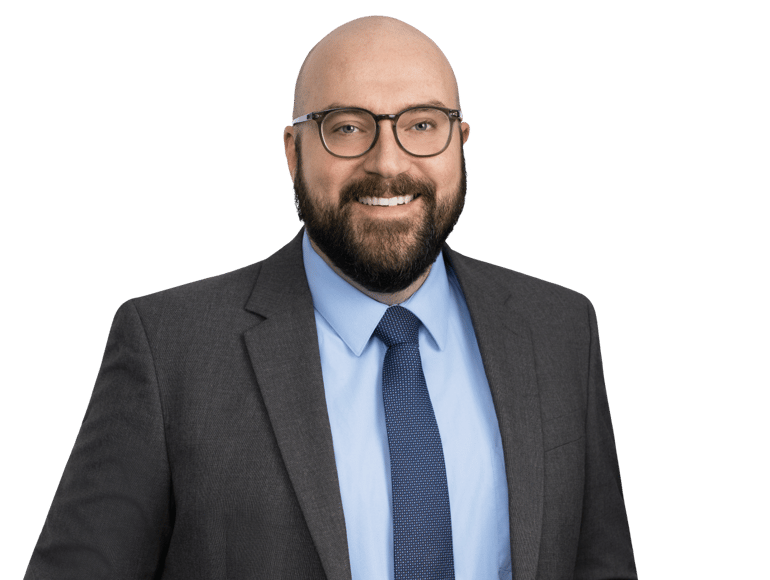
Marshall Dennehey is pleased to announce that 10 attorneys have been elected shareholders of the firm effective Jan. 1, 2025. Additionally, two attorneys have been promoted from associate to special counsel. These new shareholders and special counsel represent the firm's four core departments – Casualty, Professional Liability, Health Care and Workers' Compensation – and come from eight of the firm's 19 offices.
“Marshall Dennehey is proud to celebrate this accomplished group of newly elected shareholders,” said firm President & CEO, G. Mark Thompson. “Their talent, dedication, and hard work have been instrumental to the success of our clients and the firm. We are particularly proud that 40 percent of this class are either women or minority attorneys, reflecting our commitment to diversity and inclusion. We congratulate them on this milestone and eagerly anticipate their continued contributions to our growth and success.”
Promoted to Shareholder
LONG ISLAND, NEW YORK (MELVILLE)
James M. Boyce, Casualty Department (former Special Counsel)
James focuses his practice on New York construction and Labor Law matters, construction defect litigation and general liability matters. His clients include design professionals, owners, contractors and subcontractors when facing construction defect and delay claims, personal injury claims, fee disputes and New York State Labor Law matters. A member of the American Council of Engineering Companies, he is a graduate of the State University of New York at Albany and Hofstra University School of Law. James is admitted to practice in New York.
Matthew A. Gray, Casualty Department (former Associate)
Matthew primarily defends insurance carriers in disputes involving New York Personal Injury Protection (PIP) claims. A member of the firm’s Fraud/Special Investigation Practice Group, he is experienced in defending clients against intentional/staged losses and medical provider fraud. He has extensive motion practice experience and with alongside his fellow colleagues to obtain favorable decision for each of his clients, whether through litigation or arbitration. Matthew holds a B.A. and M.A. from St. John’s University and earned his J.D. from the Touro University Jacob D. Fuchsberg Law Center. He is admitted to practice in New York.
MOUNT LAUREL, NEW JERSEY
Mari I. Gangadean, Professional Liability Department (former Special Counsel)
Mari is a member of the firm’s Employment Law Practice Group where she defends employers in employment-related claims involving allegations of discrimination based upon age, gender, race, sexual orientation and disability, as well as retaliation and "whistle blowing" in both federal and state courts. She additionally is experienced in insurance coverage and bad faith litigation as well as defending automobile negligence and uninsured/underinsured motorist claims. Mari is a graduate of Mount Holyoke College and Temple University School of Law. She is admitted to practice in New Jersey and Pennsylvania.
Kiara Hartwell, Workers’ Compensation Department (former Associate)
Kiara devotes her practice to workers' compensation litigation on behalf of employers, insurance carriers and self-insureds. She is a member of the New Jersey State Bar Association's Workers' Compensation Executive Committee, a group charged with studying and developing beneficial changes in the administration and procedures pertaining to workers' compensation. Kiara authors the New Jersey updates for Marshall Dennehey’s monthly workers’ compensation newsletter and frequently writes for external publication. Admitted to practice in New Jersey and Pennsylvania, she is a graduate of New York University and Rutgers University School of Law.
Jonathan C. Magpantay, CPCU, Casualty Department (former Associate)
As a member of the firm’s Fraud and Special Investigation Unit (SIU) Practice Group, Jonathan focuses on large loss and medical provider fraud, including the filing of affirmative litigation recovery and RICO actions across the country. A Chartered Property and Casualty Underwriter (CPCU), he also handles insurance coverage disputes, bad faith litigation and general defense litigation. He has broad experience in New Jersey Personal Injury Protection (PIP) litigation and appears regularly before the courts and administrative bodies. Jonathan is a member of the Asian Pacific American Lawyers Association of New Jersey (APALA-NJ) and the National Filipino American Lawyers Association (NFALA). A graduate of the University of Pittsburgh and Rutgers University School of Law, he is admitted to practice in New Jersey, the District of Columbia, and Michigan.
Michael J. Sweeney, CPCU, Casualty Department (former Associate)
As a member of the firm’s Fraud and Special Investigation Unit (SIU) Practice Group, Michael investigates and defends large loss and medical provider fraud matters. He has litigated and filed affirmative litigation recovery and RICO actions in many states, recovering tens of millions of dollars in restitution and recovery on behalf of the insurance industry. A Chartered Property and Casualty Underwriter (CPCU), Michael has extensive experience handling insurance coverage disputes, SIU investigations, bad faith allegations, and general defense litigation. He is a graduate of the University of Delaware and Villanova University School of Law, and is admitted to practice in New Jersey.
KING OF PRUSSIA, PENNSYLVANIA
Gabor Ovari, Health Care Department (former Associate)
Gabor focuses his practice on the defense of hospitals, health care systems and medical providers in medical malpractice and health care liability matters. He has second-chaired multiple jury trials and is experienced in all aspects of litigation. Gabor is a member of the Pennsylvania and Montgomery County Bar Associations. He is a graduate of Temple University and Widener University School of Law, and is admitted to practice in Pennsylvania and New Jersey.
JACKSONVILLE, FLORIDA
Sean J. Reeves, Casualty Department (former Associate)
Sean litigates a wide range of general liability matters representing insureds, self-insureds, and corporations in cases involving motor vehicle negligence, catastrophic product liability matters, personal injury, premises liability, wrongful death and warranty defense. Sean also has experience representing clients in the food and beverage industry in matters involving food allergies, foreign objects, foodborne illness and contamination cases. Sean is a graduate of the University of West Florida; Saint Leo University (MBA); and the University of Florida Levin College of Law. He is admitted to practice in Florida.
PHILADELPHIA, PENNSYLVANIA
Taniesha K. Salmons, Casualty Department (former Associate)
Taniesha concentrates her practice on premises and product liability litigation. On the premises side, her clients include national and regional grocery retailers, condominium and homeowners’ associations, business owners and private property owners. On the product side, she defends manufacturers and distributors of tools, automatic doors, machinery and other heavy industrial equipment. Taniesha additionally assists in the defense of fire loss and complex product liability cases involving catastrophic losses. A certified arbitrator in Philadelphia, Taniesha is admitted to practice in Pennsylvania, New Jersey and Florida. She is a two-time graduate of the University of Miami, where she earned both her Bachelor’s and Juris Doctor degrees.
PITTSBURGH, PENNSYLVANIA
Michael D. Winsko, Casualty Department (former Associate)
Michael defends corporations, individuals, and local governments in complex civil litigation matters. In this capacity, he has successfully handled numerous high-exposure premises liability, liquor liability, product liability, and catastrophic injury/wrongful death actions throughout the state and federal courts of Pennsylvania. Michael additionally defends clients against design and construction defect claims, trucking/automobile accidents, fall down incidents and negligent security claims. A graduate of Duquesne University and Duquesne University School of Law, he is admitted to practice in Pennsylvania.
Associates Promoted to Special Counsel
ORLANDO, FLORIDA
Frank L. Madia, Casualty Department
Frank handles matters involving premises and retail liability, personal injury, product liability, negligent security and automobile liability. As former staff counsel with a national insurance company, he also has substantial experience in insurance coverage matters, business litigation, and real estate transactions. Frank is a 30-year veteran of the New York Air National Guard, where he served as a Staff Judge Advocate before retiring as a Lieutenant Colonel in 2017. He is a graduate of the University at Buffalo, the United States Air Force Judge Advocate Training School, and the Touro University Jacob D. Fuchsberg Law Center. Frank also served 18 years as a local municipal judge in the upstate New York township where he previously resided. He is admitted to practice in Florida and New York.
HARRISBURG, PENNSYLVANIA
Christopher W. Woodward, Professional Liability Department
Christopher focuses his practice on insurance coverage and bad faith litigation. An experienced litigator and former claims examiner, he has a deep understanding of insurance policy and coverage issues arising from commercial, personal, and specialty property and casualty policies, professional liability policies, health/life policies and workers’ compensation policies. He is a graduate of Pennsylvania State University and Widener University School of Law.