Pittsburgh
The Pittsburgh, Pennsylvania office of Marshall Dennehey, which opened in May of 1993, is now located in the historic Union Trust Building. The office is comprised of civil litigation attorneys practicing in all four of our major law groups covering Casualty and General Liability, Professional Liability, Health Care and Workers' Compensation. The majority of the attorneys have enjoyed a long standing professional relationship in the practice of defense litigation and are natives or long-time residents of the Pittsburgh area.
Pittsburgh is a naturally convenient location in which to quarter a litigation practice serving the Western Pennsylvania counties of Allegheny, Beaver, Butler, Lawrence, Clarion, Armstrong, Jefferson, Indiana, Westmoreland, Fayette, Washington, Greene, Somerset, Bedford, Blair, Cambria and Clearfield. The United States District Court for the Western District of Pennsylvania is located in Pittsburgh. In addition, Pittsburgh is the seat of the Allegheny County Court of Common Pleas, which operates one of the busiest civil dockets in the Commonwealth's court system. A large majority of the workers' compensation claims and civil liability suits filed in the entire Western Pennsylvania region are litigated either in Pittsburgh or within a short drive of our office.
In addition to providing counsel in Western Pennsylvania, a number of attorneys in our Pittsburgh office are admitted to the bar in West Virginia. Here, they represent clients in both the state courts and before the United States District Courts for the Northern and Southern Districts of West Virginia.
Thought Leadership
Case Law Alerts
Superior Court Upholds Nonsuit in Slip‑and‑Fall Case Involving Visible Wet‑Floor Warnings
July 20, 2026
In a non-precedential opinion, the Superior Court of Pennsylvania affirmed the entry of compulsory nonsuit in a slip-and-fall negligence case when evidence of placement of wet floor signs established adequate warnings to business invitees. The plaintiff filed negligence claims against the defendant hotel after she fell on a wet floor in the foyer/vestibule between the hotel lobby and an adjacent parking garage. The evidence included security video footage that showed, prior to the incident, a hotel employee mopping the floor and placing two yellow wet floor signs. At the close of the plaintiff’s case-in-chief during a bench trial, the defendant hotel moved for entry of a compulsory suit, which the trial court granted. The plaintiff subsequently appealed and argued that the trial court committed an error of law by usurping the function of the factfinder and resolving disputed issues of material fact. On appeal, the Superior Court of Pennsylvania held there was no error or abuse of discretion by the trial court. The Superior Court reasoned the evidence established that the placement of the yellow wet floor signs were open and obvious. The Superior Court noted that the plaintiff admitted to seeing the wet-floor sign before taking her second step into the foyer (which was the step during which she fell). The Superior Court ruled “if there is anything settled in the law of negligence in Pennsylvania, it is the duty of a person to look where he is walking and to see that which is obvious.” The Superior Court further ruled there was no evidence the defendant hotel had knowledge that the wet floor signs were inadequate to warn business invitees of the danger of slippery floor. The Superior Court held there was no evidence that the defendant hotel breached its duty to the plaintiff and thus, there was no error in the trial court’s conclusion that the plaintiff failed to assert a prima facie negligence. The Superior Court affirmed the trial court’s entry of compulsory nonsuit against the plaintiff.
Case Law Alerts
Pennsylvania Court Finds Fact Issues on Visibility of Freestanding Sign’s Legs
July 20, 2026
In a non-precedential opinion, the Superior Court of Pennsylvania held that when determining whether a freestanding sign was an open and obvious condition, the legs of the sign were to be considered separately and warranted separate analysis. The plaintiff, while walking into the defendant store, tripped and fell on a leg of a freestanding lottery sign that was placed on the sidewalk outside of the store. While the plaintiff admitted she was able to observe the sign prior to the incident, she claimed that she did not notice the legs of the freestanding frame that supported the sign. The plaintiff filed negligence claims against the defendant store and, after discovery, the defendant store filed a motion for summary judgment. In its motion for summary judgment, the defendant store argued that the sign was an open and obvious condition. In her response in opposition, the plaintiff argued that the legs of the sign were not open and obvious, and created a tripping hazard. In support of her opposition, the plaintiff presented expert reports. The trial court granted the motion for summary judgment and ruled that there were no genuine issues of fact as to whether the sign was open and obvious. The trial court concluded that it did not consider the legs separate from the sign as a matter of law when considering the issue of whether the dangerous condition was open and obvious. Instead, the trial court found the sign with its legs was open and obvious. In support of its ruling, the trial court relied upon the Superior Court of Pennsylvania’s reasoning in Larose v. Berish, 334 A.3d 406 (Pa. Super. 2002). The plaintiff appealed. On appeal, the Superior Court of Pennsylvania held that the plaintiff presented sufficient evidence that created genuine issues of material fact as to the open and obvious nature of the sign’s legs. The Superior Court held the trial court erred when it determined that Larose required it to consider the sign and its legs as one to determine whether it was open and obvious. The Superior Court reasoned that Larose does not stand for the proposition that an object resting on another object must be considered as one for purposes of determining whether the condition is open and obvious. Instead, the Superior Court found the circumstances in Larose to be distinguishable and that Larose did not dictate as a matter of law that the legs of the sign created an open and obvious danger. The Superior Court ruled that the trial court erred in granting summary judgment in favor of the defendant store and reversed the order.
Results
Defense Verdict Obtained After Seven-Day Bench Trial
We received a defense decision after a seven-day bench trial in a product liability action in which the exposure in the case exceeded $30 million. Our client designs, sells and services engineered equipment for the energy industry, including natural gas compression apparatuses for use in transmission pipeline systems. In 2015, the client sold the plaintiff two reciprocating compressor systems to replace outdated equipment at a station located near Downingtown, PA. The compressor systems were designed to inject oil into the gas stream for piston lubrication. This lubricating oil needed to be removed from the gas stream using filtration devices supplied by the plaintiff. The plaintiff claimed weld debris contained within certain vessels of the compressors migrated downstream upon commissioning and compromised several gas filtration devices. The plaintiff further contended the damaged filtration devices permitted excess lubricating oil into the pipeline, which fouled multiple turbines owned by its downstream customer at a large natural gas-fired power plant, causing significant economic losses. The applicable contract between the plaintiff and our client contained a forum selection clause requiring litigation to take place in Lake County, Indiana. The plaintiff claimed commercial losses of $18 million, plus attorney fees (per contract) in the neighborhood of $4 million. The plaintiff also maintained it was entitled to pre-judgment interest. If successful in establishing liability, this sum would have added another $5 million to $7 million to the damage award, depending on the interest rate employed by the court. Therefore, the pure exposure in the case exceeded $30 million. In response to the plaintiff’s claims, we successfully established that the weld debris incident was a red herring and did not damage the filtration equipment. Material testing of debris from within the filtration devices revealed very little weld debris compared to pipe scale and other naturally occurring components. Through key expert testimony, we established that the plaintiff could not meet its burden of proof because the oil contamination events may have been caused by several factors directly attributable to the plaintiff’s lack of design engineering, inadequate equipment maintenance, equipment failure and inappropriate response to system alarms.
Defense Victory Obtained in Workers’ Compensation Case
We secured a complete defense victory, saving our client over $500,000 in known exposure and likely millions in long-term liability. The workers’ compensation judge granted our termination petition and denied the claimant’s claim petition, finding that the claimant fully recovered and was not entitled to wage loss or medical benefits. Through medical discovery, we uncovered pre-injury treatment that directly contradicted the claimant’s testimony. The judge favored our medical expert, citing no changes on pre- and post-injury MRIs as further evidence undermining the claim.
News
106 Marshall Dennehey Attorneys Recognized in the 2027 Editions of The Best Lawyers in America® and the Best Lawyers: Ones to Watch® in America
August 20, 2026
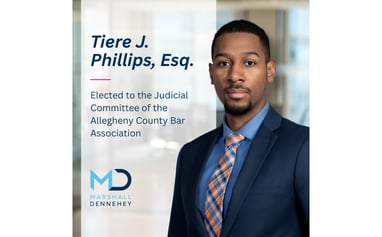
Tiere J. Phillips Elected to the Judicial Committee of the Allegheny County Bar Association
June 8, 2026
Marshall Dennehey Again Earns Recognition in Distinguished Chambers USA
June 4, 2026