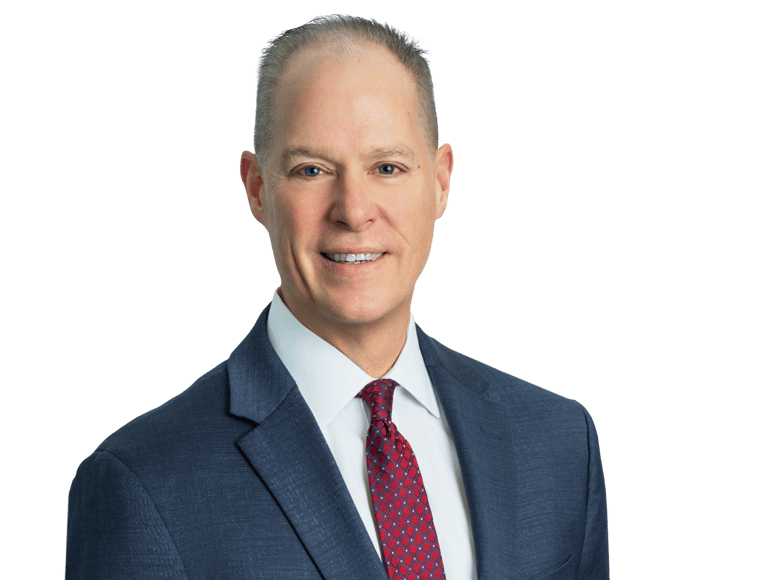
.

Justin F. Johnson

Office Managing Attorney

Portrait of Justin F. Johnson

Justin is a seasoned litigator whose practice focuses on medical malpractice, nursing home liability, and state board disciplinary actions. In addition to his legal background, Justin also received his pharmacy degree. Licensed as a pharmacist in both Iowa and Illinois, he leverages his deep knowledge in pharmacology, pharmacokinetics, toxicology, physiology, and anatomy to provide strategic, scientifically grounded defense in complex medical malpractice cases.

Justin has handled several hundred medical malpractice matters and has taken nearly 120 cases to trial. Ninety percent of all verdicts were defense verdicts, and roughly 30 of his cases ended in a verdict or mid-trial settlement significantly below the settlement demands. He has represented a considerable number of physicians and pharmacists at state board disciplinary proceedings. He successfully obtained favorable trial verdicts in multiple cases involving potentially high jury awards, including matters involving limb loss, kidney/liver injury, wrongful birth and wrongful death by demonstrating that the physicians were not negligent in the care and treatment that they rendered to their patients. He also handled a case for a physician involved in the Ortho Evra patch mass litigation.

Justin received a Bachelor of Science degree in Pharmacy from Drake University in 1986. While at Drake, he received various honors, including The Norcliff-Thayer Publishing Grant, election into the Order of Omega (honor society), and inclusion on the Dean's List. Justin received his juris doctor from Pace University School of Law in June 1989 where he was involved in the Health Law Program.

After serving a judicial internship with the Honorable John Marbach in the New York Supreme Court, Justin became associated with Jeffrey A. Krompier, Esquire, of Florham Park, New Jersey, from 1989 through 1992. In 1992, Justin became associated with Michael J. Lunga, Esquire of Fairfield, New Jersey, and became a partner at their newly named firm Lunga, Evers & Johnson in 1995. He remained at that firm until he joined Marshall Dennehey in 2007.

Justin is admitted to the bar in New Jersey and the U.S. District Court for the District of New Jersey, and he is a member of the New Jersey State Bar Association, and the American Society for Pharmacy Law. He was appointed to the Medical Malpractice Committee of the New Jersey State Bar Association, as well as the Joint Committee of Essex County Medical and Bar Associations.

Justin is an active member of the community, serving as a member of the Harrington Park Lions Club and, when his daughters were younger, serving as a board member and coach of serveral recreational and travel softball and basketball programs. He is also a consistory member and first vice-president of the Community Church of Harrington Park, New Jersey.

    • The Elisabeth Haub School of Law at Pace University (J.D., 1989)
    • Drake University (B.S., 1986)
    • New Jersey, 1989
    • U.S. District Court District of New Jersey, 1989
    • The Best Lawyers in America®, Medical Malpractice Law - Defendants (2025-2026)
    • The Best Lawyers in America®, Health Care Law (2024)
    • New Jersey Super Lawyers (2026)
      The Super Lawyers list is issued by Thomson Reuters. A description of the selection methodology can be found here. No aspect of this advertisement has been approved by the Supreme Court of New Jersey.
    • American Bar Association
    • American Society for Pharmacy Law
    • Central Illinois Pharmaceutical Association
    • Joint Committee of Essex County Medical and Bar Associations
    • New Jersey State Bar Association, Member, Medical Malpractice Committee
    • Risk Management Rounds in Anesthesia, MDAdvantage, March 17, 2015

Results

No-Cause Jury Verdict Secured in Wrongful Death Trial

We successfully obtained a no-cause jury verdict in a 13-day wrongful death trial. The decedent, a 59-year-old man, was admitted to the emergency room on February 15, 2019, with complaints of abdominal pain, decreased appetite, and constipation, despite the use of laxatives. The patient did not complain of any nausea, vomiting, or diarrhea. He had a significant medical history including diabetes, hypertension, prior coronary artery stenting, morbid obesity (with past gastric bypass surgery), longstanding ventral hernia, and back pain. A CT scan revealed multiple hernias and a potential closed-loop bowel obstruction, leading to a surgery consultation. Our client, an emergency general surgeon, interpreted that the patient did not have a closed loop or any significant obstruction and recommended non-surgical management. The patient was approved to have clear liquids, and had a vomiting incident shortly after, but our client was not notified. The patient was returned to NPO status, and after improving overnight, he was returned to “clears” and additional medical and renal consults were ordered. Our client did not receive any communications from the residents/nurses of any changes in the patient’s condition. On February 18, 2019, two rapid responses were called due to increased heart rate and vomiting. It is believed that the vomiting resulted in aspiration, causing sepsis, ultimately leading to the patient’s death. During the trial, the plaintiff’s sole medical expert highlighted imaging on the wrong hernia, which called into question all of his opinions in the case. We made key objections related to the expert testimony, limiting what the allegations were, and preventing new allegations from being made. After approximately two and a half hours of deliberating, the jury returned a no-cause verdict. 

Unanimous Verdict Obtained in a Medical Malpractice Matter in Bergen County, New Jersey

Thought Leadership

Defense Digest

On the Pulse…Our Roseland, New Jersey, Office

September 1, 2023

In February 1993, Roseland became the home of Marshall Dennehey’s North Jersey office. Its lone member, Howard Mankoff, was the original local managing attorney, and he is still with us today. Our initial home was in nearby Livingston, before relocating to our present office for the past 20 years. The Roseland office is located in the heart of North Jersey, in close proximity to two of the state’s largest cities, Newark and Paterson, and is a mere “hop, skip and a jump” to New York City (at least when traffic is light). In 2022, the office underwent a major construction project that included the creation of a beautiful new conference center, installation of state-of-the-art technology and communications systems, as well as new office furniture and decor.  Over the past three decades, our office has experienced exponential growth and currently boasts 36 attorneys (24 shareholder/senior counsel, 4 special counsel, and 8 associate attorneys). An additional 3 attorneys joined us after the Labor Day holiday, when they concluded their judicial clerkships. Roseland is one of Marshall Dennehey’s largest offices. Our attorneys specialize in all four of the firm’s essential practice department: Casualty (16 attorneys), Health Care (8 attorneys), Professional Liability (6 attorneys), and Workers’ Compensation (6 attorneys). Many of our attorneys have decades of legal experience and are recognized leaders in their areas of specialization. Our office also benefits from the support of 10 accomplished and dedicated paralegals.  Roseland’s Casualty Department is headed by Christopher Block, and includes Matt Schorr (who also serves as Assistant Director of the Casualty Department firmwide), Len Leicht (who received the honor of being named among the 2024 Best Lawyers in America for personal injury litigation), Mike Speer, Tim Jaeger, Alicia Calaf (member of the firm’s Diversity, Equity & Inclusion Committee as well as the Executive Committee Advisory Counsel), Art Bromberg, Julie Dorfman, Josie Scanlan, Sara Mazzolla, Jonathan Williams, Gary Lesser, Paul Lanza (who was recognized as a 2023 New Jersey Super Lawyer Rising Star), Brian Byrne, Hellen Tuckett, and Sean Govlick. Paul and Josie have also been identified as 2024 Best Lawyers: Ones to Watch. The Casualty Department handles a wide variety of cases. Its attorneys aggressively tackle their cases and routinely achieve successful results for their clients, both outside and in the courtroom.  The Roseland Health Care Department is supervised by Bob Evers (named as a 2023 New Jersey Super Lawyer, included among the 2024 Best Lawyers in America, named 2024 Lawyer of the Year for medical malpractice law in our region). Other members of the Health Care Department include Justin Johnson and Julia Klubenspies (both of whom also were named as 2024 Best Lawyers in America for medical malpractice law in the Newark, New Jersey, region), Ryan Gannon and Heather LaBombardi (both of whom were named as 2023 New Jersey Super Lawyers Rising Stars), Maura Brady, Dave Tomeo, and Eric Grogan. In the recent past, the Roseland Heath Care Department (in conjunction with our colleagues in the Mount Laurel office) was recognized as runner-up for the Best Litigation Group in New Jersey.  The Professional Liability Department in Roseland is led by Will Waldron (who is the supervisor for the Northeast Professional Liability Group) and Sunny Sparano (who serves as Chair of the Architectural, Engineering and Construction Defect Litigation Practice Group for the firm), Howard Mankoff, Wendy Smith, Patricia McDonagh, and Pauline Tutelo. This group has an extremely diverse portfolio of case types and is comprised of some of the most talented and experienced attorneys in their industry.  And last, but far from least, Roseland’s powerful and robust Workers’ Compensation Department is headed by Greg Bartley. Other group members include, Rachel Ramsay-Lowe (who currently serves a member of the Executive Committee of the New Jersey State Bar Association’s Workers’ Compensation section), Ida Fuda, William Murphy, Lela Eke, and David Levine. This group has grown in size during Greg’s tenure and successfully litigates a tremendous volume of cases.  In Roseland, we draw upon a wealth of experience and a depth to service our clients that goes above and beyond their expectations. Many of our attorneys have successfully litigated cases through trials, arbitrations, mediations, and keen motion practice. In combination with our Marshall Dennehey colleagues in the Mount Laurel office, we have been named a finalist in The American Lawyer Regional Litigation Department of the Year award. Although we are very diverse in our backgrounds, educations, and experiences, we are a tight-knit group (attorneys, para-professionals, and staff) who trust and care for each other, and genuinely enjoy each other’s company. If you are ever in our area, we would love to have you stop by and see for yourselves.  *Justin, a shareholder, is the managing attorney of our Roseland, New Jersey, office. He can be reached at 973.618.4185 or jfjohnson@mdwcg.com.   Defense Digest, Vol. 29, No. 3, September 2023, is prepared by Marshall Dennehey to provide information on recent legal developments of interest to our readers. This publication is not intended to provide legal advice for a specific situation or to create an attorney-client relationship. ATTORNEY ADVERTISING pursuant to New York RPC 7.1. © 2023 Marshall Dennehey. All Rights Reserved. This article may not be reprinted without the express written permission of our firm. For reprints, contact tamontemuro@mdwcg.com.

Firm Highlights

Result

No-Cause Jury Verdict Secured in Wrongful Death Trial

We successfully obtained a no-cause jury verdict in a 13-day wrongful death trial. The decedent, a 59-year-old man, was admitted to the emergency room on February 15, 2019, with complaints of abdominal pain, decreased appetite, and constipation, despite the use of laxatives. The patient did not complain of any nausea, vomiting, or diarrhea. He had a significant medical history including diabetes, hypertension, prior coronary artery stenting, morbid obesity (with past gastric bypass surgery), longstanding ventral hernia, and back pain. A CT scan revealed multiple hernias and a potential closed-loop bowel obstruction, leading to a surgery consultation. Our client, an emergency general surgeon, interpreted that the patient did not have a closed loop or any significant obstruction and recommended non-surgical management. The patient was approved to have clear liquids, and had a vomiting incident shortly after, but our client was not notified. The patient was returned to NPO status, and after improving overnight, he was returned to “clears” and additional medical and renal consults were ordered. Our client did not receive any communications from the residents/nurses of any changes in the patient’s condition. On February 18, 2019, two rapid responses were called due to increased heart rate and vomiting. It is believed that the vomiting resulted in aspiration, causing sepsis, ultimately leading to the patient’s death. During the trial, the plaintiff’s sole medical expert highlighted imaging on the wrong hernia, which called into question all of his opinions in the case. We made key objections related to the expert testimony, limiting what the allegations were, and preventing new allegations from being made. After approximately two and a half hours of deliberating, the jury returned a no-cause verdict. 

Thought Leadership

Featured Conversations... Key Takeaways from A.M. Best’s Webinar on the Misuse Defense in Product Liability Claims, Featuring Michael Salvati

Michael Salvati, shareholder in our Philadelphia office, was a panelist for the April A.M. Best webinar, “The Misuse Defense: Strategic Approaches to Defending Product Liability Claims for Insurers.” During the program, Michael and his fellow panelists offered practical, jurisdiction‑specific guidance on how misuse and failure‑to‑warn theories intersect in modern product liability litigation. Michael emphasized the unique challenges these claims present—particularly in states like Pennsylvania, where evidentiary rules diverge sharply from those applied in many other jurisdictions. Failure to Warn as the “Flip Side” of Misuse Salvati explained that failure‑to‑warn allegations often arise as a direct counter to a misuse defense. As he noted, “If our misuse defense is that the plaintiff didn't use a product properly or safely, then the failure to warn claim is that we didn't tell them how to use it properly.” He emphasized that these claims can stem from either the absence of warnings or criticisms of existing warnings, such as insufficient specificity or lack of clarity about risks. Pennsylvania’s Unique Evidentiary Landscape One of Salvati’s most notable points was the stark difference in how Pennsylvania treats evidence of compliance with industry standards. He highlighted that Pennsylvania is “one of the only states…where that evidence is not admissible” in strict liability cases. Manufacturers cannot rely on compliance with ANSI, UL, ISO, or even federal safety standards to defend the product against a strict liability claim—because the focus is solely on the product itself, not the manufacturer’s conduct. Salvati acknowledged the challenge this creates for defense counsel and clients who expect such compliance to carry weight. Understanding the Three Defect Theories Salvati also walked through the three primary defect theories recognized in many jurisdictions: - Design defect – a flaw in the product’s intended design - Manufacturing defect – a deviation affecting a specific unit - Failure to warn – inadequate instructions or warnings He noted that warnings claims are increasingly significant and sometimes stand alone when design or manufacturing theories are weak. As he put it, plaintiffs often default to warnings claims because “the default position seems to be, ‘If I got hurt, there must be something wrong.’” Warranties and State‑by‑State Variations Salvati addressed how breach‑of‑warranty claims fit into the broader framework, explaining that implied warranties—such as merchantability—often overlap with strict liability in Pennsylvania. He emphasized the importance of understanding local nuances, as warranty law and admissibility rules vary widely across states. Looking Ahead: The Growing Importance of Warnings In his closing remarks, Salvati stressed that warnings should never be treated as an afterthought in product liability defense. He observed that warnings‑only claims are becoming more common and urged manufacturers and insurers to continually evaluate the clarity and completeness of their instructions and warnings. His takeaway: “We should always be talking about what are the instructions that come with our products…to bolster a misuse defense.” Listen to the complete webinar here: https://www3.ambest.com/conferences/events/eventregister.aspx?event_id=WEB1074.

Thought Leadership

The Enforceability of Online Arbitration Agreements Remains Unresolved in Pennsylvania, But the Pennsylvania Superior Court has Provided Substantive Guidance on the Issue

Key Points: The Pennsylvania Supreme Court confirms that an order compelling arbitration is not immediately appealable as collateral orders. The outcome of Chilutti II has generally left the substantive enforceability issues with browsewrap agreements unresolved in Pennsylvania. Until this issue is resolved by the Pennsylvania courts, companies operating in the Commonwealth should strive to ensure that their registration websites and/or application screens conspicuously present arbitration agreements in manners which ensure their users and consumers assent to the terms of the agreements by following the standards set forth in Chilutti I. Browsewrap agreements have been defined as agreements “‘in which a website offers terms that are disclosed only through a hyperlink and the user supposedly manifests assent to those terms simply by continuing to use the website,’ and typically do not require an electronic signature.” See, Cobb v. Tesla, Inc., 2026 WL 458470, at *1 n. 2 (Pa. Super. Feb. 18, 2026) (citation omitted). They are largely regarded as the “if you keep using this, you agree to everything buried in this link” terms embedded into almost every online agreement consumers and users sign before proceeding with purchases of goods and/or services. While consumers are generally aware of them, many almost never click on the link, nor read them in their entirety. This leaves many consumers and users ignorant of the terms and impact of such agreements. However, one’s ignorance of the otherwise neatly-tucked-away terms rarely renders them unenforceable. The issue of the enforceability of browsewrap agreements has been up for debate for some time in many jurisdictions, including Pennsylvania. Indeed, Pennsylvania had a brief grip on this issue for a period in time. Specifically, in 2023, an en banc Superior Court set forth heightened standards for companies to meet in order to secure assent and enforce browsewrap arbitration agreements. See Chilutti v. Uber Techs., Inc., 300 A.3d 430 (Pa.Super. 2023) (en banc) (“Chilutti I”) Chilutti I involved a husband and wife who sued Uber and its subsidiaries after the wife, a wheelchair bound passenger using Uber’s rideshare service, fell, struck her head, and lost consciousness due to her uber driver failing to provide a seatbelt and making an aggressive turn during the trip. The Chilutti’s filed a negligence lawsuit against Uber and its subsidiaries. In response, the defendants moved to compel arbitration, arguing that “the couple’s conduct on the company’s website and application — when they registered for the ridesharing service — signified that they agreed to be bound by the mandatory arbitration provision found in the hyperlinked terms and conditions.” The trial court granted the defendants’ petition and stayed the proceedings pending the results of arbitration, and the Chilutti’s appealed. On appeal, the Superior Court addressed two issues. First, it addressed the issue of whether it had jurisdiction to hear the appeal. A divided Superior Court determined that it did, with its basis for the holding being that the order from which the Chilutti’s appealed was a collateral order. Next, the Superior Court set out to address the merits of the Chilutti’s substantive claim. The Superior Court concluded that the parties lacked a valid agreement to arbitrate. Its rationale was that Uber’s website and application did not provide reasonably conspicuous notice of the terms to the Chiluttis. In reaching this decision, the en banc Superior Court held that browsewrap arbitration agreements are enforceable in Pennsylvania only if the registration website and application screens explicitly inform consumers that they are waiving the right to a jury trial, the registration process cannot be completed until the consumer is fully informed of this waiver, and, when the agreement is available via hyperlink, the waiver appears at the top of the first page of the terms in bold, capitalized text. Since the ruling, Pennsylvania courts have applied Chilutti I to determine if browsewrap agreements are enforceable.  For instance, the Allegheny County Court of Common Pleas invoked Chilutti I to reject an agreement that lacked an express jury-trial waiver on the assent screen.  See Miller v. Festival Fun Parks, LLC, 92 WDA 2025 (C.P. Alleg. Cnty. Mar. 24, 2025). Similarly, the Superior Court has held that notice which failed to explicitly state the consumer was waiving a jury-trial right did not “me[e]t the strict burden set forth by our en banc Court in Chilutti I.” Pierce v. FloatMe Corp., 348 A.3d 1077, 1088 (Pa. Super. 2025). While the issue of enforceability of browsewrap agreements appeared to have been resolved by Chilutti I, Pennsylvania courts’ grip on this issue has been slackened by the Pennsylvania Supreme Court’s January 21, 2026, opinion in Chilutti II. See Chilutti v. Uber Techs., Inc., 349 A.3d 826 (Pa. 2026) (“Chilutti II”). Therein, the Supreme Court did not address the merits of the Chiluttis’ substantive claim, but rather the issue of whether the Superior Court had appellate jurisdiction to immediately review the orders staying litigation pending arbitration. The Court ultimately vacated the en banc opinion on jurisdictional grounds, holding that the Superior Court did not have appellate jurisdiction because the trial court’s order from which the Chiluttis appealed did not qualify as a collateral order and, thus, the Superior Court erred in holding to the contrary and lacked jurisdiction to entertain the merits” of the Chiluttis’ substantive claim. As such, Chilutti II has rendered Chilutti I nonbinding, and the issue of enforceability of online arbitration agreements remains unresolved. However, in light of the fact the Supreme Court did not address or comment on the merits of the Chiluttis’ appeal, Chilutti I is still meaningful. Specifically, it provides guidance as to the standards a company should strive to meet to ensure they have obtained users’ assent so that they are able to enforce online arbitration agreements. Additionally, it may serve as persuasive authority in judges’ evaluations of petitions and/or motions to compel browsewrap arbitration agreements until this particular issue is properly put before our appellate courts. Keanna works in our Pittsburgh, PA office. She can be reached at (412) 803-1174 or KASeabrooks@MDWCG.com.
