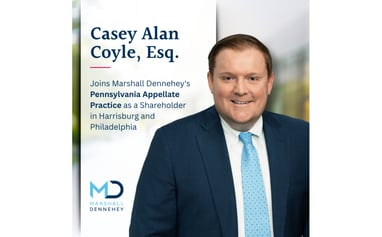
.

Oswald is an associate in the firm's Casualty Department, where he focuses his practice on defending products liability matters, including automobile design cases, industrial equipment, appliances, and many other consumer goods. He also represents clients in premises liability actions, workplace and construction accidents, as well as motor vehicle accident cases. He previously worked in the firm’s Healthcare Department representing emergency room physicians, physician’s assistants, nursing homes, dentists, podiatrists, chiropractors, and other healthcare providers. That experience has given him an acuity for analyzing complex medical records, which is essential for rebutting potentially uncorroborated damages claims.  

Oswald received his Bachelor of Arts from the University of Pittsburgh, majoring in Philosophy. After graduation, he took post-graduate classes at Villanova University focusing on communication theory. While attending Drexel Law, Oswald taught constitutional law to local high students through the Marshall-Brennan Constitutional Literacy Project. In addition to teaching the weekly classes, he coached selected students to compete in a moot court competition, arguing a case incorporating the First and Fourth Amendments of the United States Constitution. Oswald was also a Leadership Fellow at Drexel, serving as a mentor to first year students transitioning into the law school curriculum.

Prior to joining Marshall Dennehey as a summer law clerk in May of 2017, Oswald was a student law clerk for the Honorable Anne Lazarus of the Superior Court of Pennsylvania, where he performed research assignments and drafted memorandum opinions on a number of criminal and civil cases.

    • Drexel University Thomas R. Kline School of Law (J.D., 2018)
    • University of Pittsburgh (B.A., 2011)
    • Pennsylvania, 2018
    • Pennsylvania Super Lawyers Rising Star (2025-2026)
    • Successfully defended an appeal from a jury verdict previously secured by Aaron Moore and Alesia Sulock (Philadelphia) in favor of the firm’s client in a legal malpractice case. The plaintiffs initially asserted multiple tort claims and a claim under the Unfair Trade Practices and Consumer Protection Law, which were dismissed by the trial court upon partial grant of the defense’s motion for judgment on the pleadings. The case proceeded to trial on a remaining breach of contract claim, resulting in a defense verdict. On appeal, the plaintiffs challenged the trial court’s rulings on both the motion for judgment on the pleadings and a motion in limine related to evidentiary exclusions. The Pennsylvania Superior Court unanimously affirmed the trial court’s rulings, holding that the tort claims were time-barred and that the plaintiffs had waived their evidentiary argument by failing to properly develop it in their appellate brief.
    • Successfully defended a national homebuilding company in a Philadelphia arbitration involving a motor vehicle negligence claim. The plaintiff falsely alleged he was a passenger in a vehicle operated by an independent contractor, triggering a contractual indemnity dispute. The arbitration panel found no liability and concluded the plaintiff’s claims were fraudulent. The panel also ordered the co-defendant to reimburse all reasonable attorneys’ fees expended in the defense pursuant to the indemnity agreement.
    • Obtained Defense Verdict in Slip and Fall Arbitration Matter: Plaintiff alleged that she slipped and fell on a wet floor in a check cashing facility in Philadelphia. On cross examination, Plaintiff admitted that she saw the wet floor prior to walking through it twice, slipping and falling on her second trek through the wet floor. She also admitted on cross-examination that she had prior similar injuries. During closing arguments, we argued that the wet floor was open and obvious, Plaintiff assumed the risk by walking through it, and that she required expert testimony to support her causation arguments. We further argued that Plaintiff failed to meet her burden of proof regarding our client’s responsibility for maintaining the property. The Arbitration panel agreed with our arguments and entered a defense verdict on behalf of our client. 
    • Obtained Defense Verdict in Slip and Fall Arbitration Matter: Plaintiff alleged that she slipped and fell on a wet floor in her workplace, and brought suit against our clients, the owner and property manager of the building. On the day of the arbitration, Plaintiff introduced, for the first time, a $70,000 wage loss lien in support of her claims. We successfully argued that the lien and Plaintiff’s wage loss claim should be precluded at the arbitration due to her failure to produce the documents in a timely manner. Regarding liability, Plaintiff subpoenaed her employer to testify about who was responsible for maintaining the inside of the premises. On cross-examination, the employer admitted it was their duty to maintain the premises and that our clients were not responsible for the wet floor. The Arbitration panel entered a defense verdict for our clients.
    • Obtained Defense Verdict in Trip and Fall Arbitration Matter: Plaintiff alleged that she tripped and fell on broken sidewalk in Philadelphia, and brought suit against our client, the owner of the property. On cross-examination, I introduced evidence that Plaintiff fainted rather than tripped and fell, and argued that she required expert testimony to support her damages claims. Plaintiff denied that she fainted and introduced photographs of the broken sidewalk. The Arbitration panel entered a defense verdict in favor of our clients, finding that Plaintiff did not trip and fall on the broken sidewalk.
    • Obtained Defense Verdict in Rear-End Collision Case: Plaintiff was rear-ended by our client, a bus driver. Through Requests for Admission, we successfully obtained evidence supporting a limited tort defense. At arbitration, we argued that Plaintiff failed to exhaust his PIP benefits policy and, therefore, was precluded from entering any medical bills into evidence. Plaintiff attempted to argue at the arbitration that his injuries breached the “serious injury” threshold, and that he was entitled to non-economic damages. The Arbitration panel found in our favor, ruling that while our client caused the accident, Plaintiff’s injuries did not meet the “serious injury” threshold and, therefore, entitled to no damages as a matter of law.  
    • Successfully Asserted Limited Tort Defense at Arbitration in Rear-End Collision Case: Plaintiff alleged that she suffered injury due to a motor vehicle accident caused by our client. For purposes of the Arbitration, we admitted that our driver caused the accident, but that Plaintiff was limited tort and did not breach the serious injury threshold. Plaintiff attempted to argue that she breached the serious injury threshold because her injuries caused her severe hardship with taking care of her two children, each of whom had learning disabilities. On cross-examination, we introduced evidence that Plaintiff had similar pre-existing injuries, which Plaintiff denied. Because of the pre-existing injuries, we argued that Plaintiff required expert testimony to support her causation arguments. The Arbitration panel found that Plaintiff did not breach the serious injury threshold and, therefore, she was entitled only to her economic damages, which were approximately one-third of Plaintiff’s lowest pre-arbitration demand.

Results

Defense Verdict Obtained in Philadelphia Arbitration Matter

We were successful in a Philadelphia arbitration matter, obtaining a defense verdict as to the plaintiff’s claims and an order requiring the co-defendant to reimburse attorneys’ fees. It was undisputed that a motor vehicle accident occurred involving a third-party independent contractor of our client, a prominent homebuilding company. The plaintiff claimed he was a passenger in the vehicle and, accordingly, brought a negligence action against our client, who tendered its defense to the independent contractor based on a contractual provision requiring defense and indemnification. The independent contractor denied the tender. During discovery, it was revealed that the plaintiff falsely claimed he was a passenger in the vehicle. The independent contractor again denied the tender, claiming that its duty to defend was never triggered. The case proceeded to an arbitration where the panel found neither defendant was liable but disagreed with the co-defendant’s arguments regarding defense and indemnity. Accordingly, the arbitration panel entered a judgment in favor of our client and ordered the co-defendant to reimburse all reasonable attorneys’ fees expended defending the action.

Multimillion Dollar Default Judgment Successfully Struck Down by Appellate Court

We succeeded in striking a $4.1 million default judgment entered in the Philadelphia Court of Common Pleas by a plaintiff who alleged defective residential construction. We convinced the court that Pennsylvania Prothonotaries and Clerks of Court lack authority to accept a praecipe to enter a default judgment in a specified amount unless the amount is approved by a judge or is a sum certain, meaning that the amount is ascertainable from a confessed judgment or a contract that specifies the amount due. The default judgment had spawned significant coverage litigation by and against the defendant’s insurer.

Thought Leadership

Case Law Alerts

In One Fell Swoop, Federal Court Clarifies Pleading Standards for Product Misuse Defense

January 1, 2026

Thomas Donnelly brought suit in Greene County, Pennsylvania, against Defendants, General Electric Company and Joenic Steel, LLC, claiming he was injured while participating in the lift of a specially fabricated expansion joint. The plaintiff’s claims sounded in negligence, strict product liability, and breach of warranty. General Electric properly removed the case to the Western District of Pennsylvania based on diversity jurisdiction. Both defendants raised the affirmative defense of product misuse, pursuant to Reott v. Asia Trend, Inc., 55 A.3d 1088 (Pa. 2012), which held that “a defendant in a Section 402A action must plead and prove, as an affirmative defense, that the plaintiff acted in a highly reckless manner, if such conduct is asserted.” However, the words used in each defendants’ responsive pleadings were significantly different. In particular, Joenic Steel pled that the “plaintiff may have failed to exercise that degree of care and caution requiring attempting to assist in lifting a section of the expansion joint, and as such, the plaintiff’s injuries and damages were due to the conduct and actions of the plaintiff,” and that the “plaintiff assumed a known risk of harm by engaging in the means, methods and manner by which the expansion joint was being erected, and as such, Joenic Steel, Inc. cannot be found liable to the plaintiff.” Conversely, General Electric pled, among other things, that the “plaintiff’s claims against defendant GE are barred to the extent plaintiff’s conduct was the sole cause of the alleged incident,” and that the allegedly defective condition of the product “may have been the result of misuse, abuse or neglect, or substantial alteration, modification and/or change in the product between the time it left the custody, possession and/or control of defendant GE.” Donnelly moved for summary judgment on both of the defendants’ product misuse defenses. Judge Horan granted the plaintiff’s motion as to Joenic Steel but denied the motion as to General Electric based on the language that each defendant used in pleading the defense. In particular, Judge Horan found that Joenic Steel’s pleading failed to plead either product misuse or highly reckless conduct as mandated under Reott, while General Electric’s pleading stated both terms “misuse” and “sole cause,” thereby properly preserving the defense. Accordingly, the court found that Joenic Steel waived its defense of product misuse, while General Electric was permitted to proceed on the theory. This case highlights that answers to complaints are neither boilerplate nor form documents, and that words matter. It is clear from Joenic Steel’s pleading that it intended to pursue a product misuse defense, but by failing to use the specific words required in Reott, the legitimate and dispositive defense was deemed waived. Pleading requirements, especially in federal court, cannot be taken lightly. Attorneys must take extra care to follow them at all times or risk waiving important defenses for their clients.

Case Law Alerts

Court Dismisses Claims in Electrocution Death, Citing Shotgun Pleading and Immunity for Decedent’s Employer

July 1, 2025

Carlos Melendez was working on a “transmission tower painting crew” for one of several named defendants when he was electrocuted and killed while working in the course and scope of his employment. After his death, Mr. Melendez’s parents settled a workers’ compensation claim against his employer, Morris Painting, and subsequently brought suit against Morris, several electrical utility entities linked to the transmission tower painting project, and three of those entities’ employer who allegedly were involved in the project.  After the plaintiffs’ original complaint was dismissed as an improper “shotgun pleading,” they filed an amended complaint, lumping together the utility corporations, making allegations that: they “or any one of them ... owned the electricity that killed ... Melendez”; they “or any one of them ... had substantial control over the electricity that killed ... Melendez”; they “or any one of them ... owned the transmission tower and/or the associated equipment that ... Melendez came in contact with when he was killed”; they “or any one of them ... had a possessory interest in the transmission tower and/or the associated equipment that ... Melendez came in contact with when he was killed.” The amended complaint contained several other allegations similar to the ones above with no specificity directed toward the individual defendants, including some general averments against Morris, as well.  The court granted several motions to dismiss, paring down the complaint significantly. In particular, the court dismissed all claims against the decedent’s employer, with prejudice, because it determined that any amendments to the complaint by the plaintiffs would be futile. As for the so-called “utility defendants” improperly lumped together, the court dismissed all claims without prejudice, providing the plaintiffs another opportunity to amend the complaint with more specific allegations of negligence. Plaintiffs will often plead complaints in a similar fashion, lumping several defendants together and lobbing general averments of negligence against all of the defendants. This case highlights that defendants must move aggressively to strike improperly pled cases, especially in federal court, where dispositive motions are more likely to be granted.    Case Law Alerts, 3rd Quarter, July 2025 is prepared by Marshall Dennehey to provide information on recent developments of interest to our readers. This publication is not intended to provide legal advice for a specific situation or to create an attorney-client relationship. Copyright © 2025 Marshall Dennehey, all rights reserved. This article may not be reprinted without the express written permission of our firm.

Firm Highlights

News

Marshall Dennehey’s John J. Hare Brings Home Attorney of the Year Honors; Firm Named Litigation Department of the Year in Two Categories

Marshall Dennehey took home top honors in three categories at the The Legal Intelligencer’s 2026 Pennsylvania Legal Awards, held June 11 in Philadelphia. The first place awards include: Attorney of the Year: John J. Hare, Chair of the firm’s Appellate Advocacy & Post-Trial Practice Group and Executive Committee member, together with Charles “Chip” Becker of Kline & Specter Litigation Department of the Year, Appellate – Third Win in a Row! Litigation Department of the Year, Product Liability/Mass Torts “There is no one more deserving of Attorney of the Year honors than John. This award is a testament to his exceptional skill, dedication, and leadership—qualities that truly exemplify the very best of our firm,” said G. Mark Thompson, Marshall Dennehey’s President & CEO. “These honors also reflect the strength and depth of our product liability, mass torts, and appellate practices across Pennsylvania and beyond, underscoring our ongoing commitment to delivering outstanding results for our clients.” Attorney of the Year – John J. Hare, Marshall Dennehey, together with Charles “Chip” Becker, Kline & Specter Over the past year, John and Charles were opposing counsel in many of the highest-profile civil appeals in Pennsylvania. John is renowned as a preeminent appellate lawyer on the defense side, and Chip on the plaintiff's side. They have opposed each other repeatedly, exhibiting peerless professionalism and exceptional civility, while zealously litigating under the unremitting pressure of high-profile litigation and record-setting verdicts totaling more than $3.5 billion. They have also collaborated, outside of litigation, on many commissions, committees, and projects of importance to the Pennsylvania judiciary and legal community. Litigation Department of the Year – Appellate Law, Winner (previous winner, 2025 and 2024) 2025 was another standout year for the firm’s Appellate Advocacy & Post‑Trial Practice Group, led by John J. Hare, which was retained to challenge many of Pennsylvania’s “nuclear” verdicts—awards exceeding $10 million. Notably, the department persuaded the Pennsylvania Superior Court to reverse a Philadelphia judgment of $1.09 billion, the largest judgment ever overturned by a Pennsylvania appellate court. The group’s 11 full‑time Pennsylvania‑based appellate lawyers are at the center of Pennsylvania’s most high-profile matters, bringing more than 150 years of combined appellate experience. They routinely handle post‑trial and appellate matters and are frequently engaged to participate in and monitor trials in high‑exposure cases to ensure that critical legal issues are properly raised and preserved for appeal. Litigation Department of the Year – Product Liability/Mass Torts, Winner This marks the first win for the firm’s Pennsylvania Product Liability and Mass Torts practices, which operate within our Casualty Department, managed by Matthew Schorr and Jeff Rapattoni. For almost five decades, Fortune 500 product manufacturers/distributors and their insurers have turned to these groups to defend their litigation. Led by Bradley D. Remick and Vlada Tasich, our Product Liability group’s success can be attributed to its commitment to keeping abreast of ever-changing legal theories, judicial viewpoints, and evolving technology impacting the product liability landscape. Our attorneys have successfully handled thousands of product liability matters in all jurisdictions across the state. Likewise, our mass tort litigation practice – divided into Asbestos & Mass Tort, and Environmental & Toxic Tort Litigation –  has defended manufacturers, distributors, contractors, and premises owners in thousands of personal injury and other claims. Led by Kevin E. Hexstall and Patrick T. Reilly, most attorneys in these groups have more than 20 years of experience, and our seasoned trial team has tried hundreds of cases to verdict, consistently achieving strong results through both trials and settlements. In addition to these awards, Marshall Dennehey was a Litigation Department of the Year finalist for Professional Liability.

Thought Leadership

Perlmutter Provides Predictability for Punitive Damages Claims in Florida

In a much anticipated decision, the Florida Supreme Court provided clarity for the standards of proof for punitive damages claims in Perlmutter v. Federal Insurance Company, SC2024-0058 (Fla. June 11, 2026). Litigants and trial judges must be mindful of the standards laid out by the Court. And, defense practitioners must be prepared to alter their strategies to defend against such claims. Perlmutter came to the Court from the Fourth District, based on conflict jurisdiction with decisions from the Second and Fifth District and on certification of a question of great public importance as to the standard of proof for punitive damages claims at the pleading stage. Fed. Ins. Co. v. Perlmutter, 376 So. 3d 24, 29 (Fla. 4th DCA 2023). In the underlying case, the Fourth District made two conclusions. First, it held that a “trial court must consider the evidentiary showing by all parties at the hearing on the motion to amend, that is, evidence ‘in the record’ and evidence ‘proffered by the claimant.’”  376 So. 3d at 33. Second, the Fourth held that it “interpreted section 768.72(1) and (2) to require the trial court to make a preliminary determination of whether a reasonable jury, viewing the totality of proffered evidence in the light most favorable to the movant, could find by clear and convincing evidence that punitive damages are warranted.  Id. at 34 (underscoring in the original). In making these conclusions, the court cautioned trial courts that the “preliminary determination” analysis did not entitle the trial court to decide whether the evidence is clear and convincing and noted that the trial court should not weigh evidence and should not determine witness credibility. Id. The Florida Supreme Court accepted jurisdiction and answered the certified question in the negative. It quashed the decision below and remanded the case for application of the following standards: The trial court should consider only the evidence identified or proffered by the claimant; it should not entertain an evidentiary counter-submission from the opponent. The trial court should consider whether a reasonable person could conclude based on the claimant’s evidence, that the defendant committed “intentional misconduct” or “gross negligence” as defined in section 768.72(2) or section 768.72(3). The trial court must review the request for punitive damages in the context of the underlying claims. The trial court should not apply the clear and convincing standard of proof in reviewing the sufficiency of the evidence at the pleading stage. The trial court does not act as a fact-finder; the trial court must not weigh the claimant’s evidence—it cannot decide the truth of the matter. The trial court must consider the record evidence and the proffered evidence in the light most favorable to the plaintiff, but the allegations in the proposed amended complaint are not themselves evidence. Perlmutter, SC2024-0058 at 13-15 (emphasis added). In explaining these standards, the Court interpreted the text of the statute and compared it to a related statute which governs punitive damages in the nursing home context. The nursing home statute expressly calls for evidentiary submissions by “the parties” and expressly tells the trial court to determine whether there is a reasonable basis to believe the claimant could satisfy the “clear and convincing evidence” standard at trial. Id. at 17-18 (comparing the text of section 768.72(1), Florida Statutes, with section 400.0237, Florida Statutes). Without that express language in section 768.72, the statute could not be applied in the same manner. With these standards specially delineated for the trial courts, the Court is “confident that its interpretation of section 768.72(1) will not frustrate the effectiveness of the statute in accomplishing the Legislature’s textually evident purposes.” Id.  at 22 (cleaned up). This remains to be seen. While Perlmutter provides predictability and clarity for trial courts when reviewing the evidentiary submissions in support of a punitive damages claim, the decision will not likely impact the numbers of punitive damages motions filed. Rather, these new parameters will change the way claims are defended, reminiscent of a time when rulings on punitive damages were only subject to certiorari review and appellate courts were limited in reviewing procedural errors. This decision will likely deflate the level-playing field that Florida Rule of Appellate Procedure 9.130(a)(3)(G) addressed by allowing appeals of orders granting and denying punitive damages amendments. Further, Perlmutter may have impliedly created a call to action for the Legislature to amend section 768.72(1) in the same manner it amended section 400.0237 to allow the courts to analyze “admissible evidence submitted by the parties” and determine at a hearing whether there is a reasonable basis to believe the claimant at trial would be able to demonstrate by “clear and convincing evidence” that the recovery of punitive damages is warranted. Until then, defendants must adjust their strategies. To adapt to these new standards, defense practitioners will need to tailor their strategy for defending punitive damages claims since they can no longer submit a counter-proffer or urge a court to apply the clear and convincing standard at the pleading phase. Instead, defendants will need to attack the deficiencies in the claimant’s pleadings and proffer. If the trial court fails to serve as a gatekeeper, and does not apply the above standards, then defendants can pursue an interlocutory appeal under Rule 9.130(a)(3)(G). If a nonfinal appeal is taken, then defendants should move to stay any intrusive financial discovery while the appellate court analyzes the issues on appeal. Finally, defendants should utilize Florida Rule of Civil Procedure 1.510 to serve as a screening device to allow the trial court to analyze all evidence and prevent nonmeritorious punitive damages claims from proceeding to a jury.

Thought Leadership

Appeals Court Reverses Trial Court Order Striking Complaint as Sanction for Violating Discovery Order

All Dry USA v. Savell, 2026 WL 816093 (Fla. 1st DCA 2026) The First District Court of Appeal reversed the trial court’s order denying All Dry USA’s complaint as a sanction for violating a discovery order. The appellate court found that All Dry USA’s failure to comply with the trial court’s case management order did not give the trial court the authority to strike All Dry USA’s pleadings. All Dry USA provided water mitigation, mold remediation, and a restorative tarp at the property owned by the Savells. The property had been damaged by Hurricane Sally. All Dry USA provided invoices for the three services it performed in the amount of $90,130.61. The Savells refused to pay the invoices, stating that while they had retained All Dry USA, there was no agreement reached regarding the cost of the services. All Dry USA proceeded to file a lawsuit against the Savells, alleging breach of contract and unjust enrichment. The Savells answered the lawsuit and served discovery upon All Dry USA. All Dry USA failed to respond to the discovery requests and the Savells moved for an order compelling discovery. The trial court issued an order compelling All Dry USA to respond to Savells discovery requests and comply with all outstanding discovery deadlines per the case management order. On the day its responses were due, All Dry USA filed a motion to extend the deadline to comply with the court’s order. Before the motion was ruled upon, the Savells filed a motion to have All Dry USA’s complaint stricken for violating the trial court’s order compelling All Dry USA’s responses. The trial court granted the motion to strike, and then granted the Savell’s request for entry of default final judgment, based upon there no longer being an operative complaint. The First District Court of Appeal reversed, ruling that an order striking pleadings is justified if it is found that a party has violated numerous discovery orders, or has shown a “deliberate and contumacious disregard of the court's authority.” Mercer v. Raine, 443 So. 2d 944, 946 (Fla. 1983). The appellate court stated that a trial court’s authority to strike pleadings is not unbridled and that the situation before the court did not justify the striking of All Dry USA’s pleadings. In reaching its decision, the First District focused on the fact that the trial court only addressed the potential prejudice to Savell by All Dry USA failing to respond to discovery and seeking an extension of the deadline. The appellate court stated that prejudice is not the only factor to be considered and that the trial court needed to address if All Dry USA’s behavior in failing to comply with the discovery order was willful and deliberate.  The First District also stated that nothing in rule 1.200 or 1.380 grants a trial court the authority to strike a pleading because certain case management deadlines are not met. The appellate court held that the Florida Rules of Civil Procedure allow trial courts to bring the parties in, order them to comply with the case management discovery deadlines, and then strike pleadings if the subsequent discovery orders are disobeyed. This ruling shows the importance of understanding the authority that is binding on the trial court a party is appearing in front of. The First District’s view on a trial court’s ability to strike pleadings is in contrast with other appellate court’s throughout Florida.

Thought Leadership

Court Reaffirms That Actual Cash Value Includes Labor and Overhead, Not Just Materials

Greenaker v. Universal Prop. & Cas. Ins. Co., Case No. 2D2024-1964, (Fla. 2nd DCA May 8, 2026). The plaintiffs filed a breach of contract suit against Universal for refusal to pay for all of plaintiffs’ damages from a storm in November 2020. Universal filed a motion in limine to prevent the plaintiffs from introducing evidence concerning both actual cash value and replacement cost value of the loss. They argued that the plaintiffs did not complete repairs or incur any expenses in repairing the damaged property, thus being limited to actual cash value as their measure of damage and the plaintiffs’ submitted estimate of damages contained labor costs necessary for repair and, therefore, not an actual cash value estimate. Universal further asked for a directed verdict at the hearing because the plaintiffs would have no evidence to support the claim for damages. The trial court agreed and granted Universal’s motion, entering a final judgment in Universal’s favor.  The plaintiffs filed a motion for rehearing and reconsideration due to the court improperly converting Universal’s motion in limine to a motion for final summary judgment. The court denied plaintiffs’ motion and the plaintiffs appealed. The Second District Court of Appeal agreed with the plaintiffs and determined that the trial court improperly entered a final judgment based on a pretrial ruling in limine, advising there was recognized procedures, including summary judgment, judgment on the pleadings, and default judgment that could have been exercised. Further, the court continued that the improper procedure was not the only reason for the judgment to be reversed. They noted the insurance policy did not provide a definition of actual cash value nor how to calculate it, and the parties disputed the definition and calculation of such.  Universal argued that actual cash value is defined as the value of the property that suffered the direct physical loss less depreciation and deductible, i.e. costs of physical materials that were damaged.  The plaintiffs argued that actual cash value includes the amount of repair costs in addition to the value of the property that suffered direct physical loss because it is calculated as the replacement cost minus depreciation.  The court agreed with the plaintiffs, noting that Universal’s definition was not supported by the insurance contract, the statute governing replacement value insurance contracts, nor decisional authority.  The court noted that Universal “cherry-picked” the phrase “direct physical loss” from the perils insured against provision and applied it to the loss settlement provision, which doesn’t state “direct physical loss,” but instead states “insured loss.”  Further, the court conveyed that application of “direct physical loss” would be used on both actual cash value and replacement cost value, as they are both present in the loss settlement provision, which would mean insureds never got payments beyond costs of physically damaged material, which is contradictory to the replacement cost value definition.  The court advised that the Florida Supreme Court had approved the court’s interpretation of actual cash value as including costs other than damaged physical property, including overhead and profit, noting that these costs can be included in actual cash value to which a portion, like all other costs, could be depreciated. The court noted the difference between actual cash value and replacement cost value is not between types of costs, i.e. materials vs. labor, but between the valuation of the costs with the distinction of being a depreciated vs. undepreciated value. The court refused to exclude intangible costs such as labor, profit and overhead from actual cash value, finding these costs inclusions were consistent with statutory and contractual language as well as Florida Supreme Court precedent. The court reversed the judgment and remanded the case back to the trial court.

Result

No-Cause Jury Verdict Secured in Wrongful Death Trial

We successfully obtained a no-cause jury verdict in a 13-day wrongful death trial. The decedent, a 59-year-old man, was admitted to the emergency room on February 15, 2019, with complaints of abdominal pain, decreased appetite, and constipation, despite the use of laxatives. The patient did not complain of any nausea, vomiting, or diarrhea. He had a significant medical history including diabetes, hypertension, prior coronary artery stenting, morbid obesity (with past gastric bypass surgery), longstanding ventral hernia, and back pain. A CT scan revealed multiple hernias and a potential closed-loop bowel obstruction, leading to a surgery consultation. Our client, an emergency general surgeon, interpreted that the patient did not have a closed loop or any significant obstruction and recommended non-surgical management. The patient was approved to have clear liquids, and had a vomiting incident shortly after, but our client was not notified. The patient was returned to NPO status, and after improving overnight, he was returned to “clears” and additional medical and renal consults were ordered. Our client did not receive any communications from the residents/nurses of any changes in the patient’s condition. On February 18, 2019, two rapid responses were called due to increased heart rate and vomiting. It is believed that the vomiting resulted in aspiration, causing sepsis, ultimately leading to the patient’s death. During the trial, the plaintiff’s sole medical expert highlighted imaging on the wrong hernia, which called into question all of his opinions in the case. We made key objections related to the expert testimony, limiting what the allegations were, and preventing new allegations from being made. After approximately two and a half hours of deliberating, the jury returned a no-cause verdict.