.

Nicholas P. Chrysanthem

Portrait of Nicholas P. Chrysanthem

Nicholas is a member of the Professional Liability Department where his practice is focused on the representation of law firms, attorneys, employers and agents and brokers, in state and federal courts.

An experienced trial attorney and litigator for over 30 years, Nicholas defends clients in matters involving legal malpractice, employment litigation, real estate litigation, complex commercial litigation, ADA public accommodation and ADA class action litigation. Nicholas has experience practicing before the New York State Division of Human Rights and the New York City Human Rights Commission. He has also been retained by clients to consult on risk avoidance matters and as a trial expert. Nicholas has lectured on evidence and trial practice at various continuing legal education seminars.

Nicholas has significant experience defending owners and contractors in actions arising out of New York Labor Law and New York Industrial Code violations. His experience in litigating commercial and tort disputes provides clients with the ability to understand a variety of underlying matters that are often the basis of legal malpractice actions.

Nicholas graduated with his Bachelor of Arts in Communication Arts from Iona College in 1982. In 1988, he earned his juris doctor from Fordham University School of Law and received the American Jurisprudence Award in Torts.

Prior to joining Marshall Dennehey, Nicholas was a member of a New York firm where he focused his practice on the defense of law firms and attorneys in legal malpractice actions, commercial and corporate litigation, and cases brought under New York’s Labor Law.

    • Fordham University School of Law (J.D., 1988)
    • Iona University (B.A., 1982)
    • New York, 1989
    • New Jersey, 1988
    • U.S. District Court District of New Jersey
    • U.S. District Court Eastern District of New York
    • U.S. District Court Southern District of New York
    • U.S. Court of Appeals 2nd Circuit
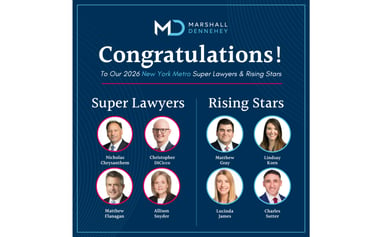
    • New York Metro Super Lawyers (2021-2026)
    • American Bar Association, Trial Evidence Committee; Employment Law Section; Tort Trial and Insurance Practice Section; and Section of Litigation
    • DRI, Employment and Labor Law Section, Professional Liability Section, and Commercial Litigation Section
    • New York State Bar Association, Law Practice Management Committee 2013-Present, Labor and Employment Law Section
    • New York Trial Notebook Editorial Advisory Board, 2005
    • Professional Responsibility, Columbia University School of Law, Guest Speaker,  June 2021
    • Employment Law Seminar, ACEC, Albany, New York, Presenter, January 2019
    • Legal Malpractice: How to Avoid it, What to do If You Can't, Lecturer 
    • Legal Malpractice and Ethics, Brooklyn Law School, Solo Practice Seminar, Lecturer
    • ESI For Dummies, What Every Legal Team Should Know, The Lawyers Guide to ESI Forensics 101, New York State Bar Association, Moderator 
    • Obtained summary judgment in a legal malpractice case alleging failure to properly cancel a real estate contract and alleging loss of a $175,000 security deposit and unspecified loss of opportunity income.
    • Successfully had a pre-answer motion to dismiss granted. The plaintiff, a practicing attorney, sued our client, an insurance broker, alleging that she was an additional insured under an insurance policy for her contractor, who ruined her kitchen. The motion was granted unopposed.
    • Successfully had a motion to dismiss a legal malpractice case pre-answered granted. The plaintiff used our client as an attorney because his associate neglected to oppose a threshold motion in the underlying auto case. The underlying court granted that motion in-part and denied it, in-part. The plaintiff retained a new attorney without firing our client. The new attorney commenced a malpractice action against our client and refused to substitute as attorney of record in the underlying action. We moved to dismiss the case on a number of issues pre-answer, but primarily because it was premature and the plaintiff could not prove that but for the failure to oppose the motion, he would have prevailed in overcoming the threshold.
    • Successfully had a pre-answer motion to dismiss granted as the court declined to apply supplemental jurisdiction over the state law claims. Plaintiffs commenced this action against our client for violation §1983 and other state law tort and discrimination claims. Our motion to dismiss the first complaint was granted and plaintiffs were given the opportunity to amend, which they did. We moved to dismiss the amended complaint pursuant to FRCP 12(b)(6), which was granted by the court.
    • Was granted a motion to dismiss a legal malpractice case where the plaintiff claimed that the settlement she entered into at trial was the result of our client not being prepared. Plaintiff allocuted on the record, yet she claimed, in opposition to our motion to dismiss that she had a condition that forced her to answer “yes” instead of “no” when she is under stress. Plaintiff submitted a note from a psychiatrist that backed up her claim. We successfully argued that the plaintiff was properly allocuted on the record before the court. The presiding judge asked the questions and determined that her condition was manufactured subsequent to her allocution.  We convinced the judge that if a client could make up a condition because she was unhappy with a settlement, there would be no more settlements.
    • Successfully obtained dismissal on a Rule 12(b)(6) pre-answer motion to dismiss of a 42 U.S.C. §1983 civil rights case against our clients. Plaintiff claimed that our clients acted under color of state law in having her arrested for harassment. Plaintiff alleged various causes of action for false arrest, abuse of process, malicious prosecution, conspiracy, and intentional and negligent infliction of emotional distress. The court rejected plaintiff’s claims even though our client was a retired police officer with significant contracts with the police department and DA’s office.
    • Obtained defense verdict after jury trial in U.S. Dist. Court, S.D.N.Y in the matter of Flushing Bank v. AGCS Marine Insurance Company, 16-CV-2638 (RJS) in breach of contract action arising out of a claim by a loss payee.
    • Obtained Multiple "No Probable Cause" determinations from New York State Division of Human Rights in favor of Employer-Clients
    • Obtained favorable resolutions of Federal ADA Class Action lawsuits
    • Obtained pre-answer dismissal of adversary proceeding against law firm-client arising out of underlying bankruptcy proceeding
    • Obtained a defense verdict after a five-day jury trial in a legal malpractice action arising out of an underlying divorce case
    • Obtained reversal of a denial of summary judgment from the New York Appellate Division, Second Department in a legal malpractice action
    • Obtained voluntary dismissal with prejudice of action against attorneys based on underlying commercial real estate matter
    • Obtained favorable result in complex software copyright infringement case
    • Obtained reversal of a decision re-instating a lead poisoning case after dismissal from the New York Appellate Division, Second Department
    • Obtained favorable settlement including millions of dollars' worth of real estate in connection with resolution of complex shareholder litigation

Thought Leadership

Legal Updates for Lawyers' Professional Liability

Legal Updates for Lawyers’ Professional Liability - CASE LAW UPDATE

February 1, 2025

An attorney cannot be liable for failing act outside the scope of the retainer agreement. Kohler v. Polsky, 219 AD3d 821, 822 (2d Dept 2023) The plaintiff had retained the defendant-attorney for representation in a workers’ compensation claim. The retainer agreement explicitly excluded the possibility that the defendant was representing him in other types of claims.  The plaintiff alleged the defendant committed malpractice by failing to advise him of potential personal injury claims against other third parties. The defendant subsequently moved for summary judgment, arguing that advising the plaintiff of potential personal injury actions was beyond the scope of the retainer agreement.  Looking to Rule 1.2(c) of the Rules of Professional Conduct, the court noted that a lawyer cannot be liable for failing act outside the scope of their retainer.    Legal Updates for Lawyers’ Professional Liability – February 2025 is prepared by Marshall Dennehey to provide information on recent legal developments of interest to our readers. This publication is not intended to provide legal advice for a specific situation or to create an attorney-client relationship. We would be pleased to provide such legal assistance as you require on these and other subjects when called upon. ATTORNEY ADVERTISING pursuant to New York RPC 7.1 Copyright © 2025 Marshall Dennehey, all rights reserved. No part of this publication may be reprinted without the express written permission of our firm. For reprints or inquiries, or if you wish to be removed from this mailing list, contact tamontemuro@mdwcg.com.

Legal Updates for Lawyers' Professional Liability

Legal Updates for Lawyers’ Professional Liability - CASE LAW UPDATE

February 1, 2025

Venue and Retainer Agreements  Price v. Kohn, Swift & Graf, P.C., 24-CV-04720 (JMW), 2024 WL 4528928 (E.D.N.Y. Oct. 18, 2024) In this case, argued by Nicholas P. Chrysanthem of tour New York City and Long Island offices, the plaintiff filed a myriad of claims that mainly sounded in legal malpractice.  After the plaintiff’s meditation business attracted the attention of the FBI for, inter alia, forced labor, the plaintiff retained the defendants for representation in the criminal proceedings. The retainer agreement contained a forum selection clause for Philadelphia. The plaintiff unsuccessfully attempted to argue the retainer agreement was procured by fraud. Accordingly, the court transferred the action to the Eastern District of Pennsylvania.    Legal Updates for Lawyers’ Professional Liability – February 2025 is prepared by Marshall Dennehey to provide information on recent legal developments of interest to our readers. This publication is not intended to provide legal advice for a specific situation or to create an attorney-client relationship. We would be pleased to provide such legal assistance as you require on these and other subjects when called upon. ATTORNEY ADVERTISING pursuant to New York RPC 7.1 Copyright © 2025 Marshall Dennehey, all rights reserved. No part of this publication may be reprinted without the express written permission of our firm. For reprints or inquiries, or if you wish to be removed from this mailing list, contact tamontemuro@mdwcg.com.
Firm Highlights

Thought Leadership

Ohio Supreme Court Holds That a Binding Appraisal Award May Not Be Set Aside Absent Specific Evidence of Manifest Mistake or Fraud

On July 23, 2026, the Ohio Supreme Court issued a rare opinion on the binding effect of an appraisal award in a property insurance policy.  The Court in One Church held: A binding appraisal award will not be set aside unless an error is so palpably wrong that it undermines the intent of the agreement, such as corruption or gross mistake, not a mere error of judgment—To plead a claim of mistake with particularity as required by Civ.R. 9(B), facts alleged in a complaint must constitute the elements of mistake—Allegation that additional, hidden damage was discovered after appraisal award failed to state a claim of mistake that could justify setting aside binding appraisal.  The case arose out of a claim brought by One Church against its insurer, Brotherhood Mutual Insurance Company for roof damage from a storm. Pursuant to the terms of the insurance policy, the parties agreed to submit the matter to appraisal. The two appraisers inspected the building, and both appraisers agreed that the damages were $313,271.98. The insurer paid the agreed appraised amount.  Thereafter, the insured submitted a claim for an additional $206,663.09 in damages. The insured argued that these additional damages were not discovered until after the repairs began, and that they should be permitted to submit an additional claim, even though there had already been a binding appraisal of damages. The insurer refused to pay the additional damages, and the insured sued for breach of contract and bad faith.  In the trial court, the insurer moved to dismiss for failure to state a claim, arguing that the binding appraisal award barred any further claims. The insured took the position that additional hidden damages could not be discovered until after the repairs began, and therefore there was a mutual mistake. The trial court dismissed the case on the insurer’s motion, because there was no “evidence of fraud, misfeasance, or mistake”. The Court of Appeals agreed that appraisal awards are generally binding, but noted that an appraisal award can be set aside for fraud or manifest mistake. The Court of Appeals reversed and remanded the case to the trial court, finding that the insured had pled mistake with sufficient particularity. The insurer appealed to the Ohio Supreme Court. On appeal, the Ohio Supreme Court reversed the Court of Appeals, and reinstated the trial court decision dismissing the case for failure to state a claim upon which relief can be granted. The Supreme Court found that since the insured had already demanded appraisal, and the appraisal award was binding, “something more than error of judgement, such as corruption in the arbitrator, or gross mistake” must be pled with particularity, and proven for the insured to override the appraisal award. Since the complaint did not allege fraud or manifest mistake with sufficient particularity, something more than a mere error of judgment, the complaint was insufficient to state a claim.  The complaint in this case did not challenge the appraisal award. It pled that additional damages were discovered that were not apparent when the appraisal was done. It did not specify “who discovered the damages, how they were discovered, where they were found, why they were previously hidden, or why they rise to the level of a manifest mistake that the “appraiser would have corrected...had it been called to his attention”. Id at ¶22 citing Lakewood Mfg. Co. v. Home Ins. Co. of New York, 422 F.2d 796, 798 (6th Cir. 1970). Cases deciding the effect of appraisal awards are unusual. The Ohio Supreme Court’s decision in One Church relies primarily on 19th century case law for its conclusion. This emphasizes the fact that there is minimal case law deciding the effect of binding appraisal clauses in property insurance policies, and makes this case all the more significant. A lengthy dissent was written by Justice Fisher, who would have affirmed the Court of Appeals decision reversing and remanding the case for a decision on the merits. Of course, the decision works both ways, and an insurer dissatisfied with a binding appraisal award will likewise be without further recourse absent evidence of corruption, fraud, misfeasance, or manifest mistake, which must be pled with particularity. To constitute manifest mistake, “the mistake must be of such character that the arbitrator or appraiser would have corrected it had it been called to his attention.”  Lakewood Mfg. Co. v. Home Ins. Co. of New York, 422 F.2d 796, 798 (6th Cir. 1970).  The majority opinion does not specifically identify what would have been sufficient to plead mistake with particularity, or if the insured could have amended the complaint to overcome the deficiencies. The dissent argues that this was not really a case alleging mistake, but rather a question of contract interpretation. The insured did not challenge the appraisal, but argued that the hidden damage was not part of the appraisal, and the appraisal only covered the known damages.  However, this argument did not carry the day with the majority. 

Result

No-Cause Jury Verdict Secured in Wrongful Death Trial

We successfully obtained a no-cause jury verdict in a 13-day wrongful death trial. The decedent, a 59-year-old man, was admitted to the emergency room on February 15, 2019, with complaints of abdominal pain, decreased appetite, and constipation, despite the use of laxatives. The patient did not complain of any nausea, vomiting, or diarrhea. He had a significant medical history including diabetes, hypertension, prior coronary artery stenting, morbid obesity (with past gastric bypass surgery), longstanding ventral hernia, and back pain. A CT scan revealed multiple hernias and a potential closed-loop bowel obstruction, leading to a surgery consultation. Our client, an emergency general surgeon, interpreted that the patient did not have a closed loop or any significant obstruction and recommended non-surgical management. The patient was approved to have clear liquids, and had a vomiting incident shortly after, but our client was not notified. The patient was returned to NPO status, and after improving overnight, he was returned to “clears” and additional medical and renal consults were ordered. Our client did not receive any communications from the residents/nurses of any changes in the patient’s condition. On February 18, 2019, two rapid responses were called due to increased heart rate and vomiting. It is believed that the vomiting resulted in aspiration, causing sepsis, ultimately leading to the patient’s death. During the trial, the plaintiff’s sole medical expert highlighted imaging on the wrong hernia, which called into question all of his opinions in the case. We made key objections related to the expert testimony, limiting what the allegations were, and preventing new allegations from being made. After approximately two and a half hours of deliberating, the jury returned a no-cause verdict. 

Thought Leadership

New Jersey Appellate Division Affirms Exclusion of Legal Malpractice Expert as Impermissible Net Opinion

Jack Slimm and Jeremy Zacharias obtained a favorable decision on behalf of their client in a case centering on the admissibility of expert testimony in legal malpractice actions. In Martin v. Loury, the New Jersey Appellate Division affirmed the exclusion of a plaintiff's legal malpractice expert, holding that the expert's opinions on causation and damages were too speculative to support the malpractice claim. The legal malpractice action arose from an underlying employment dispute involving claims for damages stemming from the breach of an employment agreement. The plaintiff alleged that defense counsel committed malpractice during a second trial by failing to recall the plaintiff as a rebuttal witness after the employer's CEO testified. According to the plaintiff's expert, additional rebuttal testimony would have bolstered the plaintiff's damages claims and led to a more favorable result. Both the trial court and the Appellate Division rejected that theory. The courts found that the expert could not explain how the proposed rebuttal testimony would have altered the outcome of the underlying case or resulted in any additional recoverable damages. Notably, the trial judge in the underlying employment matter had already rejected the CEO's testimony as not credible and had accepted the damages analysis advanced by the plaintiff. The court had also determined that the amount of damages was not genuinely disputed. As a result, the expert's opinion that additional rebuttal testimony would have produced a better outcome was unsupported by the record and based on speculation rather than evidence. The Appellate Division agreed that neither the plaintiff nor the expert could identify any actual damages attributable to the alleged malpractice or demonstrate the required element of proximate causation. The court further upheld the trial court's application of New Jersey's net opinion doctrine, finding that the expert failed to provide the necessary "why and wherefore" supporting his conclusion that the attorney's conduct caused a compensable loss. Because the opinions rested on unquantified possibilities rather than demonstrable facts, they were inadmissible. Key Takeaway for Legal Malpractice Defendants For attorneys and firms defending legal malpractice claims, Martin v. Loury underscores the importance of closely scrutinizing an opponent's expert report on the critical elements of proximate causation and damages. The decision demonstrates that a malpractice claim cannot survive where an expert merely speculates that different litigation tactics might have produced a better result. Instead, the plaintiff must present admissible expert testimony grounded in the record that explains how the alleged attorney error probably changed the outcome of the underlying matter and resulted in measurable damages.